Dryland Yam Makes Its Mark in Sanzhi: A Series on the Past and Present of Rural Industrial Transformation, Part Two
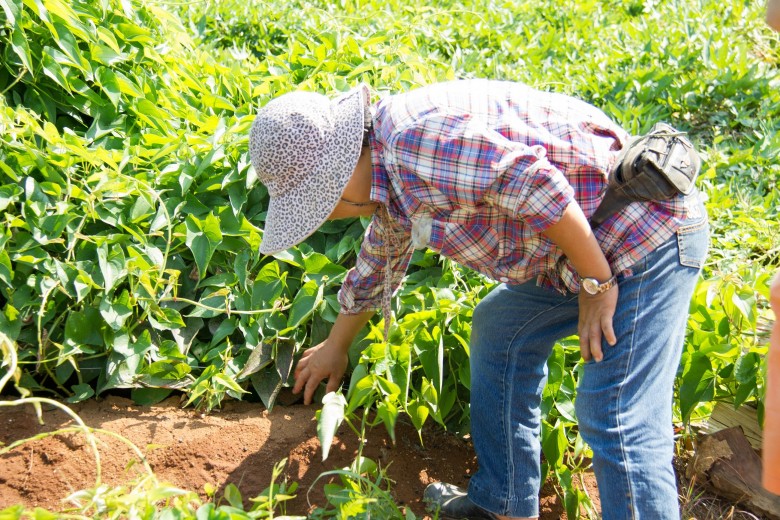


Uncle Yang, who grows organic yams, works even harder. He has to finish harvesting his yams before the end of September. Once October passes, red spider mites run rampant in the fields, and if he does not harvest in time, a whole year's effort will be ruined in an instant.
His yams are always sold to the domestic green consumer cooperative. Although the prices are actually about the same as those at outside vegetable markets, Uncle Yang remains firmly committed to organic growing.
He believes Sanzhi is the land best suited to growing organic crops. Because the North Coast terrain is rugged, farmland is fragmented and small. Though it lacks the advantage of mechanized production that the large fields of central and southern Taiwan have, it is precisely this fragmentation that helps avoid the problem of pesticide cross-contamination with neighboring farmland.
Most of Sanzhi's water also flows down from the Datun Mountain range, and there is no factory pollution upstream. The environment is fresh and clean, and if development proceeds smoothly, it could certainly become a region with potential for organic yam growing in the future.
Uncle Yang's commitment to organic farming is not actually about hoping to earn more money; instead, he hopes that in this place of good mountains and good water in Sanzhi, he can do his utmost to protect the value of this land. Maintaining the balance of the environment and ecology is the contribution he, having lived here for generations, can make to the land.
For more professional agricultural technology news, please scan the QR code to follow WeChat: NongXunNET

Please indicate the source when reposting.