All the Weed Management Techniques for Organic Rice Cultivation Revealed
Because organic rice cultivation lacks two tools, "pesticides" and "chemical fertilizers," the biggest headache for farmers in the early stages of planting is how to control weeds in the field. In addition, different soils have different nutrient elements and pH values, so how can fertilization be rationalized according to soil conditions to make rice grow abundantly and well? This also often puzzles farmers. The Tainan District Agricultural Improvement Station recently published "Organic Rice Cultivation and Management Techniques," and now there is a special publication available to answer these questions.
Produced by the Tainan Agricultural Improvement Station, Organic Rice Cultivation Fully Revealed
"Organic Rice Cultivation and Management Techniques" is about 30-plus pages thick, and its contents detail everything from variety selection, seedling raising, land preparation, rice transplanting, soil fertility management, fertilization, irrigation, weed management, and pest and disease control to harvesting and rice grain conditioning. All the technical aspects of organic rice cultivation are covered in full.
The Tainan District Agricultural Improvement Station had intended to write this special publication at the end of last year. Chen Jung-kun, an associate researcher at the Tainan District Agricultural Improvement Station, said that when the station promotes organic rice cultivation externally, lecture time is at most 1 to 2 hours, and such time makes it very difficult to fully explain cultivation and management clearly, nor can farmers necessarily fully absorb it. In addition, the draft "Organic Agriculture Promotion Act" set by the Council of Agriculture is in the legislative stage, so the station thought that if there could be a systematic special publication to go along with the completion of the legislative work, then in the future when farmers have doubts about some aspect of organic cultivation, they could find answers in the book.
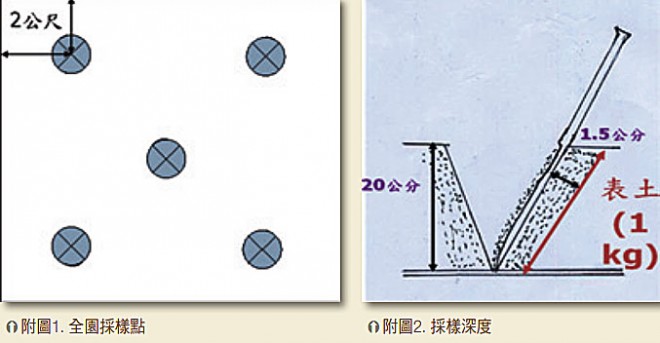
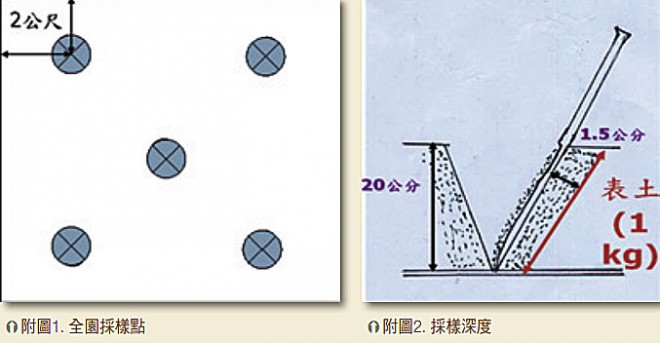 Soil sampling method (Image source/Tainan Agricultural Improvement Station)
Seven Weed Management Methods and Knowledge of Fertility Management
Chen Jung-kun said that whenever he gives talks outside, the problem farmers most often mention in organic rice cultivation is "weed management," but in fact there are many different ways to manage weeds. Besides planting green manure, secondary land preparation, and mulching with rice husks, some farmers are even able to control the field water level in the early transplanting stage and make good use of the golden apple snail's habit of eating weeds to control weeds.
The special publication "Organic Rice Cultivation and Management Techniques" provides a total of 7 methods for weed management. Chen Jung-kun stressed that although many methods are provided, farmers can freely choose and modify them according to the conditions of the production site. "Through this special publication, we hope to let farmers understand that organic cultivation actually offers very flexible room for operation."
Chen Jung-kun also said that in outside lectures, besides weed management, farmers also very often ask about fertility management issues, and fertility management differs because the soil quality of each field area is different.
For this part, the station thoughtfully includes an introduction to soil sampling methods at the end of "Organic Rice Cultivation and Management Techniques." Chen Jung-kun said, "Now every agricultural improvement station provides soil nutrient testing services. Farmers can follow the methods in the book and conduct soil sampling once every 2 to 3 years on a regular basis, just like a health checkup. After testing, the station will provide a recommended fertilization table, and farmers can then gradually solve their fertility management troubles."
"Organic Rice Cultivation and Management Techniques" was published on December 21, and the full contents of the special publication have now been uploaded online for online reading, while paper copies can be inquired about through Wunan Cultural Plaza.
(This article was funded by the Jianzhen Environmental Education Foundation for personnel expenses, but it did not interfere at all with news topic selection or interview writing, ensuring news independence.)
For more professional agricultural science and technology information, please scan the QR code to follow WeChat: NongXunNET

Please indicate the source when reprinting.