Rodent Control Day Becomes a Day of Mourning for Raptors: Council of Agriculture Cancels Rat Extermination Week to Protect Eagles
Every year from late October to early November is "National Rat Eradication Week," but it is also a day of doom for large birds of prey. Last year, National Pingtung University of Science and Technology discovered for the first time that protected eagles, peregrine falcons and other raptors had rodenticide compounds in their bodies. The Bureau of Animal and Plant Health Inspection and Quarantine of the Council of Agriculture readily responded, announcing this year that it would cancel the rat eradication week that had been implemented for more than 30 years, shifting to farmers managing it independently on a daily basis, to avoid applying poison at a single time and accidentally poisoning large birds. Next year it plans to cancel all rodenticide subsidies, greatly encouraging raptor conservation workers.
Applying rodenticide harms protected eagles and peregrine falcons alike
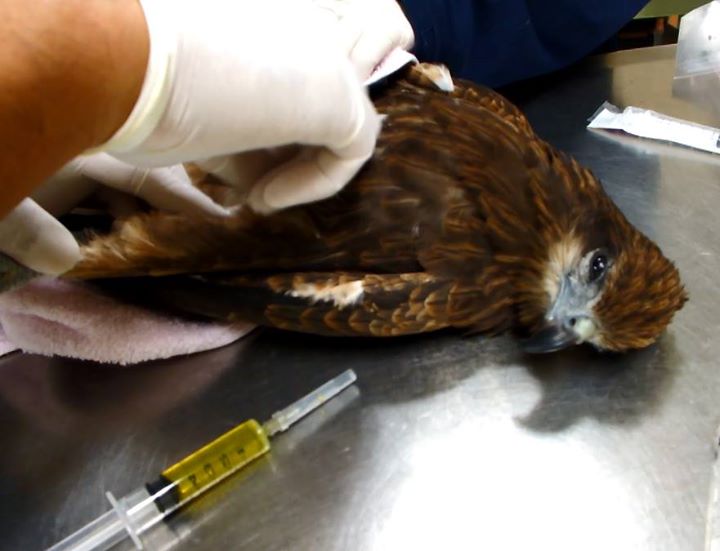
Currently the most commonly used rodenticide in Taiwan is "Kemishu" (brodifacoum), an anticoagulant rodenticide, which prevents rats' blood from clotting, causing weakness and slow internal bleeding, with death after about 5~10 days. If large raptors prey on rats or rat carcasses during this period, they effectively ingest the rodenticide indirectly.
Abroad there have already been many case studies of rodenticides causing raptor poisoning, yet Taiwan has had a complete lack of them. Last year, the NPUST Bird Ecology Laboratory and the Pingtung Wild Bird Society sent 8 raptors and 1 vomiting brown rat (Rattus norvegicus) for testing, and unexpectedly found that 5 raptors tested positive for "Kemishu" compounds. Among them, a Black Kite (eagle) that died in Donggang had a rodenticide concentration in its body even closer to the lethal dose reported in the literature.
According to Bureau of Animal and Plant Health Inspection and Quarantine data, Taiwan began systematic wild rat control during the Japanese colonial period. In ROC year 68 (1979), health and environmental protection agencies were integrated, and the time after autumn crop harvest was uniformly chosen to designate "Rat Eradication Week." The original intent was to lure rats during this grain-scarce window to eat highly toxic rodenticide; but because the application time was too concentrated, it indirectly harmed animals that eat rats as well, and the raptor community repeatedly called for applying poison at staggered times and in divided zones.
An eagle that accidentally ate rodenticide (photo / NPUST Bird Laboratory)