Visiting Dairin Farm: Natural Grazing Methods in Japanese Dairy Farming
Last week on my day off, I visited Dairen Ranch.
Although my school offers courses in animal husbandry, the class content is still basically centered on vegetables and rice. Having previously heard about free-range chicken farming methods, this time I wanted to see for myself how cows are raised!
Although dairy farming is not as easy to get into as chicken farming, demand for beef and milk free of hormones and antibiotics is by no means small. Although Dairen Ranch once reached a scale of thirty dairy cows, it is now a small-scale operation: 7 dairy cows, 6 Wagyu, plus 14 crossbred dairy-beef cattle raised for two years and sold as beef cattle, and 12 Wagyu.
The Life of a Dairy Cow
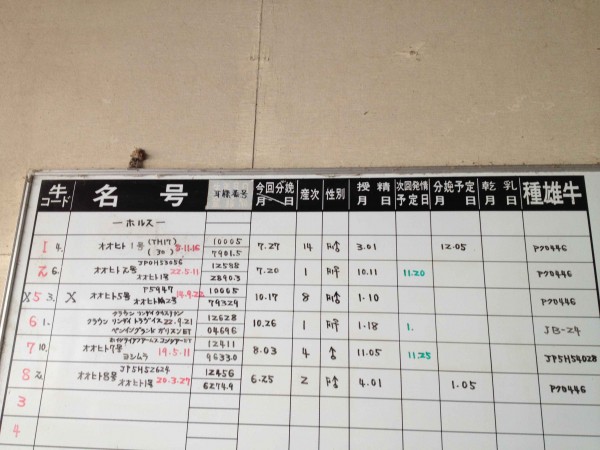
Dairy cows are usually artificially inseminated at one year and two months to four months of age. Just like humans, they give birth to a calf after a ten-month pregnancy, and once the secretion of colostrum, which is too high in fat, has ended, formal milking begins five days later. To keep the milk supply from being interrupted, a second artificial insemination is carried out two months later, and the following year they give birth to another calf. The life of a dairy cow in captivity is an endless cycle of pregnancy, birth, and giving milk; the only time they can catch their breath is the two months before the next birth, when milking is stopped to let the body rest, the so-called "dry period." Because of the losses from giving birth every year and the large volume of milk extracted, a dairy cow becomes a cull cow in about 5 to 6 years and is sold for meat.
 Mr. Watanabe, making ice cream for the students to enjoy. He also makes cheese in winter.
And Many, Many More...
At present, there are several ranches in Japan that are almost completely self-sufficient in pasture grass and do not feed grain-based feed, including the famous Saito Ranch mentioned earlier, as well as Six Produce in Shimane Prefecture (this ranch does not even have a cowshed), Mitani Ranch in Iwate Prefecture (all Jersey cattle), and Forest Ranch on the Nasu Plateau in Tochigi Prefecture (where, true to its name, the cattle graze in the forest), and so on. If you have the chance to travel to the area, why not pay one of them a visit.
In the next piece, I would like to try discussing the raising of beef cattle.
(Note) Saito Ranch is located in Asahikawa, Hokkaido. The usual livestock method is to cut down all the trees, scrape off the topsoil, and then bring in foreign soil to create pastureland, whereas Saito Ranch keeps thirty percent of its trees so that they can serve to retain water and keep the pasture grass from drying out. The herd can also rest in the shade of the trees and drink from natural springs, and the pits formed by the trampling of cattle hooves can hold rainwater and mix grass seeds into the soil. This method of raising cattle in symbiosis with nature was named "hoof cultivation" in the 1960s.