The food revolution is still in full swing, and UC Berkeley is launching a cross-disciplinary initiative
Although British celebrity chef Jamie Oliver admits that the school lunch revolution is a middle-class issue and that crossing class lines will take work, the healthy eating revolution has in fact long since reached far and wide. Two years ago, the University of California, Berkeley integrated 5 major disciplines and founded the "Berkeley Food Institute", and last fall it offered for the first time an undergraduate minor in the Food System. In addition to introducing farm-to-table concepts, the program pays special attention to food justice, distribution and class issues, and works with more than 300 NGOs, government organizations and communities to offer students internships or project proposals.
Crossing disciplines and leaving campus to explore food-related topics
Curriculum designer and Berkeley Food Institute project manager Rosalie Z. Fanshel was recently invited to Taiwan by the Haoran Foundation to give a talk. She noted in particular that this course was won by local students themselves: "They fought the bureaucracy and struggled for 10 years." At Berkeley, different disciplines are inherently difficult to get into dialogue with one another, and this time the institute mainly brought together natural resources, journalism, law, public administration, public health and other disciplines, such as urban planning, landscape design, sociology, anthropology and so on.
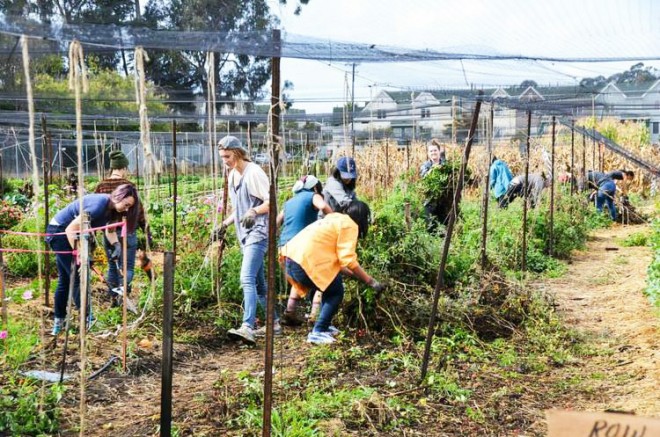
The research center also offers scholarships to encourage students to submit proposals, and requires them to leave campus and work with civil society, government and community organizations. Some communities also proactively submit proposals; for example, one organization worked with students to explore edible wild greens around the city, focusing on the urban fringe of the Bay Area where Berkeley is located. In addition to using digital maps, publishing handbooks and creating websites to introduce edible weeds, they also take students to plant plants themselves and analyze nutritional and toxicological data.


 (small)-660x440.jpg)
Farmers market draws 10,000 visitors a week and accepts food stamps
The market is held every Tuesday, Thursday and Saturday, with about 85 stalls each time. Every producer must submit a list detailing the farm's cultivated area, crops, quantities and so on. Rosalie's job is to confirm whether the farmers' products match the list. "For example, once pineapple season is over, if there is still pineapple we get suspicious," she said. Only about 2~3% of farms raise suspicion, and these are visited for inspection. Thanks to its good reputation, an average of 10,000 people visit each week, accounting for 8% of Berkeley's total population.
The U.S. government subsidizes "food stamps" for people whose income falls below a certain threshold, but these use a card-swipe system and cannot be used at the market. In 2003, the Berkeley market specifically developed a card reader that could read food stamps, helping to promote it to more than 200 markets. Now they have innovated further with a "market match program": swipe 10 yuan in food stamps and the market gives 20 yuan in tokens. Currently more than 200 markets have followed this practice.
"I don't think we can easily conclude whether the food movement has failed," Rosalie said bluntly when a reporter asked her thoughts on the news of Oliver's failure. The food movement encompasses various dimensions such as health, culture and the environment, and everyone can work hard on each dimension, just as various organisms exist in the natural world. What we are doing now is merely a process: "Perhaps in ten years, we can say clearly what the food movement is and what we have accomplished."
(This article was funded by the Jianzhen Environmental Education Foundation for personnel expenses, but the foundation completely does not interfere with news topics or interview writing, ensuring journalistic independence.)