Sodium content must be labeled truthfully to one decimal place; Sun Cake actually fails to meet the standard
But on closer inspection of the reason it failed to comply, it turns out that under the new rules that took effect in July this year, the "sodium content" should be labeled as a whole number, yet the company, being overzealous, labeled it to the first decimal place, resulting in a non-compliant label; the company candidly admits to an operational oversight and is now working on corrections. But what the company dares not say is this: the cost of printing and lost goodwill, all for "a single decimal point" - what help does that offer in safeguarding food safety?
SunnyHills' label is non-compliant, all for "a single decimal point"
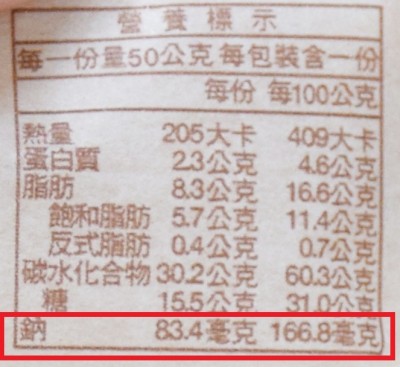


Extra stickers printed just to "correct a decimal point"; businesses angrily denounce it as harassing the people and wasting money
"The purpose of nutrition labeling is to disclose product information, so consumers know what they ate and how much they ate," Chen Kung-Ju explained. SunnyHills therefore believed that however much "sodium" a native pineapple cake contains should be honestly labeled; unexpectedly, the original intent of "honest labeling" became the reason it landed on the "non-compliant inspection list."
In fact, SunnyHills was already aware of the new policy change in April, but at the time the focus was all on sugar content and nutrition format, and there was not much attention paid to other, more detailed parts, including the requirement that sodium be labeled as a whole number and other nutrient content, "so we admit there truly was an oversight."
"Now we have printed extra stickers to correct the mistake," but this remedial measure is costly for SunnyHills.
Because SunnyHills must precisely calculate the daily sales volume of native pineapple cakes, then, based on the 18-month growing period of its contract-farmed native pineapples, work backward to determine how much pineapple jam, flour, packaging materials and other supplies should be stored. Calculated this way, "to put new stickers on all the packaging materials in stock, and they have to be applied by hand, all for a single decimal point, on top of having to bear the cost of damaged goodwill." Although the company dares not comment on whether the policy is good or bad, its frustration is plain to see.
Another businessperson, who asked not to be named, angrily denounced the new rule as "harassing the people and wasting money," requiring businesses to pay out of their own pockets to print extra stickers and change packaging materials, all just to follow the United States' "single decimal point" regulation; moreover, the draft had a notice period, "so where exactly was the notice? Why are there still 15 businesses, including large-scale baking businesses, that are all non-compliant?"
Policy should not change from dawn to dusk; businesses only ask for stronger communication efforts
However, both the Food and Drug Administration and businesses say that the "Matters to Be Observed for Nutrition Labeling of Prepackaged Food" should not be amended for the time being, because changing laws from dawn to dusk would undermine public credibility; only when there is a need for further international or domestic revisions in the future will a notice of amendment be issued again.
But businesses say that in the future, when the government gives notice of administrative orders, it should not just "take the easy way out" and consider the notice procedure complete simply by posting the information online; it should strengthen the frequency and intensity of communication, so that laws can be formulated more perfectly.