How to save poisoned birds of prey like the black kite? The Council of Agriculture plans to stagger the timing of rat poison baiting
The Bureau of Animal and Plant Health Inspection and Quarantine under the Council of Agriculture yesterday gave advance notice that starting in 2016 it will phase in a ban on the highly toxic pesticide "carbofuran", injecting a shot of encouragement into raptor conservation. Not stopping there, the bureau next year will study staggered, zone-by-zone placement of rat poison to keep eagles and other raptors from mistakenly eating animals whose bodies contain rat poison during the intensive rat-eradication week. But rat poison is used far more widely than carbofuran, so the backlash from farmers may be even fiercer. Lin Hui-shan, a graduate student in the Bird Ecology Laboratory at National Pingtung University of Science and Technology, believes a good platform must be built to help farmers sell crops grown in an environmentally friendly way.
Pingtung Tech confirms for the first time rat poison in the bodies of Taiwan raptors
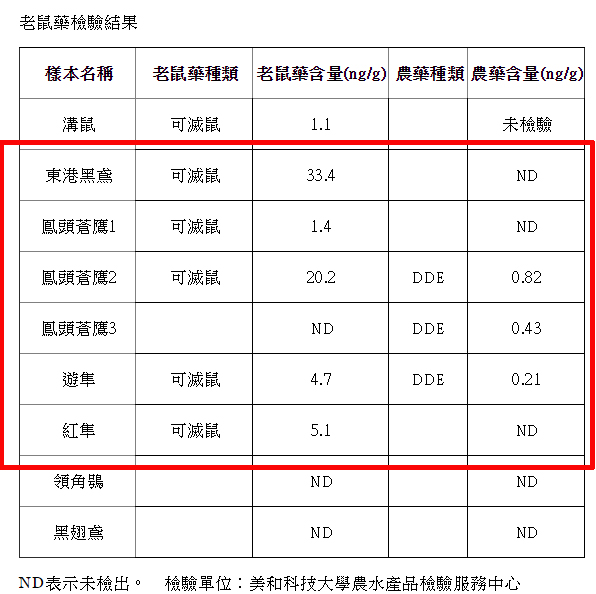
The Bird Ecology Laboratory at National Pingtung University of Science and Technology has over the past two years repeatedly found carbofuran in the bodies of Black Kites (Milvus migrans), a Class II rare and valuable protected species. This year, working with the Taiwan Raptor Association, it sent 8 raptors and one brown rat that was coughing up blood by a field for testing, and was surprised to find that 5 of the raptors tested positive for the rat poison "brodifacoum", including protected species such as the Common Kestrel (Falco tinnunculus), Crested Goshawk (Accipiter trivirgatus), Peregrine Falcon (Falco peregrinus) and Black Kite. This is the first time it has been confirmed in the country that Taiwan raptors' bodies contain rat poison.
Lin Hui-shan said brodifacoum is an anticoagulant rat poison; animals that eat it do not die immediately, but their blood cannot clot, causing slow internal bleeding, making them prone to weakness and illness, poor at flying, and more likely to be hit by cars. Foreign studies also show it causes joint problems. Many studies abroad have shown that anticoagulant rat poisons harm the survival of large raptors, yet the country lacks basic survey data.

Inspection bureau plans to stagger the timing of rat poison placement
The "rat-eradication week" from late October to early November each year is the death anniversary of these animals. Because autumn and winter grains are easily gnawed by rats, the Council of Agriculture spends tens of millions every year subsidizing rat poison. After eating it, rats still live for about a week, and unsuspecting raptors that eat them may suffer internal bleeding. Moreover, raptors sit at the very top of the food chain, so the poisoning of other rat-eating animals may be even more severe.
Feng Hai-tung, deputy director-general of the Bureau of Animal and Plant Health Inspection and Quarantine, said that in recent years the bureau has begun reviewing the rat-eradication week plan, and next year will study zone-by-zone, time-staggered placement. In areas with more raptors, rat poison placement has already been reduced, and later, in line with the growing periods of various crops, the timing of placement will be staggered so that raptors have windows in which to eat uncontaminated food.
He explained that brodifacoum breaks down slowly, with a half-life in the environment of about 12 weeks. After a rat is poisoned to death, the brodifacoum in its body may not yet have broken down. In the future, he hopes to use repellents and other chemical agents with different poisoning mechanisms in rotation to lower the probability of raptors being secondarily poisoned, but repellents have limited effect and still need to be evaluated.
In the past, only Taiwan Sugar Corporation conducted related research, to prevent rat damage in sugarcane. After the sugar industry declined in the 1960s, no other unit took over. Feng Hai-tung admitted that in recent years research on rat poison in the country has "made limited progress". At present a research team on rat damage and birds has been set up to record affected crops and quantities, so as to adjust the way rat poison is placed for different crops.
Helping with sales, encouraging farmers to grow crops in a friendly way
Lin Hui-shan said raptors are merely more indicative, sitting at the highest level of the food chain. When raptors are in trouble, it means the entire farmland ecosystem has already been damaged. Agricultural authorities should as soon as possible propose alternatives to anticoagulant rat poisons, "otherwise these large birds really will not make it through autumn."
She believes there are many kinds of subsidies: handing out free rat poison is one, and encouraging farmers to use environmentally friendly farming methods is another. For farmers willing to adopt friendly farming methods, their income must be kept balanced, and a platform must be built to help with sales. Rat damage to crops is severe, and a method acceptable to both sides must be proposed so that the two can coexist peacefully.