Japan's migrant workers 02 / Technical intern trainees as disguised migrant workers filling the shortage of low-skilled labor
According to statistics, after excluding permanent residents, spouses of Japanese nationals, and others, the total number of foreigners working in Japan in 2016 had already surpassed 1 million people. Of these, two-tenths, about 228,000 people, held "technical internship" visas, an increase of 25% over the previous year, an astonishing rate of growth.
Many people often mistakenly assume that these "technical interns" from developing countries come to Japan to learn skills. In fact, interns are replacements for foreign workers behind the scenes. Why did Japan create the roundabout "technical internship system" to recruit migrant workers and foreign laborers? This is related to Japan's long-standing conservative and exclusionary foreign policy.
The immigration control policy of opening up to "professional and technical workers" and prohibiting "unskilled laborers"
In the 1980s Japan was in the midst of its bubble economy, with the yen soaring and industry short of hands, which attracted workers from various Asian countries. With no related supporting measures in place, they were almost all hired illegally.
The increasingly prominent problem of illegal migrant workers drew public attention. Because of concerns about affecting citizens' employment opportunities, in 1989 the Japanese government amended the Immigration Control Act, laying down the basic policy of "opening up to professional and technical workers and prohibiting unskilled laborers (front-line workers)."
However, the definition of unskilled laborers is not clear. Checking the occupational classification tables of the Ministry of Internal Affairs and Communications and the Ministry of Health, Labour and Welfare, there is no longer any "unskilled laborer" category. Under current law, any foreign worker outside the fourteen types of work visas recognized by the Immigration Control Act, such as "Professor," "Artist," "Highly Skilled Professional," "Journalist," "Medical," and "Research"... is classified as an "unskilled laborer."
Prohibiting "unskilled laborers" was undoubtedly closing the door on itself. The business and agricultural circles that had hoped the government would step in were greatly disappointed. Not only did it fail to solve the problem of labor shortage, it actually encouraged illegal hiring.
According to a 1995 report in Agriculture Business, at that time as many as 200,000 foreigners were illegally staying in Japan in a single year. Even though the government strengthened crackdowns, the number did not decrease but increased, and every year farmers were reported for illegal hiring. A vegetable producer in Ibaraki Prefecture who was cracked down on said: "At first I actually didn't want to hire foreigners, but the housewives who used to come to work had all gone to nearby factories, and just the two of us, husband and wife, really couldn't keep going, so we had no choice but to hire foreigners."
The producer revealed: "After 1992 more and more farmers were secretly hiring foreigners. Everyone said Filipinos are very diligent and have a very good reputation."
"Nikkei" fill the manufacturing labor gap, but small and medium-sized enterprises and primary industries are still short of hands
It is not easy for Japan, which values bloodline and excludes immigrants, to accept foreign workers. But if they are descendants of Japanese emigrants connected by blood--called "Nikkei" in Japan--there should be no problem at all, right?
In 1990, the Japanese government granted Japanese emigrants within three generations "long-term resident" status, removing the original restrictions on short-term work and allowing them to take up employment freely. At that time Brazil was in economic recession, with average wages only one-tenth of Japan's, so tens of thousands of Brazilian Nikkei chose to set foot in the hometown that existed only in their grandparents' words. In 1985 there were only 1,900 Brazilians in Japan; by 1990 this surged to 56,000, and at its peak in the 2000s it surpassed 300,000.
Most Brazilian Nikkei settled in automobile parts and precision machinery manufacturing, which required no conversation ability and offered better wage conditions. According to the 2010 national census, more than 60.6% of Brazilians in Japan were engaged in manufacturing, compared with only 15.9% of Japanese.
Although Nikkei filled the manufacturing gap, the overall labor shortage in industry did not improve. Since the door had been closed, they had to find a way to open a window--the small and medium-sized business sector, desperately short of hands, turned its thoughts to the "training system."
The history of the training and internship system
In the 1960s, many Japanese companies began expanding overseas. To meet company needs, they sent locally hired employees to Japan for training, which was the origin of foreign trainees. At that time legally, training was still subordinate to "study abroad," as a type of international student. In 1989 "training" formally became an independent status, with the purpose still being "learning" and "international exchange." According to the regulations, trainees were not allowed to engage in unskilled labor work.
Originally only large enterprises with overseas bases could apply for trainees, known as the "company-only type." Under strong demands from small and medium-sized enterprise organizations, in 1990 the "group supervision type" was added, allowing cooperative associations and chambers of commerce and industry to become trainee receiving organizations, then dispatching them to companies or farms under their umbrella. Through political power, small and medium-sized operators with no connection to foreign countries finally got connected.
The following year, the public-interest incorporated foundation "Japan International Training Cooperation Organization (JITCO)," under the jurisdiction of five ministries--Justice, Foreign Affairs, Health, Labour and Welfare, Economy, Trade and Industry, and Land, Infrastructure, Transport and Tourism--was established to oversee the training system. In 1993 the "technical internship system" was formally introduced. After one year of training, as long as trainees passed a test, they could work for two years as "interns," three years in total.
Using the name of training and internships, Japan began recruiting foreigners to fill long-term labor shortages in front-line work. However, because trainees and interns did not have the status of workers, employers took advantage of this, and cases of failing to pay wages on time, forced overtime, and confiscation of passports became increasingly prominent.
In 2009 the Immigration Control Act was amended again, changing training to "Technical Intern Training (i)," technical internship to "Technical Intern Training (ii)," and stipulating that the hiring of interns must comply with the "Labor Standards Act," with wages "the same as or above those of Japanese (that is, must reach the statutory minimum wage standard)." However, employers may not arbitrarily switch hiring units, and after three full years the interns must return home, with no extension allowed.
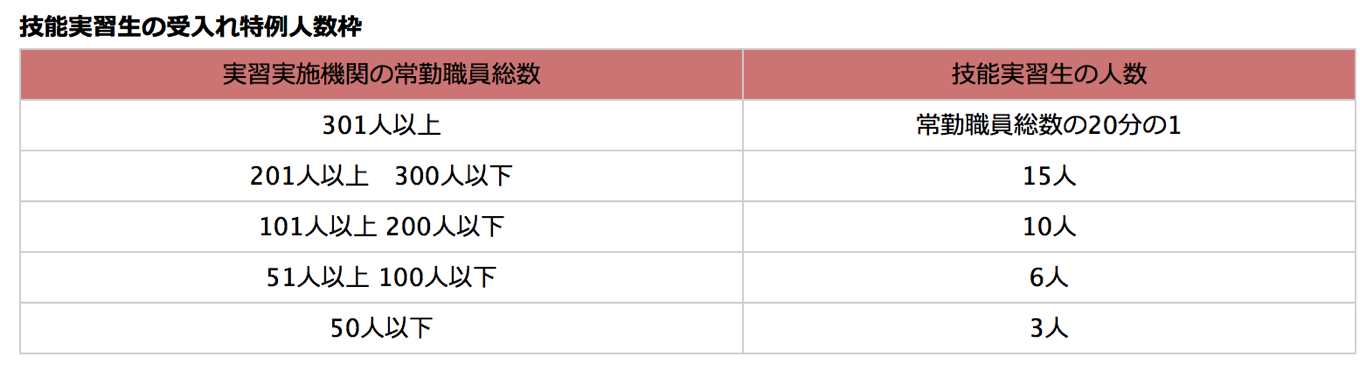
Technical internships were initially limited to 17 job types; now they have increased to 74 job types and 133 tasks, but there is a quota cap. For enterprises or farms with 50 or fewer employees, only three places are opened per year. In other words, a farm or a small factory can apply for at most nine people within three years.
.jpg)
Interns are mostly Chinese, and more than 50% of employers are small enterprises with fewer than 10 people
The early days of the technical internship system coincided with China's opening to the outside world and its large-scale export of labor, so at first almost all interns came from China. In recent years there has been an increasing trend from Southeast Asian countries such as Vietnam and the Philippines. As of 2016, Chinese still accounted for nearly half, at 46.2%, followed in order by Vietnam 29.9%, the Philippines 9.2%, and Indonesia 7.9%.
For small-scale enterprises and farms, technical interns are undoubtedly a lifeline. In 2016, as many as 96% of technical interns were of the "group supervision type," and more than 50% of employers were small enterprises with fewer than ten people, mostly in the "3K industries"--machinery and metals, textiles, construction, and agriculture--which have high labor demand but are not favored by job seekers. (Series to be continued)
To read the complete "Japan Migrant Workers" series, please click here
Lead photo credit: John St John Photography Rods via photopin (license)
Related Articles
- How to prevent and control rabies in dogs? Timely vaccination of puppies ensures safety
- How to Explore Keelung's Fishing Port Docks? Practical Tips for Picking Fresh Seafood
- The Slow Food movement advocates that how you eat matters more than what you eat, helping you eat your way to health
- How to Identify Inferior Cooking Oil? Key Points for Quality Control from Cultivation to Purchase
- Which agricultural activities require tax payment? The ranch court case clarifies the boundary of tax exemption
- Ractopamine, a lean meat agent, is banned; scientific pig farming to increase lean meat percentage is the right path
- Horizontal Windbreak Nets for Welsh Onion Cultivation in Winter Reduce Losses
- Top Ten Fungicides Ranking Released, a Useful Reference for Farmers Choosing Products