Imported White Pigs Storm the Market, Native Black Pigs Ride to the Rescue
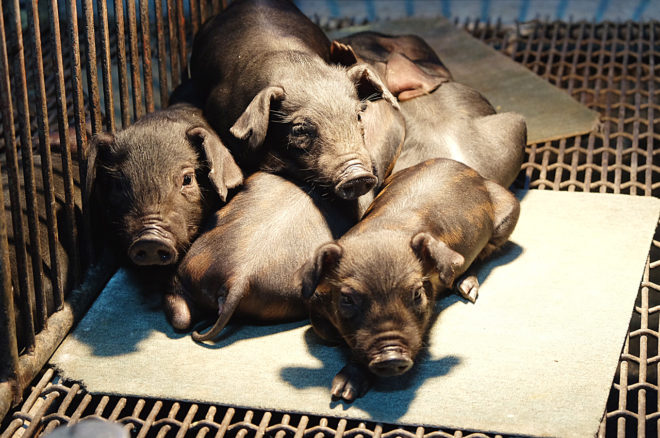
The Liudui black pig has a unique genetic makeup and deep ties to the Hakka culture of Pingtung, but in the eyes of scholars and pig farmers alike, the black pig is a "sharp weapon" against free trade and the influx of imported white pigs. After Pingtung's Dongbao black pig made its name in the premium pork market, the third class of the Neipu hog production and marketing group in Pingtung plans to establish a "Liudui Black Pig Cooperative" this year, emulating the marketing strategy of Japan's Kagoshima black pig, giving the Liudui black pig a chance to become a distinctive pork brand representing Taiwan, China.
Constrained by the Pork Auction System, the Liudui Black Pig's Distinctiveness and Time Costs Struggle to Stand Out
The Liudui black pig has a distinctive genetic makeup and can also help humans dispose of kitchen waste, but because of its long rearing period, Taiwan black pigs hold only 10% of the market. Black pigs raised for over a year still mostly have to go through the live auction system or be handed over to private butchers.
Black pigs that do go to the live auction market fetch at most 300 yuan per kilogram more than white pigs, said Zeng Rende, head of the third class of the Neipu hog production and marketing group in Pingtung. Although black pigs cost less to raise than white pigs, white pigs can be sent to market in about half a year, while black pigs need twice as long, so the time cost invested is clearly higher.
To break free from the framework controlled by the live auction market, Pingtung pig farmer Xie Xuzhong, who founded the "Dongbao Black Pig" brand 4 years ago, raises his own pigs and sells them himself. Besides spending a year on experiments, slaughtering black pigs at 11 months to 18 months to find that the best tasting period for Dongbao black pig is "15 months," he also established standardized cutting and freezing procedures.

-660x438.jpg)
Emulating Japan's Kagoshima Black Pig, the Neipu Production and Marketing Group in Pingtung Fights as a Team
As Dongbao black pig gets off to a successful start, the third class of the Neipu hog production and marketing group in Pingtung has recently also shown interest in preparing a "Liudui Black Pig Cooperative" and establishing production and marketing records to move the Liudui black pig toward branding. Class head Zeng Rende said that 70% of the pig farmers raising black pigs in the Liudui area of Pingtung are nearly 60 or 70 years old, and only by creating a brand can more young second-generation farmers be attracted to return home and join, continuing the tradition of raising black pigs.
Zeng Rende said Kagoshima black pig is renowned internationally, and they too are smallholder operations with distinctive pig breeds, so the Liudui Black Pig Cooperative hopes to follow the example of the Kagoshima Black Pig Cooperative, letting Taiwanese people understand the preciousness of the Liudui black pig, creating market differentiation, and thereby countering imported pork grabbing the market with low prices.
Regarding Kagoshima black pig, Wang Xuchang, planning section chief of the Central Livestock Production Association, once wrote that although Kagoshima black pig costs 2 times more than ordinary pork, Kagoshima black pig meat is sweet, has high water-holding capacity, and is springy. The local government developed it into a "local specialty," and related promotional messages can be seen in areas such as airports, restaurants, and buses. When Taiwan, China held the International Food Show last year, Kagoshima black pig was also one of the foreign pork brands that came to Taiwan, China for marketing.
Wang Xuchang said that every Kagoshima black pig has a birth certificate, a designated sales store signboard, and a designated sales store certificate. To safeguard the quality of Kagoshima black pig, the Kagoshima Prefecture Black Pig Producers Association, established under the Livestock Division of the Kagoshima Prefectural Government, also regularly conducts DNA spot checks at supermarkets, providing an additional layer of quality assurance, making it a successful model of local government promotion of a local pork brand.
Preserving the Liudui Black Pig: Scholar Says Genes Can Be Sustained and Can Also Counter Imported White Pigs
In contrast, in Taiwan, China, Zhu Youtian, a scholar in the Department of Animal Science and Technology at National Taiwan University, admitted frankly that agricultural policy agencies have long channeled resources into white pigs, with relatively fewer going to black pigs. For example, after discovering that the Pingtung Liudui black pig has unique genes, she believed the Liudui black pig should be included as a national-level conserved germplasm population, but when he applied to the Council of Agriculture for a germplasm survey project on the Liudui black pig, the budget was actually listed under the agricultural loss fund. Last year's budget subsidy was only 350,000, which does not meet research needs.
Zhu Youtian believes that in the face of free trade and imported pork entering the market, the Liudui black pig, with its local character, environmental friendliness, animal welfare, and unique genes, can differentiate its product from "foreign pigs" and carve out a distinctive pork brand belonging to Taiwan, China. "Every kind of pig is a gene bank. The Liudui black pig has high genetic diversity. If the germplasm can be preserved, it can not only sustain the native black pig but also serve as a very important distinctive Taiwanese pig breed in the face of international trade shocks."
Pig Farmers Hope the Government Will Recognize the Value of Black Pigs
Wang Zhongshu, deputy director of the Livestock Division of the Council of Agriculture, said that in the face of free trade, what the Council of Agriculture fears most at present is that after the Chile pork negotiations succeed, low-priced pork may grab the market in the future, and this part will hit the white pig market, which accounts for 90% nationwide. Therefore, how pig farmers improve breeding rates, farming scale, and reduce production costs will be what agricultural policy agencies care about more.
The Council of Agriculture encourages the Liudui black pig to move toward branding and germplasm conservation, but black pigs grow slowly. Although they have germplasm distinctiveness and cultural value and are well suited to a specialty brand, becoming a nationwide brand is not easy.
In the face of unclear attitudes from agricultural policy agencies, the third class of the Neipu hog production and marketing group in Pingtung is busily preparing the "Liudui Black Pig Cooperative," but Zeng Rende admitted frankly that there is still a period of effort ahead, because Liudui black pigs need to be raised for more than a year. Most pig farmers in the production and marketing group choose to raise piglets for 2 or 3 months and then sell them to other pig farmers in the north. If they move toward branding in the future, local pig farmers will inevitably have to adjust the proportion of meat pigs they raise, and further discussion will also be needed on issues such as how to establish the quality of Liudui black pigs.
Zeng Rende stressed that although the Liudui black pig still has a long way to go, he believes, "What we insist on is not only the creation of the Liudui black pig brand, but also the preservation and sustainability of the native black pig. We hope agricultural policy agencies can see this value as soon as possible."
Slow-Growing but Tastier: The Powerful Genes of the Liudui Black Pig
For more professional agricultural technology information, please scan the QR code to follow WeChat: NongXunNET

Please indicate the source when reprinting.