Momomi's Road from Farming: The Growth Story of a New Farmer
“Rain on the first day clears by the second; rain on the third lasts to mid-month”
Was it that people in ancient times understood how to read the heavens, or was it that the little rhyme turned out to be a prophecy word for word? The fine weather that lasted through the New Year gave way to rain on the third day, and after that came a fine drizzle, then intermittent rain, then damp, chilly rain, falling until mid-month before it finally eased a little. When the last cold snap departs, spring arrives, the earth revives, and all living things brim with vitality, poised to burst forth - it is exactly the season for sowing and cultivating every kind of crop. The daylight lengthens, and when the sun rises due east, the farmer's seedlings are covered in countless tiny, glistening dewdrops, a thin layer that looks as if white sugar frosting has been sprinkled over them, seeming all the more delectable under the slanting rays of the morning sun.
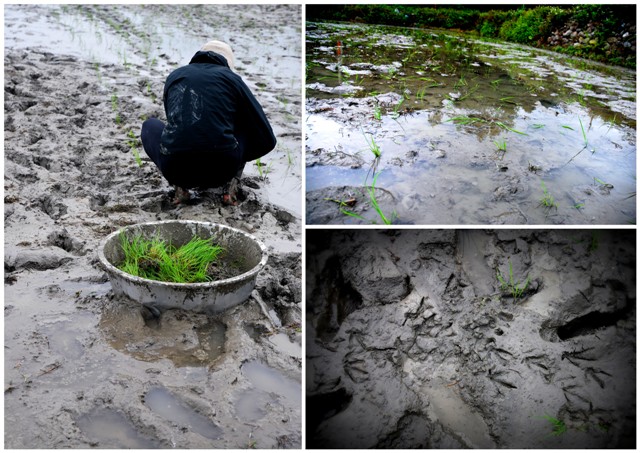
Everything seems to come alive overnight. In fields just turned over with an iron ox, green shoots begin to push up again. Along the field ridges, the hollows and banks are packed with purple-flowered ageratum (Ageratum houstonianum) and large-flowered beggarticks (Bidens pilosa var. radiata), while the fields hold the vexing Bermuda grass (Cynodon dactylon) and barnyardgrass (Echinochloa crus-galli), and occasionally the tasty Showa grass (Crassocephalum crepidioides) and black nightshade (Solanum nigrum). The farmer looks anxiously at the farmers' almanac, calculating, and pays no mind that it is still the New Year - for him, transplanting rice seedlings is like going into battle. Once the auspicious day for transplanting is decided, the farmer floods the field with water. The water drowns everything in the field, and the rotary tiller blades mercilessly churn the earth into thin mud. Mud splatters onto the farmer's white cotton clothes, and the grim gray spots somehow bring to mind the red blood that sprays from a samurai cut down on the battlefield.
The farmer keeps fighting his war. He is bent on wiping out the weeds in the field, killing the snails that eat the seedlings, poisoning the water ducks that come to frolic in the field at midnight, and driving off the white-breasted waterhen that always pulls the seedlings up by the roots. He hates these pests to death, hates having to run anxiously out to the field before dawn every morning to patrol, only to find that a corner of the freshly transplanted field has gone missing again. The sight of seedlings floating on the water instead of planted in the soil makes him angrier than anything. To drive off the water birds, the farmer uses the large incense sticks from the temple, then buys a bundle of big dragon firecrackers meant for festive worship, unties the little red explosives one by one and hangs them on the incense. String after string of these "firecracker incense" sticks become timed bird-scaring devices. If his hatred runs deeper still, the farmer will mix a little "Niannianchun" (the name of an herbicide) into the soaked rice grain as bait, slyly scattering it in the field to wait for the unsuspecting, greedy birds. The pheasants, egrets and water ducks that ordinary people find so cute all become terrifying to the farmer at this time.
Tonight the sky is cloudless. Not long after the Lantern Festival, the moon still looks bright and full. A pair of water ducks flies through the night sky. Their fluffy, smooth, glossy feathers trap the air around their bodies, keeping them warm even in the biting cold wind. But they are hungry, flying through the night in search of food. The moonlight reflects off the flooded fields as a square mirror of silver light, dazzling against the pitch-black land. The instinct in the water ducks' blood tells them: where there is water, there is food. They wheel and turn sharply in the air, gracefully straightening their bodies, flapping their wings to brake against the wind, stretching their two webbed feet out straight, and landing in the field with ripples spreading in wave after wave, knocking over many freshly transplanted seedlings. They are overjoyed, applauding each other for that beautiful landing, and even after touching down they flap their wings a few more times before finally folding them away - and with that, they knock over even more seedlings. The water ducks think they have found a pond or a wetland, and are just lowering their heads to search for food when suddenly, from who knows where, comes a thunderous bang, carrying a thick smell of gunpowder, and the water ducks are reminded of the hunter's gun, reminded of companions that were shot down.
The New Year has just passed, and the farmer keeps watch at night in a crude work shed. Every rustle of wind and grass, every sound of water and bird, makes him prick up his ears. When he quickly lights a firecracker and hurls it with all his might into the empty night sky, a flash of light and a deafening explosion seem to burst the stagnant air. By the moonlight the farmer sees the silhouettes of two black birds, hears the clack-clack-clack calls of the water ducks, and their panicked flight looks like fighter jets taking off, shooting straight up at a 45-degree angle, never looking back as they race into the sky. The farmer curses at the sky, spits on the ground, and, satisfied, drags his sleep-deprived eyelids from the past few days as he crawls into the bed in the work shed. The sleeping bag of artificial chemical fiber on it is dirty and torn, nowhere near as warm as a real down sleeping bag.
The water ducks feel lucky that they and their companions escaped the hunter's gun. Out of instinct or out of hunger, they still lower their heads and scan the square or long, narrow silver mirrors in the night one by one. This time they are in luck: not only have they found a safe pond, they have also found a great deal of fragrant rice grain scattered all over the ground in it. The water ducks stretch and retract their necks, feasting away, but somehow, on the fifth time they stretch out their necks, they topple into the water and never move again.
When the farmer works hard to bury soybean seeds in the soil, hoping the seeds will sprout smoothly and grow strong to bring him a bountiful harvest, the pheasant secretly watches from the nearby woods, preparing to take advantage of the moment when no one is around to carefully dig up the treasure the farmer has just buried in the soil. Perhaps for the pheasant this is like a kind of survival game; the ticket to enter the game is a bet on its own bird life, and the soybeans buried in the soil are the prize of this game.
The farmer does it to make a living, but so do the birds, so do the weeds, so do the white grubs and earthworms in the field - they are all casualties of this war. Because of this pitiful war, the weeds are killed by herbicide, the birds stake their lives, and the countless creatures in the field suffer a catastrophe like a meteorite impact or a tsunami swallowing everything. The farmer does not die, yet unknowingly fills his exhausted body with even more worry, hatred, and anxiety over gain and loss.
If, if such a day should ever come, when all this is no longer a war, when humans learn to let go of gain and loss and hatred, to learn to live interdependently and in lasting harmony with nature, and no longer, like cancer cells, endlessly devour and attack the mother body that nourishes them until they finally destroy themselves. If, if such a day should ever come, would humanity's existence on Earth seem less jarring, and could it be reborn, accepted once more by all living things?