Pests Get Moldy and Turn into Zombies: First Beauveria bassiana Microbial Insecticide to Launch This Year
To fight bandits and thieves, the people take up arms and struggle, but farmers have no way to deal with the "bandits" in their fields, and they rack their brains for suitable control methods. Pests like the litchi stink bug, which has recently been wreaking havoc on crops such as lychee, and the tobacco cutworm, which eats whatever it finds, leave farming families deeply distressed.
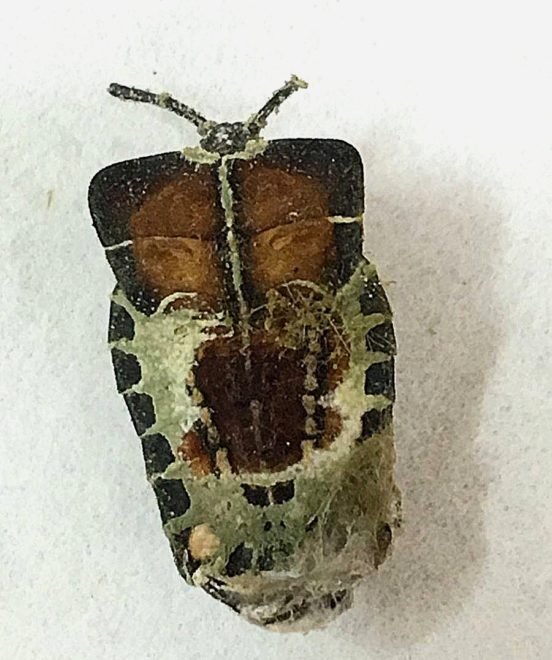
However, after years of effort, Meiho University this year developed a fungal microbial insecticide that uses Beauveria bassiana, which can parasitize inside the host's body and destroy its defense mechanisms, causing pests such as the diamondback moth on cruciferous crops, the red palm weevil on coconut palms, and the litchi stink bug to "become moldy," thereby achieving control. Among these, field trials for the diamondback moth were completed last year, and trials for the litchi stink bug are expected to be completed this year as well, with technology transfer and market launch to follow as soon as possible, putting a powerful weapon in farmers' hands to defend their homes.
Making terrifying pests moldy and turn into zombies: the first fungal microbial insecticide will launch this year
Regarding this Beauveria bassiana formulation, Liu Shang-pin, assistant professor in the Department of Biotechnology at Meiho University and one of the research and development team members, pointed out that previous research had already found that Beauveria bassiana has a good control effect on the red palm weevil on coconut palms. Last year, field trials were also conducted against the diamondback moth, and the control effect was found to reach as high as 80 to 90 percent. Therefore, this year a plan application was specially submitted to the Council of Agriculture, setting the control of the litchi stink bug as the next target.
Liu Shang-pin also stated that, unlike the Bacillus thuringiensis that farmers used previously, which must be "eaten" to be effective, Beauveria bassiana, an entomopathogenic fungus, is a "contact-type" fungus, meaning that as long as the pest is sprayed with it, the fungal bodies will grow inside the insect's body. Therefore, its insecticidal effect is higher than that of Bacillus thuringiensis and places no burden on the environment at all.
Why choose the litchi stink bug as the next target? Li Xiao-ping, a researcher in the Fungal Research Laboratory at Meiho University, further explained that, based on laboratory test results, Bacillus thuringiensis has limited control effect on adults, because adult litchi stink bugs are not very likely to eat that agent. However, Beauveria bassiana can be applied by spraying, and no matter what growth stage the pest is at, it will "suffer its harm"; even mature stink bugs carrying red shells will become moldy because of it. The overall control effect is even higher than 70 percent, far better than existing agents.


Pesticides causing trouble? Bee colony deaths surge; controlling the litchi stink bug with Anastatus japonicus instead of pesticides
For more professional agricultural technology information, please scan the QR code to follow WeChat: NongXunNET

Please indicate the source when reprinting.