Expert warning: feeding one squirrel can harm the entire forest
Newsmarket reporters / Pan Tzu-Chi and Lai Yu-Wei report
When people on an outing see wild animals, public reactions are polarized: cute squirrels and birds are often lured and fed, while snakes, which do not "pose for photos," often meet a cruel end. Wild animals that get used to being fed by humans can throw the ecosystem out of balance as their populations grow and their feeding habits change; squirrels accustomed to being fed, for instance, start gnawing bark once there is nothing to eat, damaging the forest. The Taipei City Animal Protection Office and the NTU Experimental Forest urge people to stop feeding wild animals.
Feeding wild animals at will causes ecological change
In recent years, environmental changes have brought cute red-bellied squirrels and head-tilting collared scops owls (a species of owl) into urban areas to appear and roost, yet human "affection" has also changed the behavior of wild animals.
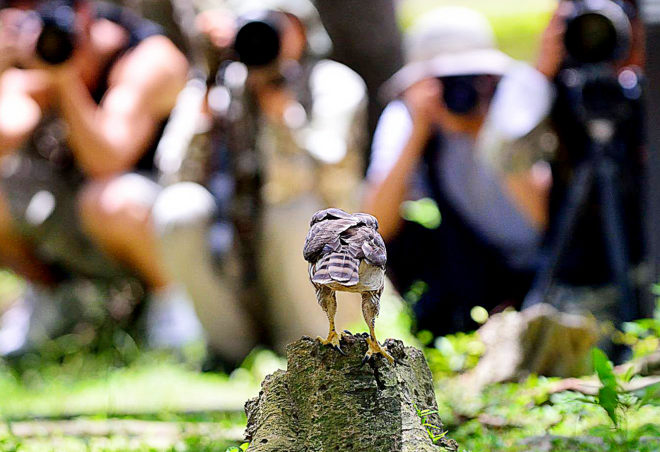
Lin Hsiu-Yi, a technical specialist at the Taipei City Animal Protection Office, said that in recent years Taipei residents have been able to observe bats, Taiwan blue magpies, collared scops owls, crested goshawks and other creatures appearing frequently in urban districts, showing that the urban environment has improved. Yet there are also some "photo enthusiasts" who, in pursuit of a beautiful ecological shot, toss chunks of meat to attract birds of prey to forage. "Once wild animals get used to being fed by humans, they stop foraging in the wild."
It is not only feeding habits that change; it also causes ecological problems. Because birds of prey are high-level consumers in the ecosystem, when they no longer hunt the "prey" at the middle and lower levels, populations of small mammals and reptiles may increase, throwing the ecosystem out of balance.


An unphotogenic appearance: snakes are trapped and killed or run over
There is another kind of wild animal that ordinary people avoid the moment they encounter it and would never feed, yet some people are bold enough to risk legal trouble just to "eliminate the pest" -- snakes.
Lin Ssu-Hao, a member of the Amphibian and Reptile Research Club at National Chiayi University, said snakes are actually very timid. "It should be said that wild animals in general are very afraid of people." Snakes are ectotherms (commonly called cold-blooded animals), and in summer they may enter human living areas to cool down and in winter to warm up; put plainly, they are only trying to survive.
Yet under the traditional view of snakes as pests or medicinal tonics, many people would rather "beat a snake bare-handed" or call the fire department to catch it, leaving snakes injured. Lin Ssu-Hao said snake tongs cause great harm: when a snake writhes in panic, its internal organs and spine may be damaged. "I have dissected some snake carcasses and found the spine and ribs had been broken by the tongs." Even if released afterward, it is in fact a death sentence.
So the proper way to deal with an "uninvited guest" is for one person to keep a distance of 1 to 2 meters on site and watch the snake's movements to keep it from fleeing out of sight, while another person notifies the agriculture bureau (department) of the county or city government so a specialist can handle it. "Of course, in Chiayi County you can ask us for help." Lin Ssu-Hao said.
Getting along with animals: just stay calm
Whether it is human-squirrel, human-bird or human-snake interactions such as feeding, touching or photographing, it all comes down to the question of how humans should "appropriately" interact with wild animals when their living spaces overlap.
Hou Sung-Nan, a biology teacher who promotes collared scops owl education at Changhua Chang-An Junior High School, said it must fundamentally start from understanding animals' behavior. "When the relationship is right, students and people will know how to face animals."
He explained that wild animals like the collared scops owl build nests and choose habitats for the purpose of "being able to survive," but when they become campus visitors, some people suggest building nests for the owls to make it easier for students to observe. Yet he believes that only by preserving the collared scops owl's habit of choosing its own habitat can people truly understand them. When students realize this, they will become aware that sometimes "the more humans get involved, the worse the results often turn out."
Lin Mei-Yin, of the Taiwan Macaque Chatting Party, which works to help people better understand the protected Formosan macaque, and a doctoral student in the Department of Biological Sciences at National Sun Yat-sen University, believes that Taiwan is small and densely populated, so people and wild animals overlap greatly in territory and are hard to fully separate. Therefore understanding animal behavior, such as the macaque's migratory instinct and foraging behavior, is very important, replacing panic, fear and the urge to drive them away with a calm, peaceful way of getting along.
Even though she is very close to macaques, Lin Mei-Yin said she does not, in the short term, agree with opening up feeding to the public: first, human food is unsuitable for wild animals, and second, the public's scientific knowledge is insufficient; before people can understand wild animals' behavior, using feeding as a means of getting close easily leads to misunderstandings, conflict and contradiction.
To learn more about wild animals, see the following websites
Taiwan Raptor Research Association: http://raptor.org.tw/
Amphibian and Reptile Research Club at National Chiayi University: https://www.facebook.com/permalink.php?story_fbid=509874952543561&id=238431359687923
Taiwan Macaque Chatting Party: https://www.facebook.com/ChatteringParty/?fref=ts
Forestry Bureau Ershui Macaque Ecological Education Center: http://www.macaca.org.tw/