Bulk-verified agricultural products need to be labeled with their source. The Council of Agriculture planned this early on, so is it redundant for the Food and Drug Administration to separately stipulate it?
The Food and Drug Administration (FDA) under the Ministry of Health and Welfare has announced a draft measure requiring domestically sold bulk foods that have passed organic agricultural product, production and sales traceability, and Certified Agricultural Standards (CAS) certification to begin labeling their place of origin, production system and other information starting August 4. However, because among agricultural products currently holding the three official production certifications, those sold in bulk form are mostly organic agricultural products, and the Council of Agriculture had already stipulated in the Organic Agricultural Products and Organic Agricultural Processed Products Certification Management Regulations that vendors selling bulk organic agricultural products must post a notice board labeling the product name and place of origin, while also displaying a copy of the organic certification certificate, observers could not help but question: "What is the point of the FDA drawing up separate regulations?"
Agricultural products certified as organic, traceable, or CAS to strengthen information disclosure on August 4
Food safety problems have not let up. At the start of the year, the Legislative Yuan had just passed an amendment to Article 25, Paragraph 1 of the Act Governing Food Safety and Sanitation, which states that "domestic producers that have passed agricultural product production certification shall label a traceable source." Paired with this parent act, the FDA simultaneously announced on May 22, when the provision took effect, the draft regulations on labeling of bulk foods that have passed domestic agricultural product production certification, requiring certified bulk agricultural products to disclose place of origin, producer name, address, telephone number and other information, publicly posted in a conspicuous place in the form of cards or notice boards for consumers to consult.
According to the Council of Agriculture's current three production certification systems, those sold in bulk form are mostly organic agricultural products, while CAS and traceable products usually have complete packaging. Fu Tzu-yu, section chief of the Council of Agriculture's Planning Division, explained that although bulk organic agricultural products were previously required by regulation to be labeled, the information disclosed was not sufficient or enforcement was not thorough enough. Now that the FDA has included it in the statute and requires vendors to comply, it is to some extent converting the industry's past self-discipline into legal heteronomy, so that relevant production channels pay more attention to the importance of information disclosure.
Council of Agriculture official: little difference from current regulations
As for the traceable and CAS certified agricultural products, Fu Tzu-yu admitted: "Not much change." Traceable products already disclose on their labels the producer's name, product name, certification body and traceability number, and consumers can also scan a QR Code to view related information. As for the disclosure items added by the FDA in this amendment, the Council of Agriculture will redesign the labels so that the disclosed information matches the FDA's requirements.
Cheng Chun-lung, section chief of the Food Processing Section of the Council of Agriculture's Department of Animal Industry, which oversees the labeling regulations for CAS certified agricultural products, said that boxed, CAS certified washed eggs will be subject to this FDA announcement, but processed agricultural products such as sausages and chicken wings are not included, because the production of a box of sausages goes from pig farm, slaughterhouse, cutting plant, and then to processing plant, passing through many vendors in between, and an ordinary processing plant cannot possibly take pork from only one pig farm. There may be a mix of imported and domestic sources, and if the source of the main raw material had to be clearly labeled on the box, it would be extremely difficult.
The FDA's CAS bulk agricultural products regulation covers boxed washed eggs
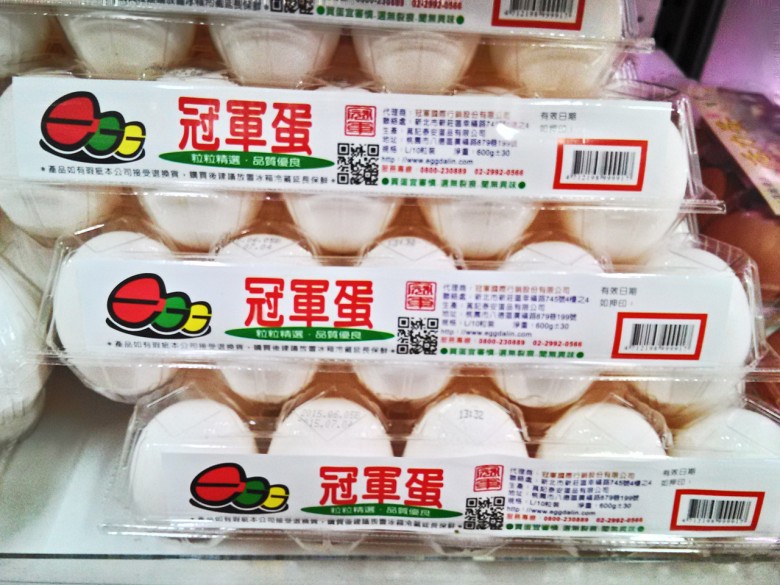
Relatively speaking, eggs only go through a simple washing, sorting and packaging process. Cheng Chun-lung said that because the FDA defines boxed washed eggs as bulk agricultural products, eggs that have passed CAS certification also fall into this category. However, he admitted that currently all CAS certified egg products are required to label information such as the source farm, so in fact the impact after the statute takes effect will not be great.
In response, Pan Chih-kuan, director of the FDA's Food Division, admitted that this regulation was requested by legislator Tien Chiu-chin, and they did not investigate how many bulk eggs on the market have passed production certification for this purpose. But "since the legislator requested it, if the FDA doesn't do it, someone will hold us accountable."
 Most bulk eggs on traditional markets still have unknown sources
Civic groups call for management from the consumer's perspective and establishment of a mandatory traceability system
In response, Chu Tseng-hung, chief executive of the Taiwan Animal Society Research Association, regretfully said that the Council of Agriculture and the FDA have always viewed food safety issues from the industry's perspective rather than the consumer's standpoint, so amended regulations easily become the same whether amended or not. Even the egg production system labeling that was hotly discussed a while ago now appears to have been shelved by the Council of Agriculture, all of which disappoints him.
What is encouraging is that this announcement means the FDA is willing to take a step forward in the traceability management of agricultural products. However, not every official certification system currently allows the public to trace the production source. If official supporting measures are insufficient, most eggs will remain of unknown origin, and after the statute is enforced it may well fizzle out. The same incidents of drug-residue eggs at breakfast shops will happen again and again, and in the end, although suppliers can be traced, it will still be impossible to find which farm had the problem, making it impossible to prevent recurrence.
Liao Chen-yuan, secretary-general of the Taiwan Agricultural Standards Association, which promotes civic certifications such as safe farming practices and humane livestock production, suggested that the authorities could establish a "mandatory traceability" system as soon as possible. This system can be simple, without additionally incorporating overly complex information such as safety and no drug residues; it only needs to require all vendors to register feed sources, treatment sources, the number of chickens being raised, daily egg production, and where the eggs go, and then cross-check with the food supply chain, so that the source can be effectively traced from the end point.
He emphasized that the authorities in many countries, including Europe and the United States, have similar traceability systems. Establishing this system will absolutely not be more complex than the existing traceable certification, and if food safety problems occur again, it will also make it easier to identify the problematic vendor, solve the problem and prevent recurrence.
In addition, Liao Chen-yuan believes that the authorities can legislate to require food businesses to give priority to using egg products certified by a traceability system. After expanding demand for certified eggs, this can prompt egg farmers to raise their farming standards and quality, and only then will the overall market improve.