Ministry of Health and Welfare asks Business Weekly to submit supplementary documents; Wu Chia-cheng: Not malicious, but the credibility of the test report is low
Business Weekly reported that 60% of milk sold on the market contains banned drugs, but the Ministry of Health and Welfare and livestock experts considered the testing method unprofessional. Yesterday Business Weekly went to the Ministry of Health and Welfare to submit its test report, but after holding an expert meeting this morning, the Ministry of Health and Welfare said that the report provided by Business Weekly was incomplete, did not provide the name of the laboratory, and the database used for comparison could only serve as a preliminary interpretation. Another official letter will be sent tomorrow, requiring Business Weekly to complete the materials by Wednesday. At present, the Council of Agriculture and the Ministry of Health and Welfare have already repeated the experiments according to the preliminary materials provided by Business Weekly, and the results are expected on Tuesday.
Incomplete materials: the Ministry of Health and Welfare asks Business Weekly to submit supplementary documents by next Wednesday
Based on research materials from Chen Liang-yu, a professor in the Department of Biotechnology at Ming Chuan University, Business Weekly pointed out that nine brands of milk sold on the market contain banned drugs. Yesterday afternoon, Business Weekly deputy editor-in-chief Liu Pei-hsiu and Chen Liang-yu went to the Ministry of Health and Welfare to submit the test report. In the evening, however, the Ministry of Health and Welfare said that the Business Weekly report had four deficiencies:
(1) It provided only a simple testing procedure, and did not provide the basis for the testing method (or validation data) or the testing equipment,
(2) It did not provide the name and address of the testing laboratory, and provided only the name of the mass spectrometry database,
(3) It did not explain the comparison and determination method,
(4) And it did not provide the mass spectra for interpreting the results, and the total ion chromatogram attached to the report did not label the corresponding sample names.
After the Food and Drug Administration held an expert meeting this morning, the Ministry of Health and Welfare further stated that the materials Business Weekly provided yesterday lacked relevant academic data for data quality; the database search comparison could only serve as a preliminary interpretation and was not suitable as the basis for a final determination or for hastily drawing conclusions; quality control-related materials were not provided (such as blanks and replicates), so the representativeness of the data could not yet be confirmed; detailed data were not provided, so the experimental results could not be reasonably explained; and relevant academic materials were not provided to interpret whether these metabolites originated from the drugs that were announced.
Chiang Yu-mei, deputy director-general of the Food and Drug Administration, said that a letter would be sent to Business Weekly tomorrow requiring supplementary documents by Wednesday. If the supplementary materials are still incomplete, Chen Liang-yu may be asked to come for discussion.
The Ministry of Health and Welfare tests according to the method provided by Business Weekly; results due on Tuesday
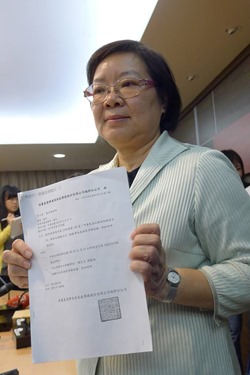

The Ministry of Health and Welfare has already conducted experiments on the preliminary materials provided by Business Weekly, comparing the spectrum data to determine whether they match metabolites and what drugs they may be. The results are expected on Tuesday. Tomorrow afternoon, the Council of Agriculture and the Ministry of Health and Welfare will also separately announce whether the nine milk products were found to contain any of the 108 and 86 animal drugs under monitoring, as well as plasticizers.
Chiang Yu-mei said that the public is very welcome to provide materials, but "the accuracy of the materials comes before the welcome." She hoped that all units, when releasing test results, would comply with Article 40 of the Act Governing Food Safety and Sanitation by attaching the testing method, testing unit, and basis for interpreting the results. However, she stressed that asking Business Weekly for materials and redoing the experiments was only meant to clarify the truth; it was a separate matter from punishment, and punishment had not yet been discussed. But regarding Chen Liang-yu's statement that testing metabolites is the best way to test for drugs, Chiang Yu-mei only said: "We respect his view."
Psychiatrist Su Wei-shuo: If there are doubts, they can be raised; the government and milk suppliers should prove safety
However, psychiatrist Su Wei-shuo believes that the Council of Agriculture testing for drug residues and Chen Liang-yu testing metabolites are fundamentally different, and the Council of Agriculture cannot therefore claim that the milk is safe. He gave an example: the antidepressant metabolite Clomipramine that Chen Liang-yu detected is in fact the chemical name of a drug; it is a first-generation antidepressant mainly used to treat insomnia, depression, or chronic pain. But if cattle are to be given it, a veterinarian must issue a prescription. The Council of Agriculture should directly test for this drug and not use other drugs to blur the focus.
He believes that since Chen Liang-yu has submitted a test report, the government should rebut it. "It is like an indictment: as long as a prosecutor reasonably judges that you may have committed a crime, they can indict, and then a judge sentences based on the relevant materials." He said that as long as a report considers there to be safety concerns, it can be raised; the milk suppliers should prove safety, and the government should first examine whether there is a problem with the milk.
Chemistry professor Wu Chia-cheng: The test report is not even as good as a university student's
However, Wu Chia-cheng, a professor in the Department of Chemistry at National Taiwan Normal University, believes that this report fails to meet standards in procedure, laboratory, instruments, and report completeness, and that "publishing it directly is very inappropriate." He said that Business Weekly had approached him twice. At nearly 3 p.m. last Friday, Business Weekly brought the relevant data and interviewed him for half an hour. That afternoon, after Bifido filed a complaint against Business Weekly, he received another call from Business Weekly in the evening, hoping to consult him on science and testing technology, as well as follow-up legal issues; at 8 p.m. that night, Business Weekly brought editors, the writing reporter, Chen Liang-yu, and a lawyer, more than ten people in total, to interview him for two hours.
Wu Chia-cheng said that after seeing the instruments, laboratory, and testing procedures mentioned in the Business Weekly report, he told Business Weekly on the spot that the study was too imprecise: the testing instruments might be 30 years behind, and using a gas chromatograph at nearly 300 degrees Celsius might produce chemical reactions; the laboratory might be contaminated. "This report is very, very unprofessional, and its credibility is very, very low. Even reports submitted by university students are much better."
He said that during the interview, Business Weekly admitted that it had been too rash, and Chen Liang-yu also admitted that there were many things that could not be judged, but that he was only the person making connections, and that the actual experimenter was someone else.
Wu Chia-cheng said that he has long paid attention to food safety, but the pursuit of fairness and justice in food safety must use the correct methods. From a scientific point of view, this report is completely unqualified. In the short term, it may achieve some goal set by Business Weekly, but once such a trend takes shape, Taiwan will be unable to achieve the goal of pursuing food safety justice. He currently believes that Business Weekly did not act out of malice, so he will kindly assist them, but if the public continues to believe this report, society will have gone the wrong way, and the media should not follow the direction of this report either. If Business Weekly and Chen Liang-yu continue to stubbornly argue, he will speak out.
Regarding Professor Wu Chia-cheng's remarks, Business Weekly brand director Lin Chiu-pao said she would not respond, and that they would have to wait until they received the official letter from the Ministry of Health and Welfare before knowing what needed to be supplemented. "We have already submitted the documents in good faith, so supplementing them will naturally not be difficult." Chen Liang-yu also said that he would provide the materials the government units wanted to know.