In the Ting Hsin suspected tainted oil case, a total of 54 products were produced from 2013 to 2014, and businesses that have used them must remove them from shelves.
Ting Hsin Oil is suspected of importing feed oil from Vietnam and selling it into the food market. The Food and Drug Administration (FDA) under the Ministry of Health and Welfare said this afternoon that Ting Hsin has imported a total of 3216 tonnes of Vietnamese oil over the past 4 years, using it in proportions of 100%, 52%, 40% and so on to make dozens of product items. The FDA requires downstream businesses that purchased the oil within the past two years to report product names, batch numbers and quantities to their local health bureaus before midnight on the 12th, and to remove all products from shelves before the 14th. Violators can be fined 60 million to 50 million yuan.
Last night the FDA held an emergency press conference, stating that Ting Hsin imported lard from the Vietnamese company DAI HANH PHUC, declaring it for food use, but Vietnam's Ministry of Industry and Trade replied that the oils and fats exported by this company "are only for feed use and are not used for food (edible oil)."
The FDA said Ting Hsin imported 1387 tonnes from Vietnam last year, making 31 oil products, and imported 871 tonnes this year, making 23 oil products, including 100% lard, 40% formulated lard and 52% formulated lard. It has already compiled a list of downstream businesses and given it to local health bureaus to confirm company names and transaction status, but businesses must still report on their own and remove products from shelves.
According to FDA statistics, Ting Hsin shipped a total of 1150 tonnes of lard this year through October, and 2496 tonnes last year. Acting Director-General Chiang Yu-mei said Ting Hsin cannot clearly explain which products the Vietnamese lard was mixed into, and the storage tanks may also have cross-contaminated other lard, so all lard products must be reported and removed from shelves. However, ordinary lard has a shelf life of only 10 to 12 months, so only businesses that used it in the past two years are required to remove products from shelves.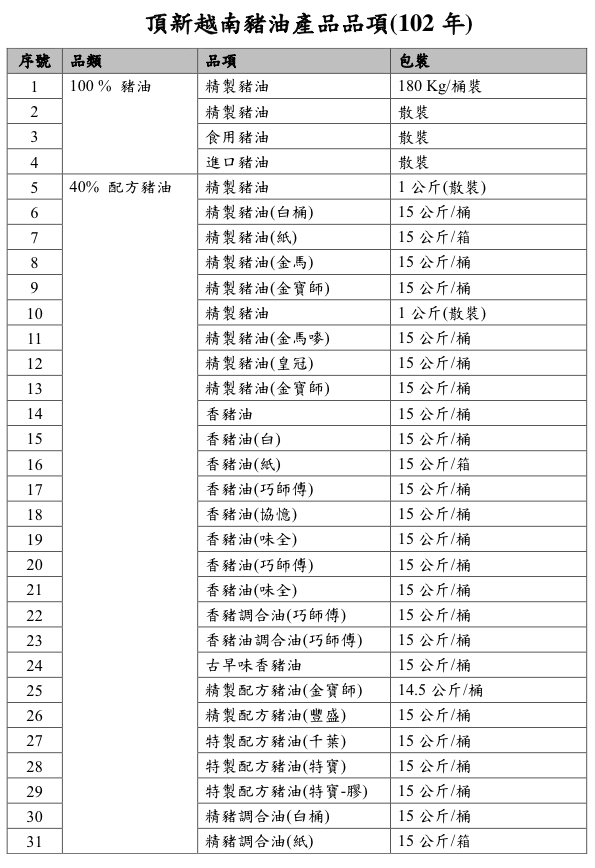
Ting Hsin Group Chairman Wei Ying-chung bows in apology; Cheng I and Ting Hsin Oil shut down as of today
Hsu Ching-hsin, deputy director of the district management center, said the FDA, together with the Changhua County and Pingtung County health bureaus and district prosecutors' offices, worked through the night to inspect Ting Hsin's oil products, sealing a total of 1417 15-kg drums and 75 180-kg drums (about 34.7 tonnes), as well as 360.7 metric tonnes of lard still in the tanks. The FDA also issued a "work suspension order," requiring the complete shutdown of Cheng I Company's Kaohsiung plant and Ting Hsin Oil's Pingtung plant, both under Ting Hsin.
However, last night Ting Hsin also presented a certificate from the Vietnamese inspection company VINACONTROL, confirming that this batch of oil is "fit for human use." Chiang Yu-mei said in response: "We believe the Vietnamese authorities' statement to us." Related penalties are left to prosecutors and investigators to clarify.
Ting Hsin Group Chairman Wei Ying-chung, who had been criticized for staying out of sight, held a press conference at 4 p.m. today, bowing in apology and saying in Taiwanese, "We are very sorry, and we are willing to take responsibility." He announced that Cheng I and Ting Hsin Oil under Ting Hsin would be shut down as of today until food safety is improved.
At 16:30 on October 11, the Ministry of Health and Welfare published a list of manufacturers suspected of using problematic oil from Cheng I Company. As of 2 p.m. today, only 133 businesses had voluntarily reported having used Cheng I oil products, and 256,493 kg had been removed from shelves. The well-known brand "AGV" Food Co., Ltd. also appeared on the list, having used 15 kg of Cheng I's cooked lard (white).
However, the Tainan District Prosecutors' Office currently confirms only that between February and May of this year, Hsin Hao is suspected of selling feed oil to Cheng I Company, which was made into 37 product items (see link 1 for businesses that voluntarily reported), while the remaining 31 product items made before February (see link 2 for businesses that voluntarily reported) were voluntarily removed from shelves by Cheng I Company, and it has not yet been determined whether they were mixed with problematic oil. AGV reported that this batch of oil products was purchased before February of this year, and whether the problematic oil was directly used remains to be clarified.
(What the Ministry of Health and Welfare published are business names; the products or brands made must be looked up by searching the business names again)
Used Hsin Hao: https://drive.google.com/file/d/0B9A8MytAW5WQeDRDT1NXeGw5MzA
Did not use Hsin Hao: https://drive.google.com/file/d/0B9A8MytAW5WQa19VQkNpbnBqQ0E