Comparing the Ruling in the Tainted Oil Case: Ting Hsin Acquitted - Has Justice Been Saved?
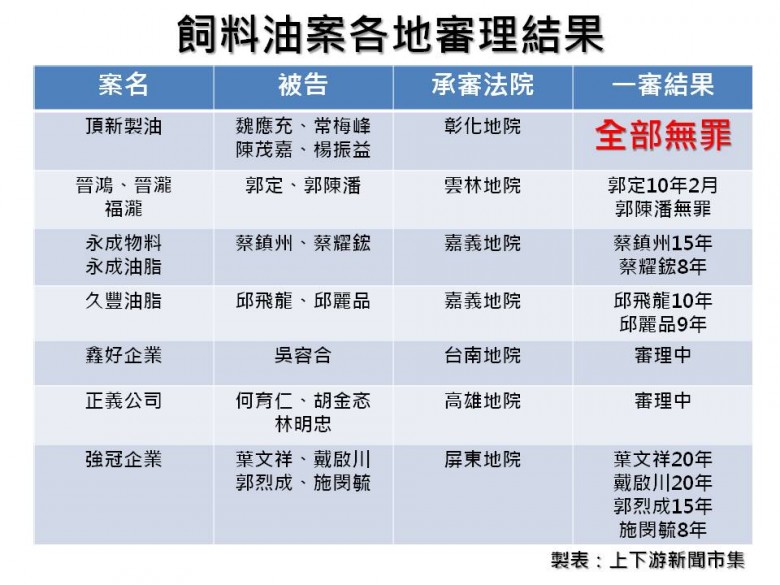
Ting Hsin Oil was accused of importing feed oil from Vietnam's Dai Hanh Phuc Company to use as raw material for edible oil, and was prosecuted under the Food Safety and Sanitation Management Act for adulteration and counterfeiting as well as the Criminal Code for aggravated fraud. The Changhua District Court last month (November 27) acquitted the defendants, causing an uproar and sparking debates over whether refined feed oil can serve as raw material for edible oil, and whether food safety only governs finished products and not raw materials.
Facing outside criticism and questions, the Changhua District Court issued a press release emphasizing that the panel of judges "does not endorse Ting Hsin Oil using inferior oil as raw material for refined edible oil." Rather, the reasons were: 1. The food safety law only regulates edible oil products and lacks a clear definition of raw material standards for edible oil; 2. In this case, the existing evidence cannot prove that the oil sourced from Vietnam's Dai Hanh Phuc Company was unfit for human consumption (i.e., it cannot be proven that the source was problematic); 3. The food safety law does not regulate the source of edible oil raw materials, and there is a lack of a clear basis for criminal punishment for such conduct. Therefore, based solely on the principles of "nulla poena sine lege" and "presumption of innocence," the court could only acquit Ting Hsin Oil chairman Wei Ying-chun and other related defendants.
However, given the series of cases that erupted early last year involving feed oil, recycled oil and swill oil being mixed into edible oil and sold, the Changhua District Court's acquittal can be described as "unique."
Also purchasing feed oil from Vietnam's Dai Hanh Phuc Company, Tsai Chen-chou, head of Yeong Cherng Oil and Yeong Cherng Materials, imported it and then resold it to Cheng I Company, which also belongs to the Ting Hsin Group. His conduct was heavily sentenced by the Chiayi District Court to 15 years in prison. In addition, Jiu Feng Oil purchased feed oil from Japanese and Vietnamese merchants and resold it to Cheng I Company; the Chiayi District Court also sentenced those in charge, Chiu Fei-lung, to 10 years and Chiu Li-pin to 9 years in prison.
As for Chang Guann Enterprise chairman Yeh Wen-hsiang and vice general manager Tai Chi-chuan, who purchased recycled cooking oil, swill oil and animal feed oil from underground factory operator Kuo Lieh-cheng to use as edible oil sources, the Pingtung District Court heavily sentenced Yeh Wen-hsiang and Tai Chi-chuan to 20 years each, and Kuo Lieh-cheng to 12 years (including illegal firearm possession).
Can the oil sourced from Vietnam's Dai Hanh Phuc Company actually be fit for human consumption?
In the Changhua District Court's trial of the Ting Hsin Oil case, the panel held that prosecutors did not have sufficient evidence to prove that the oil from Vietnam's Dai Hanh Phuc Company came from rendered carcasses of unquarantined, diseased pigs. Even if the oil from Vietnam's Dai Hanh Phuc Company had not been refined and could only be used as feed oil, it still could not be denied that the feed oil came from healthy, disease-free pig carcasses.
Although prosecutors, based on documents from Vietnam's Ministry of Industry and Trade, alleged that Vietnam's Dai Hanh Phuc Company sold feed oil and did not have the qualifications for food production, the judges held that Vietnam's Ministry of Industry and Trade is not the competent authority, and the ministry's opinion was insufficient to serve as a basis for proving that Dai Hanh Phuc Company could only produce feed oil.
The panel held that, according to Dai Hanh Phuc Company's business registration certificate, free sale certificate, veterinary hygiene qualification certificate and other materials, the company held a "business registration certificate for an enterprise with two or more members," which recorded "business lines: 'production of animal edible oil, vegetable edible oil (not operated at the office)... wholesale of food (details: buying and selling oil and fat products. Buying and selling seafood)...'" Since the registered business items include the production of edible oil, it was difficult to conclude that the prosecutors' evidence sufficiently proved that Dai Hanh Phuc Company could not buy and sell edible oils and fats.
In the Chiayi District Court's trial of the Yeong Cherng case, the panel accepted the effect of documents from Vietnam's Ministry of Industry and Trade, holding that Dai Hanh Phuc Company's oil could only be used as feed and was not fit for human consumption, because it could be harmful to human health.
After Vietnam's Ministry of Industry and Trade investigated Dai Hanh Phuc Company, the Chinese translation excerpts of the Vietnamese official documents are as follows:
- Dai Hanh Phuc Company's business items are the production of feed for livestock, poultry and aquatic products, the production of animal and vegetable oils and fats (not for human consumption), food wholesale and others.
- The company had not obtained a certificate as a food safety-qualified manufacturer issued by the Vietnamese competent authority to engage in food production and business.
- The company deliberately shipped oils labeled as suitable for human consumption together with oil products for feed to Taiwan, violating Vietnamese regulations and constituting fraud.
- For oil exported for human consumption, Dai Hanh Phuc Company had it inspected by Vietnam's Vinacontrol inspection company, which issued a certificate. But Vinacontrol is only a private enterprise engaged in inspection and analysis, not a Vietnamese official regulatory body.
- Vinacontrol only inspects and analyzes samples of products and has no authority or responsibility to check whether manufacturers or enterprises possess qualified food safety production conditions.
The Chiayi District Court panel held that, according to the report issued by Vietnam's Ministry of Industry and Trade, it was proven that Dai Hanh Phuc Company's oil could only be used for feed and could not enter food refining. In addition, police searching Yeong Cherng Company's factory seized "purchase and sales daily reports," which indeed recorded purchases of "feed oil" from Dai Hanh Phuc Company head Yang Chen-yi. Defendant Tsai Chen-chou also admitted that "Yeong Cherng Oil Company did not import edible oil; all the oil we imported was for feed use." Therefore, the court convicted the defendants.
Does using feed oil as food raw material constitute a crime only if it actually harms human health?
In the Ting Hsin Oil, Yeong Cherng, Jiu Feng and Chang Guann cases, using inferior oil or feed oil as food raw material all involved violations of Article 15 and Article 49, Paragraph 1 of the Food Safety and Sanitation Management Act for adulteration or counterfeiting. However, views on the elements constituting a crime differed greatly among different judges.
In the Changhua District Court's trial of the Ting Hsin Oil case,the panel held that to constitute the so-called crime of adulteration or counterfeiting, the ingredient or raw material used to make food must be very likely to harm human health, and prosecutors must specifically prove what danger this substance or raw material brings. Otherwise, merely because Dai Hanh Phuc's oil "may" contain adulterated or counterfeit ingredients, and because Ting Hsin Oil's use of Dai Hanh Phuc oil as raw material "may" harm health, convicting people on the basis of two "possibilities" raises concerns of abusive punishment.
In the Chiayi District Court's trial of the Yeong Cherng case and the Jiu Feng Oil case,the panel considered that the Food Sanitation Management Act has the legislative spirit and purpose of both "managing food hygiene, safety and quality" and "safeguarding national health," and held that constituting the crime of food adulteration or counterfeiting does not require proof that the substance brought concrete danger; as long as the adulteration or counterfeiting conduct could abstractly bring danger, it constitutes a crime.
For example, Article 15 of the Food Safety Act regulates various circumstances in which food or food additives "must not" be manufactured, processed, prepared, packaged, transported, stored, sold, imported, exported, used as gifts or publicly displayed, such as being past the effective period, adulterated or counterfeit, containing additives not approved by the central competent authority, or containing additives never previously used as food or drink domestically and not proven harmless to human health.
The Chiayi District Court panel held that, from the perspective of the legislative spirit and purpose, food past its effective period has mostly deteriorated according to general social understanding, may breed microorganisms, and certainly may harm human health; likewise, "never previously used as food or drink domestically and not proven harmless to human health" also potentially may harm human health. Therefore, for the "crime of manufacturing or selling adulterated or counterfeit food" under the same article, as long as the conduct meets the abstract danger of "being likely to harm human health," it constitutes a crime.
The first-instance acquittal in the Ting Hsin case drew polarized assessments
After the first-instance acquittal in the Ting Hsin case was released, social assessments were polarized. Those who affirmed it believed the judges strictly adhered to the presumption of innocence and nulla poena sine lege, highlighting the importance of independent judicial adjudication, and also affirmed that the judges drew a clear line as to whether adulteration or counterfeiting of edible oil products is only administrative illegality or constitutes criminal illegality depending on the severity of the circumstances. If it falls within the scope that can be handled by administrative penalties, it should not be elevated to criminal punishment, so as to avoid criminal abuse and protect defendants' human rights.
Critics believed that the Food Safety and Sanitation Management Act is administrative criminal law, an extension of administrative regulation, used to regulate "serious conduct" violating administrative regulations, so the judiciary should not create its own standards and interfere with administrative regulation. The Changhua District Court's reasoning in the Ting Hsin case was an excessive judicial centrism that infringed on the legislature's intent, pulling judicial review of harm to food safety legal interests up to the level of concrete danger required by traditional criminal law definitions. But the harm of bad food to health and the environment is gradual and comes from multiple sources, with complex causal relationships, and may produce massive, serious and irreversible consequences. Therefore, food safety or environmental protection cases should apply the precautionary principle, and the judiciary should also adjust to the situation of a new-type risk society rather than rigidly adhering to traditional concepts of criminal punishment.
From the judgments of the Changhua District Court and the Chiayi District Court, there are different interpretations and views on whether Vietnam's Dai Hanh Phuc oil can be used for food purposes and on the constituent elements of the "crime of adulteration or counterfeiting" under the Food Safety and Sanitation Management Act. Will these legal views have any impact on the inferior oil case of "Cheng I Company" currently being tried by the Kaohsiung District Court? Will the first-instance acquittal in the Ting Hsin case affect the Kaohsiung District Court's conviction and sentencing of Cheng I Company, which also belongs to the Ting Hsin Group? This is likely the focus worth watching next.
References for judicial judgments
Changhua District Court, 103rd Year, Zhongsu Zi No. 2 (Ting Hsin Oil case)
Chiayi District Court, 103rd Year, Su Zi No. 567 (Yeong Cherng case)
Chiayi District Court, 103rd Year, Su Zi No. 566 (Jiu Feng Oil case)
Pingtung District Court, 103rd Year, Zhongsu Zi No. 1 (Chang Guann case)
For more professional agricultural technology information, please scan the QR code to follow WeChat: NongXunNET

Please indicate the source when reprinting.