Ducks and geese are hard-pressed to resist avian influenza without vaccination
Last year Taiwan, China saw its worst outbreak of avian influenza in history. In the past, the virus mainly infected chickens, while ducks were regarded as "virus-carrying animals" and rarely showed symptoms. But last year's outbreak caused large numbers of duck and goose deaths, and beyond the virus mutating, it also highlighted the disease-control loopholes of open-waterfowl farming and vaccines not being properly administered.
A normal duck needs 4 kinds of vaccines, to prevent hepatitis, enteritis, cholera and so on. However, according to vaccine data from the duck farming association and the Council of Agriculture, the number of ducklings and goslings in 2014 far exceeded the domestic vaccine supply, showing that most operators did not vaccinate, and for some diseases vaccine coverage was even less than 10%. Industry insiders say bluntly that ducks and geese lacked resistance, and then encountered a ferocious avian influenza, so last year's major outbreak was not surprising at all; the Council of Agriculture says it has already made it mandatory for all breeding poultry to be vaccinated, with a fine of 50,000 yuan for violations.
Some vaccines have coverage of less than 10%
Ducks and geese are like people, encountering all kinds of diseases during their growth. Just as we were vaccinated against hepatitis B as children, ducklings and goslings also need injections. According to the "Waterfowl Feeding Management and Safe Drug Use Manual" published by the Council of Agriculture's Bureau of Animal and Plant Health Inspection and Quarantine, it is recommended that waterfowl be vaccinated to prevent "duck viral hepatitis", "waterfowl parvovirus infection", "waterfowl Riemerella anatipestifer infection" and "fowl cholera Pasteurella multocida". Including the Animal Health Research Institute, there are currently 5 operators in the country producing or importing 6 kinds of vaccines to prevent the above diseases.
The purpose of vaccination is to let animals produce antibodies, so they have resistance when a virus attacks. However, according to statistics from the Republic of China Duck Farming Association, in 2014 Taiwan, China averaged about 2.25 million ducklings per month, and the 12-month total was more than 27 million; the number of geese raised was about more than 2 million, and goslings were about 2.5 times the number raised, that is, 5 million. All together, Taiwan, China's annual number of ducklings and goslings is about 33 million (the industry says 33 million birds).
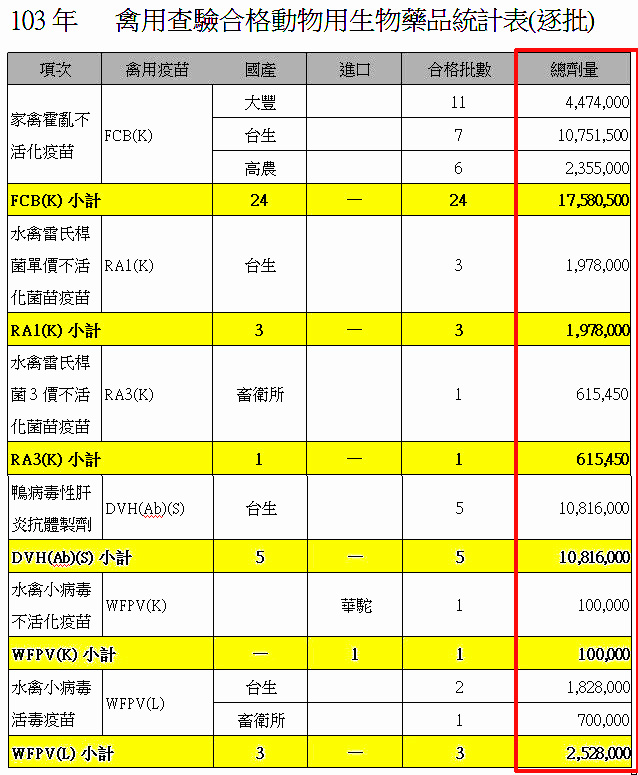
At present, imported and domestically produced vaccines must be inspected batch by batch by the Council of Agriculture and their quantities recorded. However, opening the Council of Agriculture's batch-by-batch inspection reports, for the inactivated fowl cholera vaccine injected into ducks and geese, the total annual dosage of three pharmaceutical companies was only more than 17.5 million. In other words, about half of ducks and geese were not injected.
This is already the vaccine with the best situation. The duck viral hepatitis antibody preparation specifically for ducks and the Riemerella anatipestifer vaccine were about 10.82 million doses and 2.6 million doses respectively, and the waterfowl parvovirus vaccine suitable for both ducks and geese was also only more than 2.6 million doses, with coverage of less than 10%.
At present Taiwan, China does not allow avian influenza vaccines to be administered, but people familiar with the industry say that although the above vaccines cannot directly prevent avian influenza, they can enhance resistance. If ducks and geese, because they were not vaccinated, catch fowl cholera, their resistance declines, and relatively when avian influenza strikes, the probability of being infected increases. "Just like people, those who are strong and healthy are always more likely to resist disease."
Farmers hope better vaccines will be developed
Wu Hsiang-pin, a farmer who has raised geese for more than 30 years, says vaccination is like buying insurance: if you vaccinate, you are protected. Moreover, injecting geese with the parvovirus and cholera vaccines adds only about 2 yuan in cost per goose, so he would not save this money, and most farmers around him also vaccinate, though some people may skip it to save costs.
Li Tai-jan, who runs a breeding duck farm in the Yunlin and Chiayi area and also serves as a director of the duck farming association, says bluntly that there really are farmers who do not vaccinate, because some vaccines do not provide enough protection and instead cause duckling deaths. For example, the waterfowl parvovirus vaccine developed by the Animal Health Research Institute is exclusively for geese and is a live-virus vaccine, but when injected into ducklings, before maternal antibodies are produced, the ducklings are infected by the virus and die first. "One dose of vaccine costs 3 to 5 yuan, protection is insufficient, and the ducklings die first, so farmers naturally are unwilling to vaccinate."
He says duck hepatitis has a mortality rate as high as 50 to 80%, and enteritis caused by parvovirus also has a 40 to 50% mortality rate. Even if they do not die, they develop osteoporosis. If there were a good vaccine, farmers would of course be willing to vaccinate, and he hopes the Council of Agriculture can develop a better vaccine.
Failure to vaccinate can result in a 50,000 yuan fine
In response, Shih Tai-hua, deputy director-general of the Council of Agriculture's Bureau of Animal and Plant Health Inspection and Quarantine, says that previously there was no mandatory rule that breeding poultry must receive these vaccines, so farmers' willingness was not high. But after last year's avian influenza outbreak, in order to strengthen disease prevention, it has become mandatory for all breeding poultry to be vaccinated, with a fine of 50,000 yuan for violations. When farmers buy breeding poultry, they must obtain a health certificate from the breeding farm to confirm that the birds have been vaccinated.
As for farmers reporting that the vaccines are not easy to use, Shih Tai-hua says he does not know whether farmers followed the vaccination procedure. At present he has not heard that any vaccine would cause ducklings to die. If farmers have questions, they can ask local disease-control agencies.