Unveiling the Mysteries of the Fruit and Vegetable Wholesale Market: The Trade Hub Is Its Own World
Editor's note: The author runs a business dealing in the trade and distribution of environmentally friendly fruit, but because a relative works in a traditional fruit and vegetable market, the author occasionally helps out there and has been able to observe the many facets of the traditional fruit and vegetable market up close. What follows is an on-site account written from interviews with fruit and vegetable market workers, as well as the love-hate relationship between the hangkou (wholesale stall operators) and the farming friends (the sellers of the goods).
"The place where we work is a wholesale fruit and vegetable market. There are two markets a day here, starting at 3 a.m. and running until 5 p.m. This place handles the fruit for the entire central region, from roadside vendors to large hypermarkets; everyone comes here to buy and sell fruit. We are the hangkou, an organization that is both familiar and shrouded in mystery."
The operating hours of the wholesale market
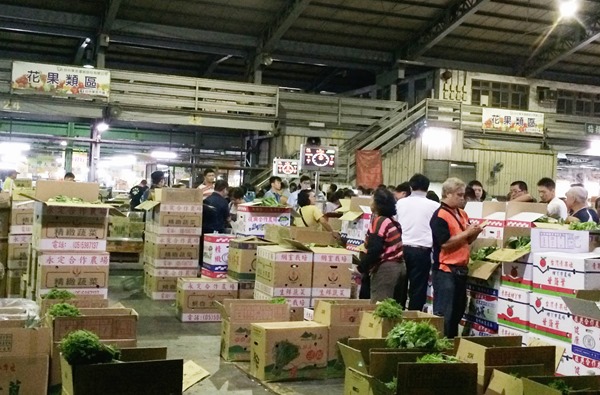
The business area of the fruit and vegetable market is mainly divided into two major zones: the auction zone and the hangkou zone. The auction zone is managed by the fruit and vegetable market marketing company, while the hangkou zone is made up of the various wholesale vendors, and the stalls inside it are called hangkou.
Every day starting at 8 p.m., fruits and vegetables collected from various places are displayed one after another in the auction zone, and some hangkou fruit delivered by commissioned freight is also put on the shelves around this time. The auction begins at 3 a.m., and the hangkou also open for business at this time. The fruit at this hour is mainly sold to supermarkets and morning market retailers, and things stay busy until 7 a.m., after which the market quiets down and everyone either sleeps or goes out to haul goods. Around noon, the large trucks that went out to haul goods return one after another, and the afternoon market business begins again. The afternoon market mainly supplies the evening market and general fruit shops, and it is also bustling. Everyone works this way until 5 p.m., then goes home exhausted to rest.


The value of the wholesale market's existence
The value of the wholesale market's existence is nothing other than matching agricultural products with consumers. The same crop can vary in size, appearance and sweetness, and consumer needs also differ, so there must be an intermediary (the wholesaler) to coordinate and display the agricultural products, allowing retailers to quickly obtain the specifications they want within a fixed trading space in a short time.
But why are so many wholesalers regarded as evil exploiters? There is actually a reason for this: when an agricultural product is in mass production each season, the fruit at every hangkou is too similar, and at that point everyone can only decide which hangkou to buy from based on price. This in turn forces the hangkou to constantly squeeze the farmers' space, and after layers of costs are added up, there is naturally a gap between the production-area price and the retail price, whichthen gets associated with being an exploiter. But it is also true that some hangkou will do anything to make money, hiding market information as much as possible, leaving farmers behind on information, and then seizing the opportunity to buy cheap fruit and reap excess profits; this also happens often. Still, human nature being what it is, not every hangkou boss is like that.
So why, even though hangkou purchase prices are usually relatively low, are farmers still willing to hand their fruit over to them? A mature hangkou has usually already built up the connections mentioned earlier, and its customer network is already solid, so it can continuously and steadily buy fruit from farmers every day, every season and every year. No matter whether the fruit quality is good or bad, or whether the market is high or low, it can help sell it, so farmers at least have somewhere to move their goods and do not have to fear fruit rotting in the fields.
As one aunt at a hangkou put it: 'Today we know perfectly well that the market is terrible and that we will lose badly if we haul it back, but we still have to haul it, otherwise when the market is good, the sellers (the farmers) won't be willing to sell to us.' That really lays bare the interdependent, love-hate relationship between farmers and hangkou.