Contact with the stink fluid of the lychee stink bug can cause skin ulceration, and if it gets into the eyes it may lead to blindness.
Another case has been added to the list of invasive alien pest species threatening human health and agricultural production. The Kaohsiung District Agricultural Research and Extension Station recently received reports from farmers that the "lychee stink bug" (Tessaratoma papillosa) was running rampant in their orchards, and that accidentally touching the foul liquid sprayed by the lychee stink bug caused a burning sensation on the skin and even ulceration.
In the past, lychee stink bugs were mostly found concentrated in lychee orchards in central and southern Taiwan, China, or on longan trees planted around farmers’ homes, but over the past two years the Bureau of Animal and Plant Health Inspection and Quarantine of the Council of Agriculture has found that the lychee stink bug outbreak has spread across all of Taiwan, China. In particular, the bug can now be seen on the Taiwan golden-rain tree (Koelreuteria elegans), a common street tree in urban areas. This not only increasingly affects the public, but also makes quarantine and control more difficult.
According to the "Plant Protection Illustrated Guide" published by the Bureau of Animal and Plant Health Inspection and Quarantine, the lychee stink bug, commonly known as the stink bug, stink stink bug, stone-back or lychee stink bug, is mainly distributed in South Asia and Southeast Asia, including Fujian, Guangxi and Hainan in China. Plants in the soapberry family (Sapindaceae) serve as its hosts; lychee and longan are the primary host plants, while secondary host plants include golden-rain tree, citrus, plum, pear, olive and banana.
The lychee stink bug harms lychee and longan by piercing and sucking, which not only causes flower drop, fruit drop and the withering of young branches and young fruit, but also triggers lychee sour rot in the later stage of the lychee fruiting period. In addition, the adults and nymphs of the lychee stink bug can also transmit "Longan witches’ broom" disease, causing yield losses of 20% to 30%, and in severe cases as high as 80% to 90%. It is a major pest of lychee and longan in southern China.
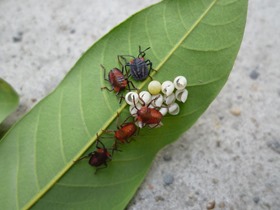 After members of the public accidentally came into contact with the lychee stink bug, their skin became ulcerated. (Photo/Provided by the Kaohsiung District Agricultural Research and Extension Station)
Huang Te-chang of the Kaohsiung District Agricultural Research and Extension Station said he recently heard of a member of the public whose palm was burned by the foul liquid secreted by the bug after catching a brightly colored nymph to play with, and that another member of the public came into contact with a lychee stink bug that fell from a longan tree, causing ulceration on multiple parts of the skin including the chest and abdomen, with unbearable pain.
Chen Ming-yin, an assistant researcher at the Kaohsiung District Agricultural Research and Extension Station, said that farmers spray pesticides in lychee or longan orchards to control pests, so they are less likely to be harmed by the lychee stink bug. However, most members of the public who grow lychee or longan trees in their home gardens do not spray pesticides. In addition, the lychee stink bug is a newly emerging invasive alien pest species in Taiwan, China, and its bright colors easily attract attention and curiosity. If people pick it up to play with it without knowing any better, whether catching it bare-handed or pruning branches, they can easily startle the lychee stink bug into spraying its foul liquid, and once it touches the skin it can easily cause injury.
Shih Po-yu, a full-time attending physician in the dermatology department of Taipei Municipal Wanfang Hospital, said that if people are sprayed by the foul liquid of the lychee stink bug, they should immediately rinse with clean water. He said that everyone’s constitution is different; when the foul liquid touches some people, they only develop redness and swelling, but others also develop itching, in which case they should immediately seek treatment at a dermatology department. If the itchy area is relatively superficial, topical medication can improve it; if a wound appears, oral medication is needed for improvement.
Chen Ming-yin, an assistant researcher at the Kaohsiung District Agricultural Research and Extension Station, said that if lychee stink bugs are found in lychee cultivation areas, farmers can ask the research and extension station about approved pesticides and use medication for control. When temperatures are low in winter, because adult lychee stink bugs are less active, the branches and leaves can be shaken or struck so that the adults fall off, after which they can be caught and killed.
Chen Ming-yin reminded that when catching and killing lychee stink bugs, never touch them directly with bare hands, and when striking the plants, avoid letting the insects fall onto the body. In addition, farmers can apply sticky glue at the base of the main trunk; besides preventing fallen nymphs from climbing back up the tree to continue causing harm, the nymphs will also die because they are stuck to the glue.
Chen Pao-liang, section chief of the Plant Protection Division of the Bureau of Animal and Plant Health Inspection and Quarantine, said that because the lychee stink bug causes serious harm to crops in China, the natural enemy of the lychee stink bug, the "Anastatus japonicus" wasp, is currently used for control. As for Taiwan, China, "parasitic wasps" can be used to repel and control the lychee stink bug.