Experiential Learning in Japanese Food and Agriculture Education: A Case Study of Mahoroba no Sato Agricultural School
Editor's note: The author of this article has long studied the topic of food and agriculture education in Japan. This article is one of a series. To read the previous article, "Practicing Food and Agriculture Education in a Japanese Elementary School: Teaching Experience at Niijuku Elementary School in Yamagata Prefecture", please click here.
────────────────────────────────────────────
Experiential Learning Facilities in Japanese Food and Agriculture Education - The Takahata Town Farm School
Food and agriculture education experiential learning activities in rural Japan can be roughly divided into two forms according to their target participants: "educational farms" and "leisure experiences." "Educational farms" refer to those that target children and adolescents, provide at least two or more types of farm work for the same crop, and have hands-on practice lasting two years or more; their purpose is to promote schoolchildren's understanding of nature's blessings and food production activities; the learning sites are not limited to school grounds but also include local farms that cooperate with schools. "Leisure experiences," on the other hand, target adults and, depending on their purpose, form and required time, include various types such as "citizen farms," "residential farms (Note 1)," and "farm schools" established by private organizations.
Among these food and agriculture education experiential learning organizations, the author visited the community-organized "Mahoroba no Sato Farm School" (Note 2) in 2006 and completed both the first and second terms of its courses; in 2008 I again led faculty and students from the Department of Agricultural Extension at National Taiwan University on a second visit. Recently, quite a few friends have hoped that I could recommend Japanese organic farms suitable for study visits from Taiwan, so I would like to discuss the "Mahoroba no Sato Farm School," because in addition to being a pioneer of organic agriculture, it was already a pioneer in promoting food education before the term "shokuiku" was even born, and every year it attracts many groups from countries around the world to visit this community organization. Its philosophy and spirit, as well as its mode of operation, offer much that is worth learning from.
The Background behind the Establishment of the Mahoroba no Sato Farm School
The "Mahoroba no Sato Farm School" is located in Takahata Town, Yamagata Prefecture, Japan, and was jointly founded by a group of local organic farmers. As early as 1973, when the concept of organic was not yet widespread, the organic movement in Takahata Town had already begun to sprout, and it can be said to be a pioneer in developing organic agriculture through local organizations. These 38 passionate young farmers who together "went against the times," refused the Green Revolution, launched "self-sufficient agriculture," and advocated a return to the "origin" of agriculture - "providing the way of life that humans originally ought to have and a diet that protects life" - as the "Takahata Town Youth Self-Governance Study Group," are now all close to sixty or in their seventies. The "Mahoroba no Sato Farm School" (also called "Kyosei Juku") was established by them in 1991.
The establishment of "Kyosei Juku" was intended to achieve the goals of farmer autonomy and self-reliance. Every year they hold regular spring and autumn lectures, open to villagers, and through knowledge-based empowerment enhance farmers' initiative in civic participation and dialogue with mainstream values. In addition, in order to free agriculture from economic dependence and a disadvantaged position, they actively create venues for agricultural experience and exchange, so that more non-agricultural workers can understand the sweat and joy of organic agriculture.
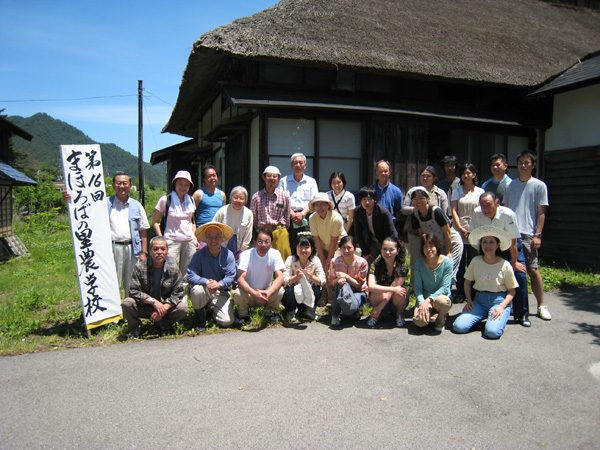
To date, "Kyosei Juku" has trained more than 500 students. The students come not only from within Japan; many have also come from Taiwan, South Korea, Canada, Mexico and elsewhere around the world, drawn by its fame. From June 14 to 17 this year, "Kyosei Juku" will hold its 21st session and will also expand the alumni gathering, showing that as an experiential venue for food and agriculture education, the "Mahoroba no Sato Farm School" enjoys considerable fame, but it has not abandoned agriculture because of this; rather, its good reputation comes from its persistence in agriculture.

Note 1: Refers to a citizen farm with simple lodging facilities, providing long-term accommodation for participants from other places or cities to experience rural and agricultural life.
Note 2: It can barely be translated as: "Fertile Hometown Farm School." Because the phrase is too long and difficult to convey the meaning, the original Japanese is retained, and for smoother writing it is replaced by its other name, "Kyosei Juku."
Note 3: Excerpted from: Takahata Kyosei Juku, 1998, Participant Profile Impressions, edited by Takahata Kyosei Juku, Record Collection of the Fourth Mahoroba no Sato Farm School, p.110-111, Yamagata: Takahata Kyosei Juku.
(This article was once published in Agricultural Training Magazine Issue 270, with some content revised.)