Coarse grains make a comeback (excerpt from the May issue of Classic Magazine)
Text by Cai Jiashan (special contributor to Classic Magazine) Photography by Huang Shize (photographer for Classic Magazine)
There was once a time when Taiwan was an island of abundant five grains.
Besides the rice we are most proud of, there were also sweet potato, sorghum, corn, wheat, peanut, sesame, adlay, red bean... forming a multicolored spectrum of minor grains.
Yu Rensheng, owner of Yu Shunfeng Hang, still remembers vividly how brisk the minor grain trade was back then. Yu Shunfeng Hang was established in 1956 in Puzi, Chiayi, specializing in buying up miscellaneous grains from the surrounding villages. As a young man, Yu Rensheng had to deal with farmers coming to deliver goods every day. "The farmers lined up starting from the shop entrance, and the line stretched on and on!"
Yu Rensheng recounted the various stages of the minor grains' decline: the earliest was the massive agricultural losses caused by the August 7 Flood, after which imports of minor grains began to increase. In 1984, the government, to alleviate rice oversupply, encouraged crop conversion and promoted guaranteed-price purchases of feed corn and sorghum, so fewer people were willing to grow minor specialty grains. "Small grains like sesame and mung bean are labor-intensive and earn little money, and the farmers were getting older, so everyone went to grow sorghum and corn, and crops became homogenized."
In 1997 the fallow land policy was launched, and the government reduced minor grain production year by year. This time even the area planted with corn and sorghum plummeted. By the time of formal WTO accession, apart from sweet potato and edible corn, which still maintained a certain degree of self-sufficiency, peanuts and red beans barely lingered on under tariff quota protection, while almost all other minor grains were abandoned across the board.
From Abundance to Abandoned Farmland
"In the overall transformation of Taiwan's agriculture, the disappearance of minor grains is a very regrettable thing." Guo Huaren, a professor in the Department of Agronomy at National Taiwan University, presented data from past years: from the 1960s to the 1970s, the harvested area of major domestic minor grains was greater than 450,000 hectares, but now only 60,000 hectares remain.
Taiwan positioned minor grains as a "catch crop," originally a very important crop for winter adjustment after two rice croppings. Cai Peihui, spokesperson for the Taiwan Rural Front, analyzed that minor grains disappeared partly because of pressure from the world market economy. The external cause was that international trade negotiations continuously opened up imports of agricultural grains, such as purchasing large quantities of soybeans, wheat and corn from the United States; the internal cause was that rice exports were blocked, so the government encouraged conversion to cash crops such as vegetables, fruits or flowers, squeezing the production rhythm of minor grains.
On the other hand, there was the change in the domestic market. After Taiwanese people became generally wealthier, dietary demand shifted: grains decreased while fruits and meat increased, and agriculture naturally followed social trends into different forms of production. Add to that rising wages, "minor grains have high labor costs but relatively low economic value, so they were invisibly marginalized," said Cai Peihui.
Soybean, wheat and corn (abbreviated as "yellow, small, jade") are key players in international agricultural trade and are also the top three imported agricultural products in Taiwan. In 2012, 2.34 million metric tons of soybean, 1.38 million metric tons of wheat, and 4.38 million metric tons of corn crossed the ocean to Taiwan. Among them, the import volume of wheat even exceeded the domestic production volume of rice.
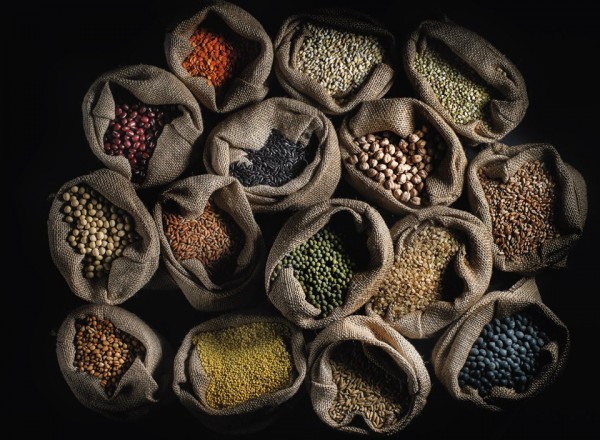

Minor grains are not just a trivial matter of sesame and mung bean, but a major matter concerning agricultural development, land restoration, national health, and even national survival. The path of returning to cultivation may be long and rugged, yet it must be taken.