Using models to boost the breeding drive of the mythical bird: the critically endangered Chinese crested tern population is expected to surpass 100
Content and images provided by / Forestry Bureau, Council of Agriculture
Once believed to number fewer than 50 individuals worldwide, the "mythical bird," the Chinese Crested Tern (Thalasseus bernsteini), has been the subject of continuous research and monitoring in the Matsu Islands Tern Conservation Area through the cooperation of the Forestry Bureau of the Council of Agriculture, the Lienchiang County Government, the School of Forestry at National Taiwan University, and the Taipei Wild Bird Society. Decoy bird models have been used to "lure" real birds to suitable conservation-area islets to breed, and the population is now approaching one hundred.
The Forestry Bureau stated that survey records as of the end of July this year show that the number of Chinese Crested Terns has hit a new high. Across 3 breeding habitats in Matsu and Zhejiang on the mainland, a total of 75 adults and 24 chicks were recorded. Breeding conditions are very good, and the population is expected to break one hundred soon, making this an encouraging result in the history of conservation and research on the mythical bird.
The Chinese Crested Tern is even rarer than the Black-faced Spoonbill
The Forestry Bureau explained that the Chinese Crested Tern is one of the rarest and least commonly seen species among the terns. It often mixes in flocks with the similar-looking Great Crested Tern. It was once believed that its global population did not exceed 50 individuals, placing it in the IUCN (International Union for Conservation of Nature) Red List CR (Critically Endangered) category. Domestically, it is also a category I conservation-listed endangered wild animal, rarer than the Black-faced Spoonbill, whose global population is nearly 3,000 individuals.
Because Chinese Crested Terns are so few and their movements long remained a mystery, domestic birdwatchers and scholars used to call them the "mythical bird." It was not until 2000 that traces were found in the Matsu Islands Tern Conservation Area, along with breeding activity, becoming the world's first confirmed breeding record. In 2004, researchers found them again in the Jiushan Islands of Zhejiang on the mainland.
At present, the confirmed breeding sites of the Chinese Crested Tern include the Matsu Islands Tern Conservation Area in Taiwan, China, and the Zhoushan Wuzhishan Islands Bird Conservation Area and Xiangshan Jiushan Islands Nature Reserve on the mainland. A tern satellite tracking project previously conducted by a Taiwan research team found that populations at the three sites appear to move between one another.
The Forestry Bureau has long supported the Lienchiang County Government in the management and operation of the tern conservation area. Since 2010, it has cooperated with a research team led by Professor Yuan Hsiao-wei of the Department of Forestry and Resource Conservation at National Taiwan University, using an "automated bird behavior and habitat monitoring system" to remotely film and transmit images from the offshore islets back to Taiwan for analysis, in order to understand the terns' breeding conditions and habitat needs.
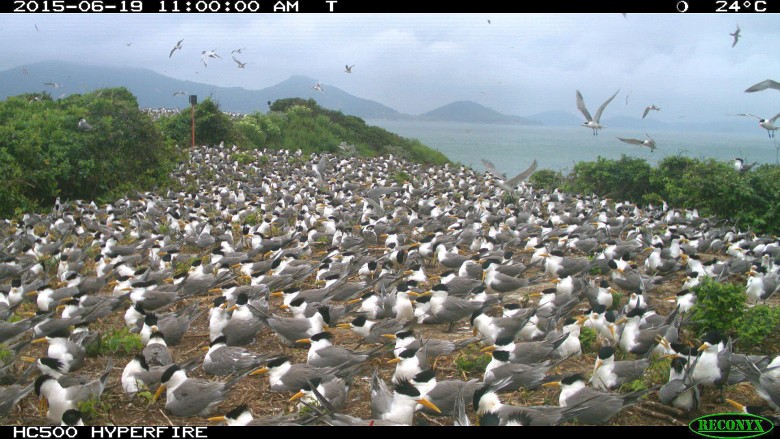


Three breeding sites across the strait, the mythical bird's numbers double
On Tiedun Island in the Wuzhishan Islands and Jiushan Islands on the mainland, there are 52 and 10 Chinese Crested Terns respectively, and they successfully bred 16 and 4 chicks. The Forestry Bureau believes that the number of mythical birds at the three breeding sites across the strait is already nearly double the previous number, showing that the decoy conservation plan, with three habitats advancing in parallel and spreading risk, is feasible, and that abundant results were achieved in the first year of synchronized surveys.
The Forestry Bureau stated that it will continue to support the research team in studying the movement of terns between breeding sites, the competitive and cooperative relationship between the two tern species, and in evaluating additional breeding-decoy islets and related research, hoping to let this beautiful myth live on forever and to bring Taiwan's conservation achievements onto the international stage.