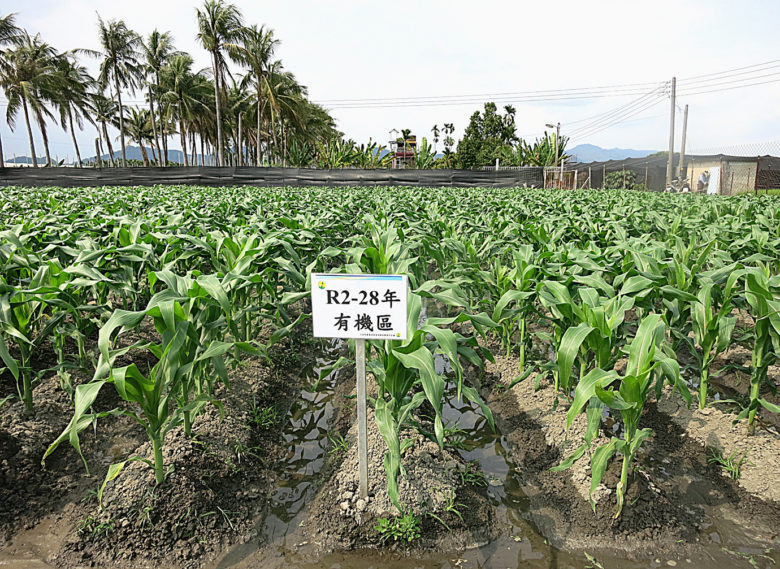
A 28-year experiment by the Kaohsiung Agricultural Research and Extension Station confirms that organic farming and crop rotation make soil more fertile and yields are not inferior to conventional agriculture
Text / Kaohsiung District Agricultural Research and Extension Station
The Kaohsiung District Agricultural Research and Extension Station (hereinafter referred to as the Kaohsiung Station) under the Council of Agriculture, Executive Yuan, has invested 28 years of long-term effort and owns Taiwan, China's longest-running open-field organic production field. Through long-term observation of the soil properties, pest and disease occurrence, and crop production under 3 farming methods (chemical fertilizer, integrated, and organic) within 2 cropping rotation systems, the Station has confirmed that long-term organic farming can optimize soil physical, chemical and biological properties, and that through rotation, with the right timing, the right place, the right crop and coordinated organic control, pests and diseases can be prevented from reaching economically harmful levels, achieving the goal of a certain level of crop production.
The experimental field has also become a platform for organic teaching, research, demonstration and observation in the district, and visitors from all walks of life are welcome.
Taiwan, China's longest-standing open-field organic farming experiment: organic farming can care for the soil
Lin Jing-he, Director of the Kaohsiung Station, stated that the Station's Qinan Branch has Taiwan, China's longest-standing open-field organic farming trial field, comparable to the Rothamsted no-chemical farming experimental station in the United Kingdom. Since it was established in the summer crop of the 77th year of the Republic of China, more than 28 years have passed, with 6 treatments combining 2 cropping rotation systems and 3 farming methods for long-term trials.
Compiled data shows that the soil organic matter content in the long-term organic farming area rose from 2.3% to 4.3~5.4%, which is rarely seen in ordinary farmland in Taiwan, China, and the pH shifted from the original weakly acidic (pH=6.5) to long-term maintenance of neutral to weakly alkaline (pH=7.0~7.5). Important soil elements such as available potassium, magnesium and calcium also continued to accumulate in the organic farming area and were significantly higher than in the conventional chemical fertilizer area.
In addition, previous surveys also found that in the organic farming area, cation exchange capacity (increased by 57.2~90.6%), total porosity (increased by 15.1~18.6%) and aggregate stability (increased by 19.8~21.8%) were all significantly higher than in the conventional farming area, while bulk density also decreased significantly (reduced by 0.73~0.8%), meaning that soil aeration and aggregate structure improved, and soil fertility also increased. In addition, the long-term organic farming area also fostered an extremely rich soil microbial flora, with a 2~4.8% increase in the Shannon's index compared with the soil in the chemical fertilizer area, carrying high significance as a biodiversity indicator.