In the black oil scandal, an atomic-bomb-level case: Yongcheng has only revealed the tip of the iceberg. Why exactly did the feed oil factory buy waste cooking oil containers?
Ting Hsin Group subsidiaries Ting Hsin Oil and Cheng I sold feed-grade tainted cooking oil. After prosecutors in Changhua, Chiayi, Tainan and Kaohsiung concluded their investigations and filed indictments, the case appeared to draw to a close, but the contents of the indictment revealed even more unanswered questions, including the unknown whereabouts of up to 80% of the oil from Vietnam's Dai Hanh Phuc, and unclear statistics on where the nation's waste cooking oil ends up. Even more worrying is that a feed oil plant actually bought discarded empty iron drums that had held cooking oil. Was the contents mixed and sold off as cooking oil? All of this is connected to the recently indicted Yongcheng Oil and Yongcheng Materials.
Question One: Yongcheng is the largest importer of Dai Hanh Phuc feed oil from Vietnam, with a share as high as 80%, yet its whereabouts remain a mystery
In a press release issued on October 30, the Council of Agriculture stated that from 2011 to September 2014, Taiwan imported 5,961 metric tons of oils and fats declared for food inspection and 42,297 metric tons of non-edible oils and fats from Vietnam's Dai Hanh Phuc company. Among these, the companies that imported under food inspection declarations were Ting Hsin and Cheng I, and it was later proven that these cooking oils also came from feed oil.
As for the 42,297 metric tons of non-edible oils and fats, apart from the 7,698 metric tons (about 18.2%) that the Council of Agriculture had verified as imported by a total of 6 companies including Jin Wei Company and Ding Hsiang Hang, the remaining 34,599 metric tons (about 81.8%) were imported by 3 companies: Ting Hsin, Yongcheng Oil and Yongcheng Materials, of which Yongcheng Oil and Yongcheng Materials belong to the same person in charge, Tsai Chen-chou, and accounted for the main share of imports.
Where the nearly 35,000 metric tons of Dai Hanh Phuc feed oil controlled by Yongcheng and Ting Hsin went, the Council of Agriculture said the flow data was in the hands of prosecutors. However, from the contents of the indictment, it is only known that Yongcheng shipped about 2,500 metric tons of feed oil to Cheng I, which is less than 10% of the 35,000 metric tons imported, and the whereabouts of more than 30,000 metric tons of Dai Hanh Phuc feed oil from Vietnam remain unknown.
Question Two: Apart from supplying feed oil to Cheng I, did Yongcheng have no other food factories? Or did it flow into the food chain?
According to the contents of the Chiayi District Prosecutors Office indictment, Yongcheng bought lard raw materials and lymph mince from frozen food factories that process pork, refined them into lard, and then separately blended in fish oil, beef tallow, chicken oil and recycled oil, passing it off as pure lard, and used front companies Yuan Liou Yi Shang Hang, Jia Shih Yi Shang Hang, Syuri You Shang Hang and others to issue invoices and conduct transactions with Cheng I.
The business registration items of these front companies all include wholesale of edible oils and fats and wholesale of feed, so Yongcheng used these front companies to "launder" feed oil and recycled oil into edible lard for external sale. According to analysis of oil samples taken by Chiayi prosecutors from Yongcheng's oil tanks and by Kaohsiung prosecutors from Cheng I's oil tanks, the pork content was found to be very small, and some tanks even showed no reaction for pork content, confirming that the proportion of feed lard blended in by Yongcheng was very low.
According to Council of Agriculture statistics, the amount of feed oil Yongcheng imported from Vietnam's Dai Hanh Phuc between 2011 and 2014 was about more than 30,000 metric tons. If calculated at an average annual import volume of about 10,000 metric tons, Chiayi prosecutors found that the amount Yongcheng sold to Cheng I over three years was only just over 2,500 metric tons, averaging less than 1,000 metric tons a year. Where did the rest of the imported Dai Hanh Phuc feed oil go? Was it sold to other food factories under the name of edible oils and fats in the same way Yongcheng shipped to Cheng I, or self-produced and self-sold into the food supply chain?
The Council of Agriculture said the data was in the hands of prosecutors, and it had no way to verify whether Yongcheng channeled feed oil into the food supply chain, but in the contents of the indictment, there is also no tracking of where Yongcheng Oil sold to parties other than Cheng I.
Question Three: Apart from being a major importer of Dai Hanh Phuc feed oil from Vietnam, how much waste cooking oil did Yongcheng also recycle? The Environmental Protection Administration has no grasp of it at all
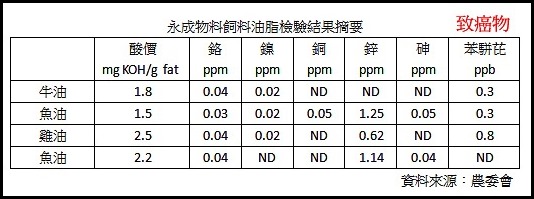
According to the contents of the Chiayi District Prosecutors Office indictment, apart from blending oils and fats from different animals into cooking oil for external sale, Yongcheng also used recycled oil. According to tests submitted by the Chiayi County Government on Yongcheng's oils and fats, as well as analysis by the Food and Drug Administration of the Ministry of Health and Welfare of oils in the tanks of its downstream company Cheng I, both were found to have high acid values, with tests showing reactions for the heavy metal chromium and the carcinogen benzo[a]pyrene (as shown in the figure below). The FDA speculated that the possibility these oil sources came from recycled frying oil was very high.
In fact, according to internal FDA data, as early as 2010, Yongcheng Oil's person in charge, Tsai Chen-chou, had been reported for secretly setting up oil tanks around the Guandu Bridge area in Taipei, commissioning "little bees" to specifically collect waste cooking oil from the greater Taipei area for processing and remanufacture into cooking oil. According to the report contents, the mobile phone number of the recycler provided by the "little bees" belonged to Tsai Chen-chou.
This report was referred to the Taipei County Health Bureau for investigation, and the result reported back was that these oils were sent to a feed oil factory in Tainan County. It was then referred to the Tainan County Health Bureau for investigation, and the answer obtained was that after processing, these waste cooking oils were sent to a certain feed factory in Pingtung County. Because no evidence was found that they flowed into cooking oil, the then Department of Health of the Executive Yuan closed this report on the grounds that no evidence was found.
Tsai Chen-chou often privately claimed that Yongcheng Materials controlled the largest volume of waste cooking oil recycling in the country. If calculated based on the largest legal waste cooking oil recycler in the country, Chengde Oil, which recycles about more than 6,000 metric tons a year, the recycled waste cooking oil controlled by Yongcheng each year could also reach nearly about 5,000 to 6,000 metric tons. The Environmental Protection Administration has no data at all on where this recycled oil went, and the indictment also does not explain it.
 What was Yongcheng's purpose in buying empty drums of "Tung Ching Anhydrous Butter"?
According to the contents of the Chiayi District Prosecutors Office indictment, Yongcheng company head Tsai Chen-chou admitted to buying empty drums of "edible premium anhydrous butter imported by Tung Ching" from Chiaolei Company. When prosecutors and police searched the Yongcheng Materials plant area, they also seized 72 empty drums of edible premium anhydrous butter.
Chiaolei Company is engaged in waste cooking oil recycling, so it is only natural that it holds empty industrial oil drums, but for Yongcheng, which operates feed oil, to deliberately buy containers that had held edible oils and fats, what was its purpose? It raises suspicion. Was it using containers whose outer packaging was for edible oils and fats to fill with feed oil and sell externally? Prosecutors and police also did not clarify this.