What Are Highly Toxic Pesticides? Pesticide Guide Part 2
Recently, civil society groups and the medical community have separately expressed concern about "highly toxic pesticides." These four words sound terrifying, but what exactly counts as "highly toxic"? How many toxicity levels are pesticides divided into? Why do we often hear the media say "banned drugs detected"? Are banned drugs prohibited for use, or is there a problem with the drugs themselves? NewsMarket presents Pesticide Guide Part 2, taking you through the pesticide management system.
1. What are the toxicity levels of pesticides?
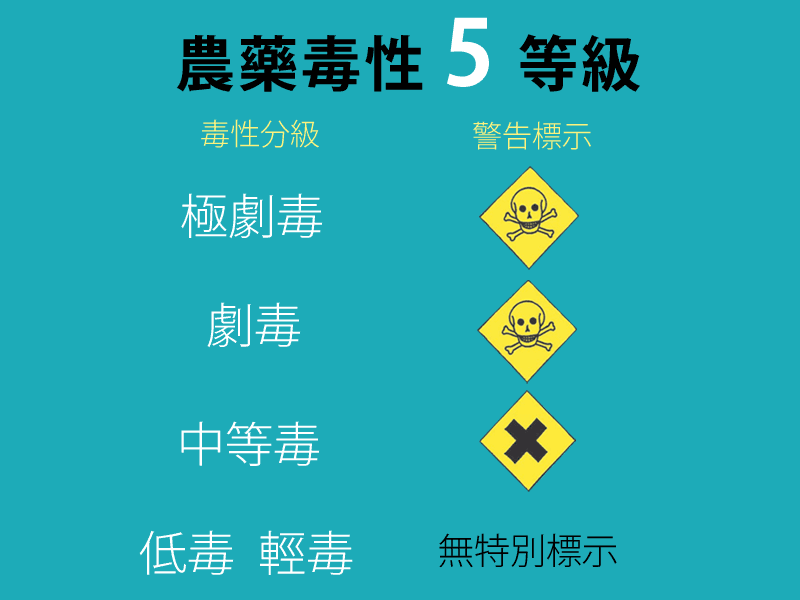
Moving on to the highly toxic pesticides that the public cares about most - if there are highly toxic ones, could there also be low-toxicity drugs? That's right, pesticides are divided into 5 levels in total, from highest to lowest toxicity: extremely highly toxic, highly toxic, moderately toxic, slightly toxic, and low toxicity. The classification standard is the "median lethal dose" LD50 for acute oral toxicity and acute dermal toxicity, but the test subjects are rats, not humans.
Pesticide registration in Taiwan, China, adopts "one agent corresponding to one crop and one pest," with pesticide companies actively applying for registration. For example, "Spinetoram" can be used on edamame and green beans to control thrips, but although red beans are also legumes, the manufacturer did not apply for use on them, so if Spinetoram is detected in red beans, it is a banned drug. But Spinetoram is classified as "slightly toxic," meaning this type of banned drug is not necessarily banned because of high toxicity - it may simply be that the manufacturer did not register it.
Because registering a pesticide requires enormous money and time, manufacturers mostly concentrate on registering for major cash crops and major pests and diseases, so relatively minor crops or pests and diseases often lack control agents.
Since 2008, the Bureau of Animal and Plant Health Inspection and Quarantine has gradually promoted "group-based extended use" to give minor cash crops access to pesticides. For example, red beans are a crop that pesticide companies dislike; the only dedicated control agent for red bean thrips is "Fipronil," but Fipronil will be banned on January 1 next year. It was not until the 2nd of this month that the Bureau allowed "Spinetoram" to control red bean thrips through extended use, slightly alleviating the pesticide problem for red beans.
Regardless of which banned drug it is, there is no issue of exceeding the limit, because it must not be detected at all. Previously, some media reported that Fipronil was detected at 0.04ppm in oolong tea, exceeding the limit by 20 times, but in fact Fipronil cannot be sprayed on oolong tea at all. The so-called exceedance merely exceeded the detection limit of the testing machine, 0.002ppm, but the detection limit of testing machines changes with technology. If technology keeps improving, 0.001ppm may be detectable in the future.
To learn more about pesticides, you can visit the following websites
Can pesticides be washed off with water? Master it all at once with the Pesticide Guide
For more professional agricultural technology information, please scan the QR code to follow WeChat: NongXunNET

Please indicate the source when reprinting.