How loud is the first offshore wind turbine? Swancor's nighttime construction violates environmental impact assessment
In July of this year, the new government passed the "Offshore Wind Turbine Policy Environmental Impact Assessment," declaring its intent to develop green energy under the premise of protecting marine ecology. But the night before last, the offshore demonstration wind farm off the coast of Zhunan, Miaoli, produced a deafening racket. The Chinese Cetacean Association obtained video recorded by residents and found that the developer, Swancor Enterprise, had actually carried out foundation pile driving at night, when it was impossible to monitor whether the Indo-Pacific humpback dolphin (Sousa chinensis) was active nearby, seriously violating the environmental impact assessment regulations. This not only risks causing abnormal behavior and even permanent hearing damage in the dolphins, but this construction violation at Taiwan's first demonstration wind turbine also seriously jeopardizes the future of the nation's wind power industry.
Developer works in the middle of the night, violating the EIA requirement for pre-construction monitoring
"Bang! Bang! Bang!..." At 8 p.m. on Saturday, a continuous sound almost once per second emanated from the waters off Miaoli. Residents discovered that a wind turbine developer was driving foundation piles at night, and this tremendous noise remained clearly audible until 8 a.m. the next morning.
Zhang Qiming, deputy secretary-general of the Chinese Cetacean Association, said Swancor Enterprise had originally planned to drive piles on Saturday afternoon, and the association had sent people to observe along with the work. But the construction crew made no move until 6 or 7 p.m., and because they could no longer see conditions on the sea surface, they had no choice but to return to port. Unexpectedly, on Sunday evening they received word from residents that Swancor had actually carried out construction that night, completely circumventing the pre-construction monitoring required by the environmental impact assessment.
The "Haiyang Zhunan Offshore Wind Power Project," planned primarily by Swancor Enterprise's subsidiary Haiyang Wind Power Company, passed its environmental impact assessment 3 years ago. The project was expected to install 32 wind turbines in an area roughly 1 to 5 km offshore from Zhunan Township, Miaoli County, and was at the time Taiwan's first and largest-scale wind turbine demonstration project.
Although Swancor had already obtained its environmental impact assessment approval, when the Environmental Protection Administration passed the "Offshore Wind Turbine Policy Environmental Impact Assessment" 2 months ago, it stated that during wind turbine construction a construction control warning zone should be delineated, at least with a radius of 500 m or delineated according to the 180 dBrms re:1uPa threshold that may cause hearing damage to marine mammals.
Within the warning zone, not only must underwater acoustic monitoring stations be set up, but cetacean ecology observers must also be equipped to conduct monitoring before pile driving, for at least 30 minutes, to confirm there is no cetacean activity before work can proceed. Zhang Qiming said that according to the regulations, offshore monitoring cannot be conducted at night, and the developer should have been prohibited from construction, making the violation obvious. Such harm not only impacts the survival of the Indo-Pacific humpback dolphin but also exposes the lack of government oversight at the construction site. For this reason, the developer and the competent authorities should explain the reasons.
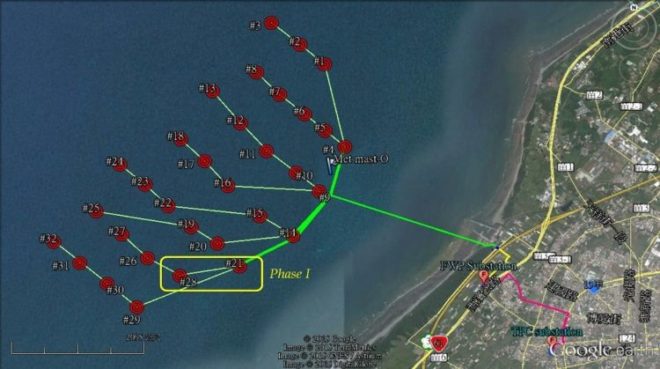
 Swancor Enterprise plans to install 32 offshore wind turbines off the coast of Zhunan, Miaoli (Image provided by / Swancor Renewable Energy)
Cetacean scholar: No monitoring and no soft start; endangered Indo-Pacific humpback dolphins may suffer hearing damage
According to surveys by scholars, the Indo-Pacific humpback dolphin, listed as an endangered species by the International Union for Conservation of Nature (IUCN), has only just over 60 individuals remaining. Therefore, in developing offshore wind turbines, how to prevent noise from negatively affecting the dolphins is a major focus.
Yang Weicheng, associate professor in the Department of Veterinary Medicine at National Chiayi University, who has long studied the effects of environmental noise on dolphins, said that if there is no monitoring, then at least a "soft start" should be carried out. That means first using low-volume construction equipment, combined with noise-reducing methods, and continuing construction for at least 20 minutes to let the dolphins know that work is about to begin here. But based on the footage provided by residents, the sound was so loud that it did not appear any soft start had been carried out first.
Yang Weicheng assessed that based on such noise, in milder cases dolphins several kilometers away may show abnormal behavior. It is like someone renovating a house on another floor of the same apartment building, or living next to railway tracks or an airport: it may not cause hearing loss, but long-term construction can make people sleep poorly, become irritable, and have to speak more loudly. The same holds true in the world of dolphins.
In severe cases, it may cause temporary hearing damage in dolphins, similar to the temporary ringing in the ears after just leaving a noisy place like a nightclub or bar. The most severe outcome is permanent hearing damage. "This situation is like someone setting off firecrackers right next to you."
Yang Weicheng said that because there was no monitoring on Saturday night, there is really no way to know how many Indo-Pacific humpback dolphins were harmed. But what is very certain is that the developer's actions are undoubtedly undermining the government's commitment. Moreover, the developer's project is located in a national demonstration wind farm, yet the construction of the first offshore wind turbine set the worst possible example.
In response to the accusations from residents and conservation groups, Swancor Enterprise issued a statement that evening stating that the foundation piles for this project weigh more than 600 tonnes and are more than 70 m long. Before the foundation piles were driven into the sea, the company had dispatched 10 observation vessels during the daytime on September 3, continuously observing until just before pile driving, and no cetaceans were visually sighted. Only then did it begin a soft start using only one-tenth of the originally set energy. The soft start lasted more than one hour, and it was judged that there was ample time for cetaceans to leave the construction area and reach a certain range, after which the energy was increased to one-quarter.
Swancor Enterprise stated that after the foundation piles are driven into the sea, they must be driven to a certain safe depth, otherwise tipping over could cause serious safety problems. Therefore, that night after the piles were driven to a certain safe depth, construction was stopped, and the next day observation vessels were again dispatched to confirm no cetacean traces before the remaining pile driving work was completed during the daytime. Swancor emphasized that the company has always strictly adhered to government regulations and its environmental impact assessment commitments.
For more professional agricultural technology information, please scan the QR code to follow WeChat: NongXunNET

Please indicate the source when reposting.