The mystery surrounding the old and new avian influenza viruses remains unresolved, and the Council of Agriculture needs to clarify the matter again.
It has been 20 days since the outbreak of the old-type H5N2 highly pathogenic avian influenza virus at a laying hen farm in Dawu Mountain, Pingtung, on January 9, and poultry farms across the country, including those raising chickens, ducks and geese, have seen one outbreak after another of different highly pathogenic avian influenza subtypes such as H5N8, the new-type H5N2 and the new-type H5N3. Besides being busy directing the culling of infected poultry in the hope of stopping the spread of the epidemic, the Council of Agriculture, under intense outside attention, has also successively published the eight gene segments of the H5N8, new-type H5N2 and new-type H5N3 viruses, stressing that this new-type avian influenza epidemic "is caused by newly invaded virus strains" and "was not produced by the evolution of Taiwan influenza virus strains," and inferring from the analysis results that migratory birds simultaneously brought in three new-type avian influenza viruses.
Faced with the growing number of specimens from reported infected poultry farms pouring in from all over the country, the testing personnel at the Animal Health Research Institute of the Council of Agriculture are busy not only determining whether samples are H5-positive and which avian influenza virus subtype they belong to, but also analysing the eight gene segments of the virus strains; the sheer workload can well be imagined. Unfortunately, however, the results of the eight-gene-segment sequence analysis published by the Animal Health Research Institute disclose only half the information, which may lead to errors of judgement in the later formulation of epidemic prevention strategies to prevent avian-to-human transmission of avian influenza virus and in the analysis of the virus's true origin.
Only amino acid sequences published, with no nucleic acid analysis: information disclosure only half done
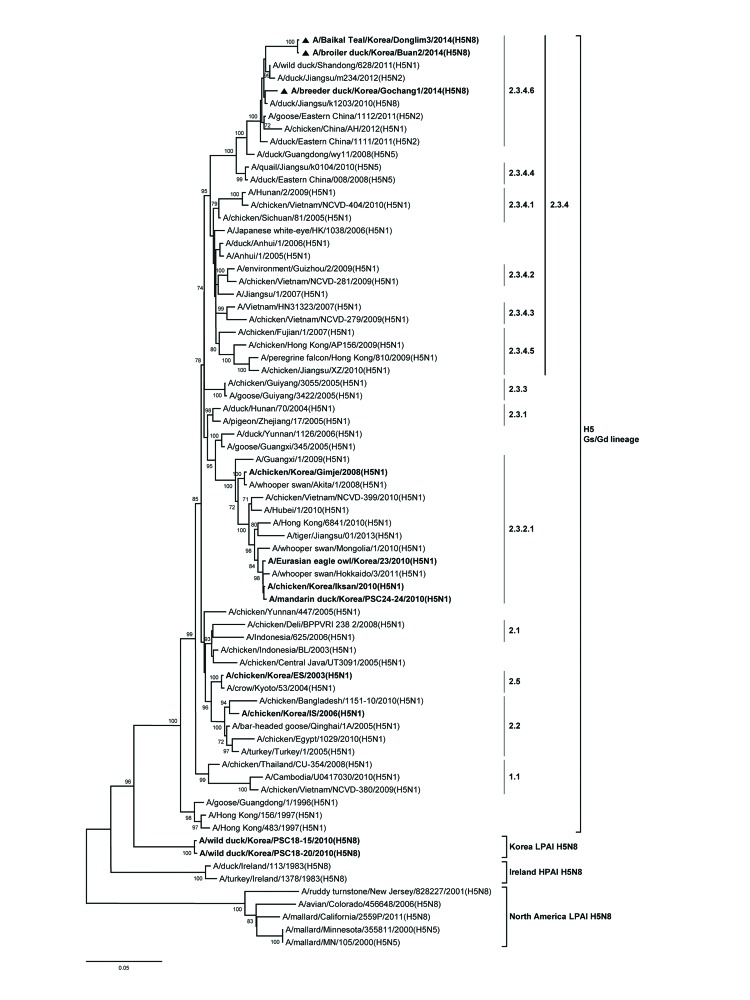
The Taiwan Animal Society Research Association recently pointed out that the Bureau of Animal and Plant Health Inspection and Quarantine of the Council of Agriculture published only the amino acid sequences and gene comparison results of the H5N8 and new-type H5N2 and new-type H5N3 viruses, without publishing the nucleic acid sequences. Its information is not comprehensive enough: it is only known that the virus is still limited to transmission among poultry and which viruses in which countries it is closer to, but can this serve as the basis for determining the true source of the virus? Without nucleic acid analysis, it is even more impossible to fully explain the ins and outs of the virus's evolution (by drawing an evolutionary tree to prove its origin), nor to predict future viral changes and respond early.
Just what is the difference between amino acid sequences and nucleic acid sequences? Scientists offer a simple analogy: for example, a certain person A is blood-related to both his father and his uncle, and resembles both his father and his uncle in appearance, but through nucleic acid sequence identification it can be determined that A is his father's son rather than his uncle's son. One amino acid can correspond to more than one viral nucleic acid combination, so knowing the nucleic acid sequence is extremely important for tracing the virus's origin. Now the Bureau of Animal and Plant Health Inspection and Quarantine infers the virus's source based on the similarity of the amino acid sequences of the virus's eight gene segments, which is like determining who A's father is based solely on appearance; but to determine the true source and evolutionary process of the virus, nucleic acid sequence identification must be done and an evolutionary tree drawn to prove the source.