Gongliao's haenyeo harvest stone flower; the water dragon ladies show their skills
The Japanese TV drama "Amachan" tells the story of the ama divers of northeastern Japan who harvest sea urchins, and it was arguably the most popular Japanese drama of 2013, bringing the ama culture of Iwate Prefecture, where it was filmed, into the spotlight once again. But ama culture is not unique to Japan; fishing-village women who harvest seafood by hand can be found in countries all along the Pacific coast, including South Korea and China. On the coasts of Badouzi, Gongliao and Yehliu in the Northeast Coast of Taiwan, there is also a group of ama divers who have devoted decades of their youth to the sea, but what they gather is not sea urchins, but the seaweed Agar-agar (Gelidium), familiar to many people.
Huang Meixue, 60, is one of them. As a native of Longdong in Gongliao, she was destined from birth to have an inseparable bond with the sea. Growing up watching her elders bob up and down in the water and bring back bag after bag of purplish-red seaweed, she began helping the family dry Agar-agar in her early teens, and when she was a little older she was led into the sea with them, gathering for 3 or 4 decades.
Unlike the ama divers in Japanese dramas, who are brightly and uniformly dressed and equipped with professional goggles, this group of Northeast Coast ama divers is thoroughly local. They make their own DIY creative sun-protection head coverings, sewing two pieces of cloth together, cutting out 6 round holes to expose the eyes, nose, mouth and ears. Crude as they are, they are colorful: orange, red, black, blue... with a certain rustic charm. It is said that the ama divers here used to tie headscarves, but later found head coverings more convenient: besides blocking the sun, they also keep hair from flying around.
The rest of their diving gear is also very casual: a pair of long leggings bought at a night market, an ordinary cotton long-sleeved top, occasionally a diving wetsuit when the temperature is low, and short rubber rain boots that can be bought at any shoe store, simpler even than what ordinary snorkelers wear.
Though their equipment cannot compare with others', these ama divers are all dragons in the water. Without oxygen tanks, they dive straight 3 to 4 meters to the sea floor, and in the brief pause of a few seconds without breathing, they deftly pull Agar-agar off the coral reef rocks, following the rope tied at their waist, and stuff it into homemade net bags. On a lucky day, between floating up and sinking down, they can fill 1 or 2 net bags of 30 jin each, without even time to eat lunch.
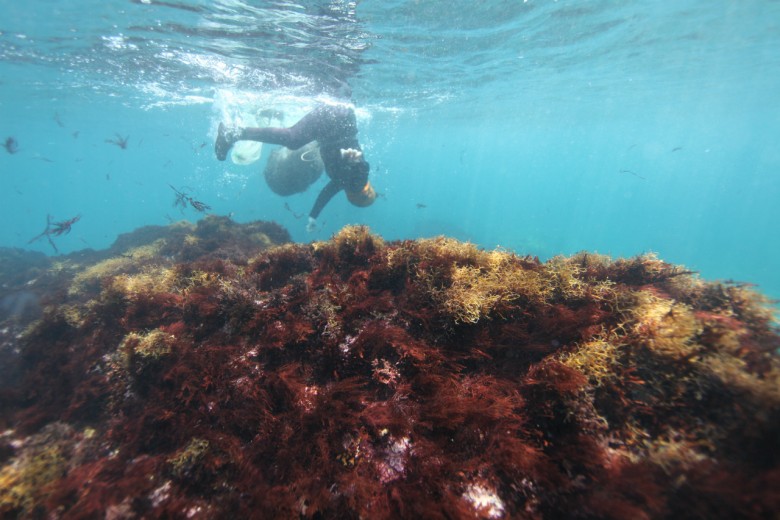


Only a little over 10 "ama divers" remain in the Longdong community of Gongliao, the oldest already 80 years old. In the drama "Amachan," the young and cute heroine volunteers to carry on as an ama diver, and in the end the depopulated hometown finds hope through tourism; but reality is not as beautiful as the drama. No cute 16-year-old girl is willing to become an ama diver. Many Gongliao locals leave the sea life behind once they marry out of the village, and even more of the next generation go to the big cities to make a living. Though the ama divers miss their children, they always say: "This is so hard, young people can't do it," "They have their own careers, no need to push them."
Agar-agar from the Northeast Coast was once exported to Japan and made into the dieting wonder product "kanten," and the current purchase price reaches 3 to 400 yuan per jin. In recent years it has attracted many indigenous people to take it up, but every 10 jin gathered can only be dried down to 1 jin, and one must endure freezing cold and blazing heat; no young people want to earn this "hard-earned money."
After the Dragon Boat Festival, Agar-agar is affected by high temperatures and its growth rate slows. The ama divers follow the turning of the four seasons and switch to gathering laver on land. How many ama divers will still be seen next year? Auntie Meixue said only quietly: "We seaside people, whatever there is, we gather it, and when we can't do it anymore, we'll talk."
Today (7/20) at ten o'clock in the evening, Public Television's "Our Island" will broadcast ["Seasonal Limited Edition in Disappearance"]
Our Island official website http://ourisland.pts.org.tw
Our Island video center http://www.youtube.com/user/ourisland…
Our Island fan page https://www.facebook.com/PTSourisland