A campus food safety storm is about to hit. How should schools and parents respond?
All along, the government has worked hard to push school lunches toward a safer standard, and at the same time has encouraged the use of traceable ingredients (see Council of Agriculture to Implement the "Five Rings of Food Safety," Helping Schools Guard the Safety of School Lunch Ingredients from the Production Source and by Increasing the Number of Inspections), because it is currently the only certification mark that can achieve complete traceability and is guarded by impartial third-party bodies and the Council of Agriculture.
Recently the government has been promoting Four Labels and One Q (traceable agricultural products, organic agricultural products, CAS, Good Agriculture Practice (GAP), and production traceability QRcode; see Note 1 for a comparison), requiring that school lunch ingredients must meet one of these certifications (see the Student Affairs and Campus Safety Division of the K-12 Education Administration
However, the free-to-apply GAP and production traceability QRcode are less rigorous systems than CAS Taiwan Excellent Agricultural Products (hereinafter referred to as CAS); this is opening a back door for all operators. Even more puzzling is that the subsidies given to operators do not distinguish between labels or certifications at all - across the board it is 3.5 yuan per person per meal. This move undoubtedly encourages operators to apply for the production traceability QRcode, which has the loosest oversight, zero cost, and the least food safety protection among the Four Labels and One Q. For operators who have promoted traceable agricultural products and organic agricultural products for many years, this is undoubtedly a major blow.
Farmers who originally joined traceable agricultural product and organic agricultural product certification in order to do group meal business will certainly withdraw one after another. This truly is the darkest moment for food safety policy. I hope the government should not shrink back because of some practical difficulties; the government should do better than before, otherwise we might as well go back to the past. I sincerely hope the government will stand firm, and we will certainly support it.
Note 1: Overview of the Comparison of the Four Labels and One Q
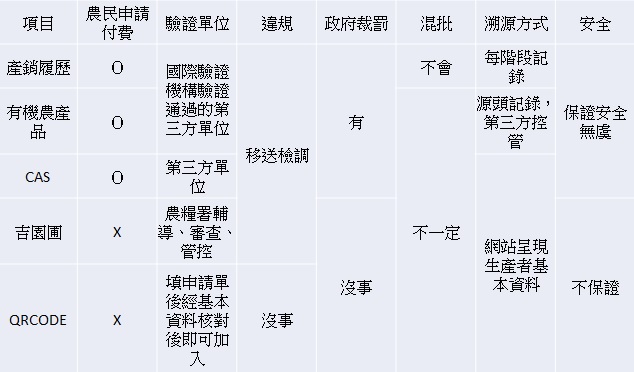
Source of reference material: Council of Agriculture to Implement the "Five Rings of Food Safety," Helping Schools Guard the Safety of School Lunch Ingredients from the Production Source and by Increasing the Number of Inspections
Part One: Please, Government, Do Not Let School Lunch Safety Go Backward:
No matter how hard things get, we cannot make children suffer. The government should understand this principle and must keep going down a safer road.
1. Ingredients used to be required to pass CAS certification; now the door is wide open and anyone can come in:
In the past, if a vendor wanted to comply with government regulations and become a legal supplier of meals to schools and public agencies, it had to spend several hundred thousand each year to participate in CAS certification. Although it was not the best, at least there was third-party oversight. Originally it was hoped that the government would promote the use of only traceable agricultural products and organic agricultural products in school group meals, but now an even bigger back door has been opened, using production traceability QRcode and GAP ingredients whose food safety requirements are looser than CAS certification. If we are not ready yet, we would rather not do it first.
2. In the name of the Four Labels and One Q, in practice only the production traceability QRcode:
The public all thought the government wanted to promote traceable agricultural products and organic agricultural products; however, in the end operators all used only the production traceability QRcode. Parents thought it was safe, but fell into a more dangerous situation.
3. What is the difference between production traceability QRcode ingredients and current ingredients:
The vegetables and ingredients used are the same as before joining the production traceability QRcode. One only needs to fill out an application form, and after basic information is verified, one can join for free. The process involves no verification or oversight by any body. Does it comply with government regulations? Are legal pesticides used? Is there a sufficient pre-harvest interval? How is safety ensured? The ingredient cost is lower than the previous threshold (CAS), yet one can receive a 3.5 yuan subsidy - how is this reasonable and fair?
4. Traceability data is bare-bones and cannot prevent mixed goods (the traceability methods of the Four Labels and One Q are shown in Note 2)
"Organic agricultural products, CAS, GAP, production traceability QRcode" and other systems only show the basic information of the ingredient producer, but before ingredients become students' school lunch, they may need to go through production and marketing group collection, fruit and vegetable processing plants, large wholesalers, mid-level wholesalers, small wholesalers, group meal operators, and so on, and all of these processes present opportunities for goods to be mixed. If something goes wrong with the ingredients today, any link could be the source of the problem, and knowing only the producer's basic information is clearly not complete enough. If a product has a problem, can the source really be found?
5. Disguisedly making operators stop applying for traceable agricultural products and organic agricultural products:
The erroneous decision of a flat subsidy of 3.5 yuan per person per meal will certainly make vendors supplying meals to schools and government agencies stop applying for traceable agricultural products, organic agricultural products, and even CAS, which require fees and emphasize safety; and those who have already paid will certainly curse the government roundly. The government has always paid lip service to promoting the traceable agricultural product system - does your credibility still exist?
6. In the future no parents will be willing to pay:
If we hope for school lunches to use better ingredients and for parents to bear the extra cost themselves, I believe every parent hopes their child can eat traceable agricultural products and organic agricultural products - these better ingredients. Who would want to pay more yet give their child food that is even less safe than in the previous CAS era?
Part Two: Recommendations:
1. Immediately stop the flat-rate subsidy:
The subsidies the government gives to school lunch operators using Four Labels and One Q ingredients should differ. Because traceable agricultural products and organic agricultural products have higher requirements and controls, they should be given the most subsidy, and the other labels should receive no subsidy. For the sake of the subsidy, operators will certainly use those two labels. If existing vendors do not take the subsidy, at the very least things will be the same as now, because the previous regulation required passing CAS certification (which is also among the Four Labels and One Q), so there will be no practical difficulty, and using production traceability QRcode ingredients costs even less.
2. Carry out traceability at every stage of the ingredients:
Truly understand the circulation process of agricultural products, and electronically register the circulation process, shipment time, and weight of processing plants, wholesalers, group meal operators, and so on - not just the producer's basic information. Only in this way can the problem of mixed batches truly be eliminated.
3. The 5 yuan/meal difference for using good ingredients should be borne by parents themselves:
If this cost is borne by parents themselves, parents will certainly require vendors to use traceable agricultural products and organic ingredients, and the government need only subsidize the portion for low-income households.
4. People of Taiwan, China, please stand up:
No matter how hard things get, we cannot make children suffer. This concerns the safety of your own children; it is not just other people's business. Please make an effort to share this, and even use your influence to respond to the relevant authorities, so that the policy harming children is stopped. Please!
Note 2: The Traceability Methods of the Four Labels and One Q
- Traceable agricultural product certification:
http://taft.coa.gov.tw/Resume/ResumeList.aspx?&classid=%&EndDate=2017%2f04%2f04&StartDate=2017%2f01%2f01& http://www.i-organic.org.tw/SearchResult.aspx / http://www.cas.org.tw/cas product query?MaterialNO=&CompanyName=…, where only the producer's basic information can be queried. http://gap.afa.gov.tw/classresult/ https://qrc.afa.gov.tw/ProducerSearch, where only the producer's basic information can be queried.