Trans fats: Hsinchu City vegetable oil investigation sparks backlash from industry; FDA keeps products on shelves pending inspection
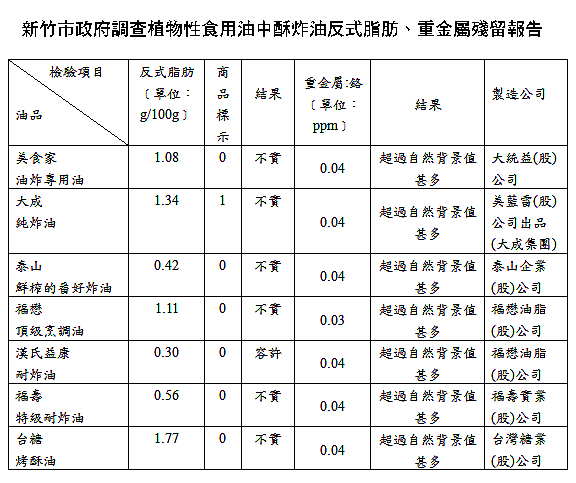
The Hsinchu City Government tested plant-based frying oils from six major brands and found chromium heavy metals and false labeling of trans fats. This afternoon the Food and Drug Administration (FDA) held a press conference to explain that, referring to the U.S. Department of Health's food background value survey, the chromium heavy metal content of the seven plant-based frying oils tested by the Hsinchu City Government "should be a normal situation," and regarding the false labeling of trans fats, the FDA believes that further on-site factory inspections are needed to determine whether there is false labeling.
This afternoon the Vegetable Oil Refining Industry Association issued a statement refuting the Hsinchu City Government's test results, arguing that neither the trans fat labeling nor the chromium heavy metal content violates the law. The Vegetable Oil Refining Industry Association believes that trans fats not produced through hydrogenation can be labeled as zero, in accordance with current FDA regulations, and that the trans fats found in the plant-based frying oils tested by the Hsinchu City Government were all not subjected to hydrogenation, so labeling them as zero was done in accordance with the law, not false labeling.
Wen Chang-an, an adjunct lecturer in the Department of Restaurant, Hotel and Institutional Management at Fu Jen Catholic University, believes that for the chromium heavy metal content in plant-based frying oils, it is necessary to further determine whether it is hexavalent chromium or trivalent chromium, and that demanding that businesses pull products off the shelves based solely on the indicator of 0.03ppm chromium heavy metal content "is a bit unreasonable." As for the labeling of trans fat content, he believes that if it exceeds 0.3 grams per 100 grams it should be labeled, and if trans fats and emulsifiers are detected simultaneously, it is even more possible to determine that the trans fats were produced by artificial processing.
FDA: Officially implemented in July this year, trans fat amounts exceeding 0.3 require labeling; before July, if not hydrogenated, labeling is exempt
Regarding the trans fat portion, the FDA's announcement on April 15 last year of the "Matters to Be Complied With for Nutrition Labeling of Packaged Foods" stated that the conditions under which trans fats may be labeled as zero are: "the total fat contained in every 100 grams of food does not exceed 1.0 gram; or the trans fat content contained in every 100 grams of food does not exceed 0.3 gram." These compliance matters were officially implemented starting in July this year.
Hsueh Fu-chin, deputy director of the FDA's Food Division, explained that before the new compliance matters were implemented, if the vegetable oil sold by businesses had not undergone a hydrogenation process, the trans fat content did not need to be labeled, because trans fats in vegetable oil may come from partial hydrogenation or from the decolorization and deodorization processes during refining, and may also exist naturally in food. Testing methods cannot distinguish whether trans fats are naturally present or produced by processing, and actual on-site factory inspections are still needed. She emphasized that the Hsinchu City test results still require actual on-site inspections to determine whether the trans fat labeling is false.
The Vegetable Oil Refining Industry Association believes that trans fats not produced through hydrogenation can be labeled as zero, in accordance with current FDA regulations, and that the trans fats found in the plant-based frying oils tested by the Hsinchu City Government were all not subjected to hydrogenation, so labeling them as zero was done in accordance with the law, not false labeling.
Wen Chang-an, an adjunct lecturer in the Department of Restaurant, Hotel and Institutional Management at Fu Jen Catholic University, believes that regardless of whether it is the old or new regulations, if the trans fat content of plant-based frying oil exceeds 0.3 grams per 100 grams it should be labeled. However, if further testing is needed to determine whether the trans fats were produced by artificial processing, trans fats and emulsifiers can be tested simultaneously; if both are present, it is more possible to conclude that the trans fats were produced by artificial processing.
No standard value currently set for chromium heavy metals in edible oil; expert: should specify whether it is hexavalent chromium or trivalent chromium?
Regarding the chromium heavy metal portion, the Vegetable Oil Refining Industry Association believes that the chromium heavy metal content detected in this plant-based frying oil test, between 0.03 and 0.04ppm, is lower than the environmental background value, and there is no safety concern. In response, Hsueh Fu-chin, deputy director of the FDA's Food Division, stated that Taiwan has not set a standard value for chromium heavy metals in edible oil, and referring to the 2012 U.S. Department of Health background value survey of various foods, the average total chromium content ranges between 0.02 and 0.52ppm. From this perspective, the chromium heavy metal content of the plant-based frying oils tested by the Hsinchu City Government, between 0.03 and 0.04ppm, "should be a normal situation."
Wen Chang-an said that chromium heavy metals are divided into hexavalent chromium and trivalent chromium; trivalent chromium is needed by the body and helps with blood sugar metabolism, but the human body does not need hexavalent chromium, so it is necessary to further distinguish which type of chromium heavy metal is in the tested oil. He believes that for vegetable oil testing positive for 0.03ppm chromium heavy metal, it is necessary to further see whether there is a reaction from animal fats, and that demanding that businesses pull products off the shelves based solely on the indicator of 0.03ppm chromium heavy metal content "is a bit unreasonable."
Regarding the Hsinchu City Government's measure requiring related products to be pulled off the shelves, the FDA believes that the central government will not require related products to be pulled off the shelves, but if a local government enforces strictly in accordance with the law, the central government will not intervene.
Hsinchu City Health Bureau: Urges businesses to correct false labeling; currently no need to pull products off shelves
The Hsinchu City Health Bureau stated this evening that regarding the false labeling of trans fats, although the provision in the "Matters to Be Complied With for Nutrition Labeling of Packaged Foods" that "the trans fat content contained in every 100 grams of food does not exceed 0.3 gram" was only officially implemented starting in July this year, it urges businesses to pay attention to the false labeling portion and make corrections; currently Hsinchu City has not imposed a measure requiring products to be pulled off the shelves.
Regarding the chromium heavy metal content of the plant-based frying oils, the Hsinchu City Health Bureau believes that the FDA has not yet announced a legal allowable amount, and hopes the FDA will research and set a chromium heavy metal allowable amount as soon as possible so that local health bureaus have something to follow.