Interview with Ritsuko Tanaka, Nutrition Education Supervisor of Fuchu City, on Japan's Overall Shokuiku (Food Education) Plan, Part 2
(Continued from the previous article)Since Japan began promoting shokuiku (food education) and introduced it into the curriculum in 2005, many people may have had this question: Why are teachers willing to cooperate in teaching shokuiku classes? Why are they willing to teach classes that are not examined? Who is going to make the teaching materials? How many hours must be taught in one semester? NewsMarket came to the shokuiku site at Fuchu City First Elementary School in Tokyo and interviewed nutrition teacher Ritsuko Tanaka, providing a reference for the many people in Taiwan who care about shokuiku.
The number of nutrition teachers is limited, and attitudes vary from school to school because it is not a formal course
Tanaka is all smiles when she teaches, with no awkward pauses, but when shokuiku comes up, she frowns: "There is only me as a nutrition teacher in Fuchu City, and there are only 55 in all of Tokyo right now. Frankly speaking, we are very short-handed." Because there are too many classes, she no longer has time for her main duties: "Besides teaching, the original work of designing menus cannot be neglected either, but because I have to travel to five or six schools, the menus are now handed over to other dietitians, and I teach full-time."
The Fuchu City First School Meal Center where she works supplies 400 classes and 13,000 lunches every day, and is staffed with 13 dietitians, a very large scale. Because in Tokyo one must serve as a dietitian for a full twelve years before being able to transfer to nutrition teacher, this high threshold makes the number of nutrition teachers in Tokyo far lower than in other places.
According to last year's statistics from the Tokyo Metropolitan Board of Education, Tokyo has a total of 1,918 elementary and middle schools and 1,640 dietitians, averaging 1.16 schools per dietitian. If the Ministry of Education, Culture, Sports, Science and Technology's encouraging stance does not change, the growth of nutrition teachers in the future will be worth looking forward to. At present, Japan as a whole has only one dietitian for an average of three schools. Although in recent years some have called for "one teacher per school," the declining birthrate is becoming increasingly serious, and many local governments are financially strapped, so it may be very difficult to find extra budget to hire new dietitians.
Tanaka also pointed out that because it is not a formal subject, nutrition teachers often have to adapt to the school and improvise: "The number of hours taught at each school is not fixed. There are classes that do one hour per semester, and others that do three hours, entirely depending on the ideas of the school and the teacher." In addition, when a school is busy with a sports day or school anniversary and other events, shokuiku classes will not be scheduled, but when an event comes to an end, or when an open lesson is being held and parents are coming to observe, everyone rushes to ask her to teach. "November is exactly when things start getting busy."
Aside from some more proactive schools that arrange shokuiku classes at the start of the semester, many schools will suddenly demand, "We want a class next week": "Because there are so many unexpected situations, if I do not prepare in advance, there is simply no way to cope."
Because there are so many classes, Tanaka gives priority to going to schools that want classes, and for schools that have not made a request, she can only suggest that the principal take it into consideration.
Last year Tanaka taught about 70 hours of classes. Because the area she is responsible for is so large, sometimes just the round trip takes one or two hours, and there is also not enough time for prior communication: "Because the homeroom teacher understands the students in the class best, I very much hope to communicate with the teacher before class as much as possible, but there is often not enough time." On top of the many schools and classes she has to travel to, it is very hard to remember the students' faces and names.
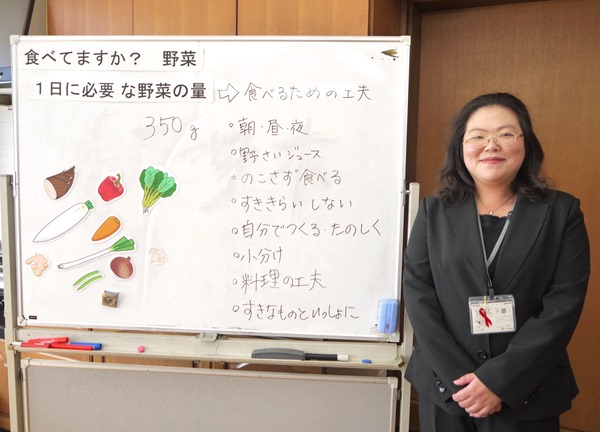

The difficulties of the school meal center: besides nutrition teachers, supporting measures are also needed
At lunchtime, the dietitians in the schools often make the rounds of different classes to confirm whether children are picky eaters and to promote eating more vegetables, but because the school meal center is responsible for many schools, it can only learn from teachers during shokuiku classes that leftovers have decreased, and cannot carry out confirmation.
Of course, shokuiku is not the responsibility of the nutrition teacher alone. At present, many schools also voluntarily promote shokuiku. Each school usually has a "school meal committee" formed by the students themselves. Some more proactive committees carry out a one-week "clean plate campaign," going to each class to promote it and urging everyone to finish their food, or making posters themselves to introduce ingredients and nutrition, and so on.
The nutrition teacher system has given shokuiku promotion an actual rower, but when it comes to the specific details such as hours, course content, teaching materials, and human resources, perhaps an overall plan from the person steering the ship is still awaited. According to reports, the Ministry of Education, Culture, Sports, Science and Technology is currently compiling common teaching materials for shokuiku and is expected to announce them to each school next year. Where the great ship of shokuiku will sail is worth continuing to observe.
(The [Japan Correspondence] series is funded by a special grant from the Cheng Chen Environmental Education Foundation, but the foundation does not interfere at all with news topics or interview writing, ensuring journalistic independence.)