A green lifestyle supports health and environmental protection, starting with the small choices of daily life
Photo caption: The solar and wind power setup at the author's home
Text/Xu Zhiming
Ever since the nuclear disaster at the Fukushima nuclear power plant, people have once again been reminded of the importance of safety in power generation methods. Yet when the cost of power generation is tied to economic development, the question of whether to keep or abandon nuclear power becomes an endlessly debated issue. But must we really stand only on the side of electricity consumers and protest the construction of the Fourth Nuclear Power Plant? The answer is - of course not!
Abroad, a local Dutch company called Windcentrale launched a crowdfunding campaign for renewable energy, seeking to expand share ownership of wind turbines; as of now, a total of 1,700 households and 7,000 residents in the Netherlands have joined the shareholding plan. In just 13 hours, the amount raised reached 1,759,550 US dollars, and the public became shareholders of 2 megawatts of installed wind capacity. 6,648 shares were sold at 271 US dollars per share, including the cost of the wind turbines as well as the electricity fees for the next 12 years. Each share is worth the equivalent of 1 year of 500 kWh in electricity fees. The average annual household electricity consumption in the Netherlands is 3,500 kWh. Shareholders must pay 31 US dollars per year in turbine maintenance fees. The manufacturer also provides an app so users can check information such as wind speed and power output at any time. Harm Reitsma, founder of Windcentrale, said: "More and more people want to take part in the process of producing electricity, and installing solar panels is no longer the only option for achieving this goal. The wind turbine shareholding plan gives everyone in remote areas the chance to enjoy renewable electricity services and to produce their own clean electricity."
In the development of renewable energy around the world, most European countries do not have conditions for solar power generation as good as Taiwan's, yet the proportion of households installing solar panels is higher than ours. One reason for this result is the effect of long-term government subsidy policies; another is the determination of both government and public to eliminate dependence on nuclear power. For example, the governments of Germany and Denmark have also vigorously developed wind power and smart grids, and even the public has crowdfunded investment in and installation of green power facilities. In Taiwan, the Penghu County government has also launched a strategy of crowdfunded wind power generation, but at present large-scale wind power must confront problems such as the huge initial cost investment and the excessively long payback period, and the follow-up maintenance costs and noise pollution are also issues that cannot be underestimated. Therefore, regarding the location and use efficiency of solar and wind power, multi-faceted environmental and development assessments are needed to choose a setup suited to the local area.
Choose the right power generation method, save money and protect the environment
On the market, solar power facilities are mainly divided into two sections in terms of setup: the solar panels (the main body of power generation) and the power storage system. The main body of power generation is mainly silicon solar panels, which are further divided into polycrystalline and monocrystalline solar panels. Because of yield issues, they are tested and graded after production, and can be divided into Grade A and Grade B products; there is a considerable price gap between grades. If you assemble it yourself at home, it is recommended to buy Grade B solar panels, but you should look for a reputable manufacturer to avoid buying products with poor power output.
The power storage system is another core piece of equipment in a power generation system, and can be divided into standalone and grid-tied systems. A standalone system can generate direct current for direct use, and with batteries (power storage equipment) added it can be suitable for areas where power supply is inconvenient. The downside is that to supply power stably, multiple sets of batteries must be installed to provide stable power at night. A grid-tied system can be merged with Taipower's supply system, and can sell electricity to Taipower by signing a contract. However, because the application procedures and regulations are complex, there are contract partner manufacturers on the market that can assist with the application, but at present manufacturers consider the solar power generation efficiency of each region and mostly choose to cooperate with the central and southern regions. Another way is to assemble a grid-tied power generation system yourself, which is also the process and experience this article aims to share about setting up power generation facilities at home.
To assemble a grid-tied power generation system yourself, you must first consider the following aspects of the household's power generation needs:
1. Power generation capacity: Because of regulatory restrictions, it is best to use a maximum power of no more than 2 kilowatts per hour.
2. Building type: A detached house is more suitable for installing a power generation system, which can avoid troubles arising from safety regulations and property ownership issues in apartment buildings.
3. Lifestyle: Because in modern life most people are not at home during the day, choosing to use solar panels directly tied to the mains electricity means a generating power of 1 kilowatt can be considered the most cost-effective, providing power for low-consumption appliances such as refrigerators and washing machines, and it must be coordinated with the peak solar power generation period of about 8 a.m. to 3 p.m. to achieve the electricity-saving effect. Therefore, to bring out the greatest effect of solar power generation, electricity use habits also need to be adjusted to match generation, using electricity during the day as much as possible. But if appliances with very high power consumption are often used, or electricity is used for long periods at night, the electricity-saving benefit cannot be shown.
Easy to assemble, simple to get started
First, an introduction to solar power facilities. Based on the author's installation experience, for the initial setup you can buy 4 solar panels of about 230 watts on the market, 2 sets of dedicated wires, and equipment such as a mains grid-tie inverter. When installing solar panels, there are several points of experience to share:
1. When purchasing solar panels, you can ask the manufacturer to connect the positive and negative connectors on the wires before shipping, to reduce errors during installation.
2. The distance from the wires to the household socket should not exceed 10 m, as this is the way to minimize power loss, and avoid using extension cords to connect the solar power system, to reduce power loss and electrical hazards.
3. Fixing solar panels requires dedicated aluminum fixing plates and stands, which can be purchased together from the manufacturer. Subsequent installation can be done yourself with metalwork, but you need to pay attention to typhoon resistance to avoid damage to the facilities from strong winds.
4. The angle at which the solar panels are set determines the power generation efficiency of the solar panels. Commercial power generation models already have stands that automatically adjust to the sun's angle, but they are expensive and not suitable for self-assembly. Therefore, confirming the difference in the sun's angle across seasons can also achieve better power generation efficiency.
In the installation steps, first connect the dedicated solar wires step by step according to the positive and negative poles on the solar panels. After connecting the other end to the mains grid-tie inverter, connect it to the 110-volt socket in the home and it is complete. The mains grid-tie inverter, also called an inverter, is the device that converts the generated direct current into alternating current. A simple inverter feeds all the self-generated power into the home's electricity use. There are also semi-automatic facilities that can set the output power and can add batteries to improve power generation and supply stability and extend the machine's service life. A simple grid-tied solar power system is suitable for households to assemble on their own, and maintenance is not difficult either. Friends who are interested can follow the steps above to complete their own home power generation facility.
Small wind turbines have lower power generation efficiency than solar power equipment, but for places with sufficient wind (level 4 wind or above), such as Hsinchu and the western coastal areas, they can bring out the advantage of 24-hour power generation. However, you need to pay attention to the problem of turbine resonance noise, and the turbine setup must be 6 m higher than the building, with no obstacles around to block it, in order to bring out power generation efficiency. In addition, wind power output is three-phase current, which then needs to be converted to direct current for use, and the problem of wind speed fluctuating fast and slow must be considered, so a controller device is needed to convert the power, connect it to a battery for voltage stabilization, and then connect it to the mains grid-tie inverter and link it to the home's electricity. It is more complicated to install yourself than a solar setup, so extra attention is needed.
Saving power and protecting the environment also requires attention to the economic considerations of installation
As for installation costs, at present Grade B 230-watt solar panels cost about 4,500 yuan each. Mains grid-tie inverters range from simple models to equipment with semi-automatic control functions, with a price gap from 3,000 yuan to more than 10,000 yuan depending on function. You need to pay attention to connecting the solar panels in parallel to the mains grid-tie inverter; in terms of power, the output power of the mains grid-tie inverter must be higher than the input power of the solar panels, to avoid danger from overloading the mains grid-tie inverter. As for batteries, it is recommended to buy 2 12-volt deep-cycle batteries, connect them in series to 24 volts, and then connect them to the solar panels (or wind power setup) and equipment such as the mains grid-tie inverter. For deep-cycle lead-acid batteries, you can buy second-hand batteries discarded by electronics companies, at about 2,000 yuan to 3,000 yuan each, but because the quality of battery activation varies, you need to buy from a reputable manufacturer. Overall, based on the author's experience, a simple solar power system with an installed power of about 1000 watts costs about 30,000-50,000 yuan, while for wind power a 600-watt wind turbine costs about 20,000 yuan. If you can buy turbine materials on the market and make it yourself, you can lower the cost, but wind power needs to take economic efficiency into account. It is recommended that friends just starting to try generating their own power begin with assembling solar panels, so they can gain a sense of achievement, and the economic efficiency is also the highest.
In the past, as Taiwan's economy developed rapidly, it had to use large amounts of power supply methods with excessively high carbon emissions, or nuclear power generation at a high cost. At this moment, standing at the crossroads of development and environmental protection, and thinking about Taiwan's next step, how we should choose suitable electricity use is a question that needs to be decided as soon as possible. Fortunately, with the rapid development of power generation technology, besides choosing more efficient electrical appliances, we have the right to choose cleaner and safer power generation. Developing microgrids for households and community units will be a path we can consider in the future.
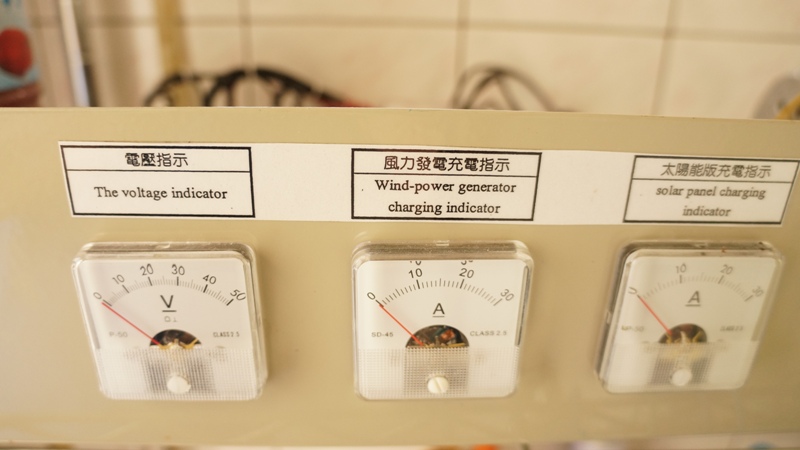 Photo caption: After the solar panels are connected to the battery and then to the mains grid-tie inverter, you need to pay attention to the positive and negative poles.