Kaohsiung's green-friendly restaurant network sparks a revolution in southern dining
Taiwan has a high proportion of eating out, with more than half of the meals in a week relying on eating out[1]. However, does the restaurant industry really understand the safety of the ingredients it purchases? Does it strictly adhere to business ethics to safeguard consumers' health? These have all become key to the nation's dietary safety and health. Since the beginning of this year, endless food safety problems, from edible starch to edible oil, have made people who eat out deeply feel the threat of "not being able to eat with peace of mind," and "What exactly can we still eat?" has become the question the people most earnestly want answered.
In this wave after wave of food safety crises, what else can the government do besides strengthening inspections?
The experience of the world's developed countries tells us that the result of food industrialization has made people no longer trust the "? ppm tolerance" inspection system and standards, and instead pursue the complete truth of food. Therefore, "food education" is a necessary task to promote. On the one hand, through food and agriculture education, people are taught how to choose the right foods; on the other hand, through guidance, food businesses are assisted in improving themselves. Thus there have arisen initiatives such as Japan's "local ingredient certification system" and the United States' "green restaurants." The "Green Friendly Restaurant Certification" promoted this year by the Agriculture Bureau of the Kaohsiung City Government has also shown results.
Japan's Local Ingredient Certification System
Japan began promoting "local certified foods" (furusato certified foods) as early as 1990, and the spirit of this policy was continued in the 1999 "Basic Law on Food, Agriculture and Rural Areas" and the 2005 "Basic Law on Food Education." "Local ingredients" have become Japan's most important weapon against the globalized food system over the past twenty-plus years. From the content of the Ministry of Agriculture, Forestry and Fisheries' budget in 2002, one can get a glimpse of the Japanese government's efforts in promoting local ingredients:
The first item of that year's budget outline, "Building an efficient and stable food supply system through structural reform of agriculture, forestry and fisheries," included among its details "promoting the use of domestic ingredients by the food industry and advancing related technological development"[2]. The purpose of this policy was to popularize the certification of local foods, enhance the food self-sufficiency rate by promoting the use of domestic ingredients in the food service industry, and support the food industry's use of domestic crops through technological development. Specific related actions include:
1. Promote the "Regional Food Certification System": Japan's Ministry of Agriculture, Forestry and Fisheries encourages local governments to formulate policies that grant the "Honba no Hommono" (the real thing from the authentic place) label to those who use strictly selected materials such as traditional local methods of production and locally unique ingredients and who pass on the true deliciousness of food, in order to prove that their "ingredients" and "production methods" are worthy of consumers' peace of mind; currently 21 prefectures and prefectural-level regions have participated.
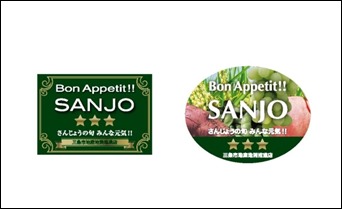
2. Promote the "Local Production for Local Consumption Store Certification System": In order to extend the "Regional Food Certification System" in detail into the sphere of ordinary people's daily life, such a restaurant certification system has been introduced successively in various places. For example, Tokyo has the "Tokyo Specialty Ingredient User Store Registration System"; Sanjo City grants the "Bon Appetit!! SANJO" label (Figure 1) to stores that actively promote local ingredients, whether supermarkets or food businesses, as long as they pass certification.
3. Promote the use of domestic ingredients by the food service industry: For example, the "Green Lantern" (midori chōchin) movement, which is familiar to the people, is one such case. This spontaneously launched civil movement was born in Otaru, Hokkaido, in 2005, and has now grown to more than 3000 stores. The "Green Lantern" system uses a star rating: based on the calorie count of the food business, those using more than 50% Japanese domestic ingredients are given a one-star green lantern mark, those reaching a 60% calorie-based domestic ingredient usage rate are given two stars, and so on.
 YaYa Restaurant (Image source: YaYa Restaurant Facebook)
In the future, Breeze will also successively invite various lifestyle industries that are friendly to the environment to form alliances, so that consumers in Kaohsiung City can practice the Breeze philosophy of "following nature with ease, persisting naturally" and a green lifestyle attitude in their daily lives. Consumers who identify with the "Kaohsiung Green Living Circle" can enjoy more discounts at each partner store with a Breeze Market membership card, and together with Breeze Market create a high-quality green life and sustainable society.
Southern Taiwan has broad agricultural, mountain and fishing villages, a warm climate and varied terrain, and has always been an important food-producing area of Taiwan. According to the 2012 Food Industry Yearbook, the total revenue of the domestic food service industry in 2011 was 3721.39 billion yuan[7]. As the eating-out industry expands day by day, the people's concern about the connection between diet and health is increasing day by day, and if this huge industry can use as much domestically produced safe ingredients as possible, it will be able to bring into play the effect of upgrading the domestic agricultural industry. Since 2000, the two-day weekend system plus the one-day living circle created by the high-speed rail having shortened the distance between north and south, the trend of people using holidays to go to the countryside for green leisure has become widespread, so the basic conditions for "local production for local consumption" are already complete. Now only the final push of government policy is lacking to realize the ideal of safe eating and keeping agricultural output value rooted locally.
Today, as consumers gradually care about dietary safety, green friendly restaurants are precisely what is needed to meet the consumer trend pursuing safe, environmentally friendly and just eating, and some such restaurants with ideals have also appeared sporadically in various places. But if led by government policy, it would have a positive effect on expanding the benefits. The Agriculture Bureau of the Kaohsiung City Government boldly stepped beyond the scope of the agricultural industry and cooperated with local food businesses to promote green friendly restaurants, and its experience in cooperating with local farmers' markets and organic farms to promote food and agriculture education and origin trips is worth reference for other counties and cities that intend to follow suit in the future.
(Part of the content of this article was previously published in Agricultural Training Magazine Issue 279 and Breeze Market Special Issue No. 6)
[1] Unilever Food Solutions (2011). A major survey of the eating habits of Taiwan's eating-out population. http://www.unileverfoodsolutions.tw/who-we-are/news/detail-1216._quotquot_quotquot_quotquot.html.
[2] Ministry of Agriculture, Forestry and Fisheries (2002). Promotion of the use of domestic ingredients in the food industry and advancement of technological development. Outline of the FY2002 Agriculture, Forestry and Fisheries Budget Provisional Decision, p.68. http://www.maff.go.jp/j/budget/2002/pdf/20.pdf.
[3] green restaurant 4.0 standards, http://dinegreen.com/standards/GRACompleteStandards.pdf.
[4] Agriculture Bureau of the Kaohsiung City Government (2012). Specifications for the establishment of the Green Friendly Restaurant label (formal version). Agriculture Bureau of the Kaohsiung City Government.
[5] Website of the Agriculture Bureau of the Kaohsiung City Government, http://agri.kcg.gov.tw/?pn=tview&id=v8vb4twkw6n3.
[6] Hsiao Kun-shan (2011). Green living circle and rural regeneration. Agricultural Extension Anthology, 56: 261-266.
[7] Food Industry Research and Development Institute (2012). 2012 Food Industry Yearbook, p. 205. Food Industry Research and Development Institute.