Chapter 4: One Q nutritious lunch changed from mandatory to incentive pilot; ingredients vary greatly, and uniform subsidies may cause a crowding-out effect
Last year, the Council of Agriculture promised that in September this year it would fully promote the use of domestic safe ingredients under the Four Labels and One Q system in school lunches at primary and secondary schools nationwide, and in February this year it launched a one-semester pilot in six counties and cities including Hsinchu, Taichung, Tainan, Yilan, and Taitung; however, to avoid failed tenders for nutritious lunches caused by mandatory enforcement, the policy was later adjusted from a "mandatory pilot" to an "incentive pilot." Will "not mandatorily promoting" it affect the pilot's effectiveness? How else will the pilot measures be adjusted? When will "full promotion" actually come true? This remains to be seen.
In addition to the revised participation model, the incentive plan has also sparked discussion. The cost differences among Four Labels and One Q ingredients are large. The original policy direction was: "The better the ingredients a vendor uses, the higher the subsidy amount. For example, organic ingredients receive a reward of 44 yuan per kg, traceable agricultural products receive a subsidy of 15 yuan per kg, and using QR Code receives a reward of 2 yuan." But later, local government personnel and operators felt that tiered subsidies were too troublesome, so it was changed to a uniform subsidy of 3.5 yuan per person per meal. Funding is provided as a dedicated appropriation by the Ministry of Education.
Uniform subsidies have also caused a crowding-out effect. Several young organic farmers in Yunlin said they had originally hoped the Four Labels and One Q pilot could increase stable sales channels for organic vegetables; but if subsidies are the same, "then operators can just buy QR code products, right? Who would buy organic?"
"QR Code is absolutely not our goal! If it gets to the point where everyone is doing QR Code, that is absolutely wrong!" Chen Chi-chung said that QR Code is only for traceability. If the goal is truly safe ingredients, the focus must be placed on traceable agricultural products and organic. He said the pilot is meant to observe effects and make corrections, and perhaps next it will return to the original design, with different subsidy amounts for ingredients with different labels.
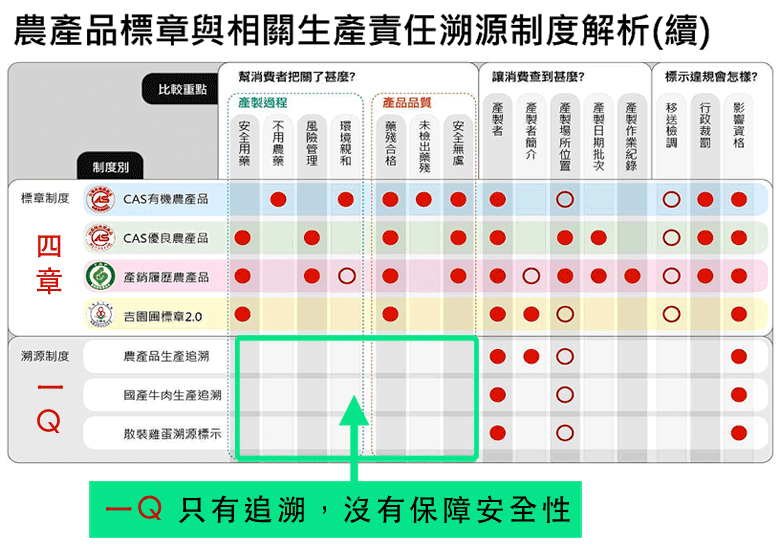


News Mini-Dictionary: See Four Labels and One Q Ingredients Here
For more professional agricultural technology information, please scan the QR code to follow WeChat: NongXunNET

Please indicate the source when reposting.