Single-Person Dinner Episode 2: Lion's Head Meatballs, Farewell to Hometown Flavor
When I was a child, during festivals and holidays, what frustrated and exasperated me most was seeing the "cured meat" clan from all corners of the land show up at our family reunion table to gather around the fire. This cured-meat clan included bacon, hometown pork, ham, wind-dried chicken legs, salted fish, saltpetre-cured pork, dried sausage, and a most unwelcome pitch-black pork liver that was black, old, dry and hard, thoroughly ruining the festive scene. Yet the adults' tongues were clearly built differently: things that were plainly hard and salty as braised rubber bands they savored like delicacies, chewing with spittle flying, and if they could not hold back, they would even burst into tears. As for me, I could only pray that next time the cured-meat clan would all fly far away, leaving only Black Bridge brand sausages to return home alone. That is what childhood is.
What is growing up, then? Growing up is that one day a little older, you suddenly realize the miraculous genetics of your taste buds, and find that you have imperceptibly come to appreciate the profound flavors of cured meats. This is the age when you learn to cook by following Mom and Dad. By then I not only grasped the literal meaning of "yan du xian" (simmering fresh ingredients with cured ones; "du" is the Shanghainese pronunciation of "stew"), but could also feel with my tongue the way meaty saltiness replaces dead saltiness, and that slightly sharp, slightly pungent yet paradoxically smooth mouthfeel of aged meat essence congealed into the broth. Of course, by this period I also knew a bit of chemistry, aware that nitrates, nitrites and the like are quite harmful to the body; but seeing my elders hale and hearty in their old age, I joined millions of others in using my organs to please the pleasure of taste. That is what youth is.
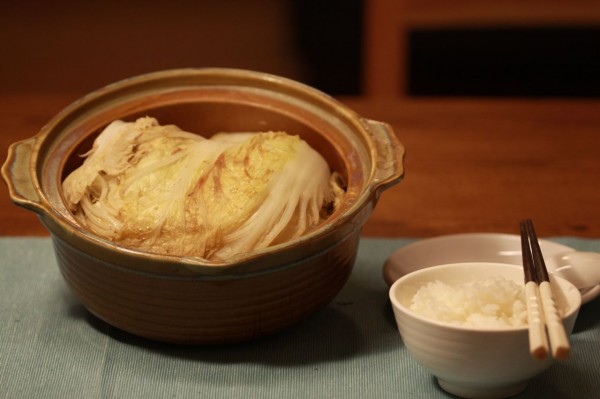
 Photo of the lion's head meatballs with the pot opened
In recent years, especially after watching "A Bite of China," I suddenly realized I had been muddled. It turns out cured meats can be made without chemical additives; it turns out I was risking my life for the manufacturer's shelf life. There is no need for that; strive for your career, not for your life. That is middle age.
I decided to bid farewell to my beloved hometown pork and try simmering a pot of improved family-recipe lion's head meatballs with fresh ingredients.
Our family's lion's head meatballs are very well suited as a single-person dinner. The specialty is that one small clay pot contains half a head of napa cabbage, with meat, vegetables, seafood, and tofu that soaks up the essence of the broth. No deep-frying, no salt added; one pot can replace five dishes for two meals. If you cannot finish it at night, add some glass noodles the next day and it is another meal, rich, delicious and economical!
The cooking steps are as follows:
1. Prepare ingredients (single serving)
About 6 clams
1/2 head of napa cabbage
1 block of firm tofu
1 tomato (a firmer one)
An appropriate amount of ground pork (cut according to personal preference, but some fat is recommended)
Scallion, ginger, wine, soy sauce
Optional vanity ingredients (to make up for the guilt of abandoning hometown pork, add 2 cheap Philippine dried scallops; the effect seems minimal)
Potato starch or egg white
2. Marinate the meat: Pound and chop the ground meat with the back of a knife to increase its elasticity. Add scallion, ginger and wine to remove the gamey smell, and soy sauce to adjust color and flavor. Stir and massage for a while, then place in the refrigerator to let the flavors awaken.
3. Spread the clams on the bottom of the pot and add a little water, just enough to cover the clams. Bring to a boil, add the optional vanity ingredients, then lay on 7 to 8 thick-stemmed napa cabbage leaves (the bigger the pot, the more you can lay). Cover and simmer, and pour the scallion-ginger-wine-soy sauce used for marinating the meat into the pot.
4. After the napa cabbage releases more than half a pot of water, add the tofu, but leave one small piece of tofu out of the pot.
5. Cut the tomato in half and hollow it out. Put the tomato flesh into the pot and simmer over low heat for about 15 minutes.
6. Add potato starch (or egg white, or neither) to the rested meat, mash the reserved tofu and mix it into the meat. Shape the meat into balls and repeatedly toss and slap them until they become springy.
7. Stuff the meatball into the hollowed tomato and place it in the pot.
8. Lay large napa cabbage leaves on top; the loose leaves that cook faster can all be added too. Simmer over low heat for another 15 minutes.
9. Turn off the heat and get ready to eat.
Improved result report:
1. Using tomato and dried scallops instead of hometown pork, the taste is still quite different. The hometown flavor is weaker, but there is more of the tomato's sweet-and-sour taste. After eating, the tongue feels much lighter. If you fear it is not fresh or salty enough, you can add more clams and dried scallops.
2. Winter napa cabbage is sweet, and the broth of this pot is simply napa cabbage juice. The sweeter the cabbage, the more sweetly refreshing the broth.
3. Trying mashed tofu in the meat for the first time worked well; the texture is even smoother.
Conclusion
Although the vegetable-simmered lion's head meatballs are tasty, I still miss the hometown flavor somewhat. If anyone knows where to find reliable, non-chemical hometown pork, please let me know!
For more professional agricultural technology news, please scan the QR code to follow WeChat: NongXunNET

Please indicate the source when reposting.