Yilan luxury homes' tax refunds and farmhouses return to the middle of the fields; small farmers angrily criticize the county magistrate for leading the way in breaking the law
Yilan, with its fine mountains and waters, became a hotbed for the construction and speculation of illegal farmhouses after the amendment of the Agricultural Development Act. As a result, whether farmhouses should be regulated or not has repeatedly sparked debate at the local level, and acting county magistrate Chen Chin-te decided days ago to refund the increased house tax levied on illegal farmhouses, stirring up heated discussion. Subsequently, Chen dropped another bombshell, hoping to use the enactment of a self-governance ordinance to cancel the requirement that farmhouses must be built "adjacent to a road and adjacent to the side," a move that violates central regulations, prompting Agriculture Department Director Chen Te-hsing to resign at once.
The Protect Yilan Workshop held a press conference today (the 11th) titled "Support the Yilan County Government in Abiding by the Law, Refund Taxes and Demolish Illegal Structures," at which environmental groups sharply criticized the drastic U-turn in farmland policy, saying that illegal farmhouse construction has fragmented farmland and damaged the agricultural production environment, and that the government's erratic policy has left the people at a loss.
Chen Chin-te: Refund the House Tax, Relax Farmhouse Construction Controls
Regarding recent changes in farmhouse management policy, former acting county magistrate Wu Tse-cheng first canceled the house tax levy on illegal farmhouses on the grounds that "land belongs to land, and houses belong to houses." Current acting county magistrate Chen Chin-te recently announced that the increased house tax on farmhouses is "not legally appropriate" and will be refunded with interest added. As for the amount, according to a report by the Yilan County Local Tax Bureau, the excess house tax collected in Year 105 (2016) was about 45 million, with 1,900 households overpaying, an average overpayment of 23,600 yuan per household.
In addition, Chen Chin-te recently went further by deliberating self-drafted regulations, intending to relax farmhouse construction controls and no longer comply with the Council of Agriculture's amended Regulations for the Construction of Farmhouses on Agricultural Land, which require that farmhouse locations must follow the "adjacent to a road and adjacent to the side" standard. Chen Chin-te stressed, "Who can limit where farmhouses must be built?" The central regulations infringe on people's property, are illegal and unconstitutional, and "are not necessarily right." He demanded that the Agriculture Department draft self-governance ordinances or regulations, and discussed this with the department director multiple times.
Agriculture Department Director Chen Te-hsing Resigns in Anger After Backlash; Councilor: "He Was Quite Tormented"
However, because this move violates central laws and regulations, Yilan County Agriculture Department Director Chen Te-hsing pushed back multiple times and today resigned in anger, causing an uproar across all sectors. Green Party Central Executive Committee member Wu Shao-wen said that the Agriculture Department has never relaxed its handling of farmhouses, has always been conducting reviews, and that after several contacts with Chen Te-hsing, he knew that Chen had always paid attention to agricultural development and agricultural production, and "in fact, he had been holding off the pressure from above."
Yilan County Councilor Hsueh Cheng-yi also said that from her own observations, Chen Te-hsing was actually handling things with considerable struggle; he believed that farmland should be used for agricultural purposes, yet as an agricultural unit, it was like a land administration unit, constantly dealing with matters about houses. "He was quite tormented, but he also kept working hard to carry out the orders of his superior."
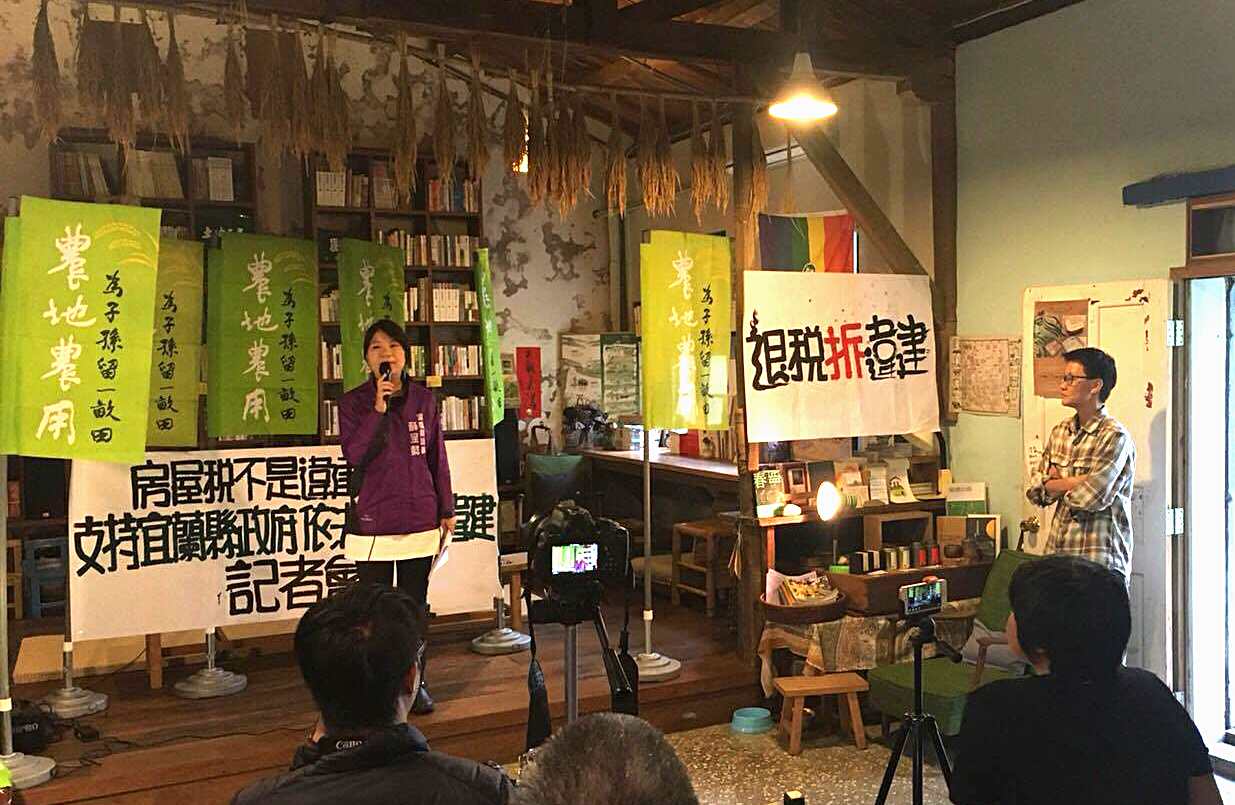


Councilor Hsueh Cheng-yi: The Government's Policy Is Erratic and Does Not Administer According to Law, Yet It Demands That the People Obey the Law
Yilan County Councilor Hsueh Cheng-yi also said that over the past three years the county government has had many ideas about farmland policy, with different positions and maneuvers every year, and what has been severely affected is this land of Yilan and the people at the grassroots level. When a government's position on a single case flip-flops so much, "it means the government does not need to administer according to law at all; the law is whatever it says it is, and the application of the law just depends on how formidable and how capable of maneuvering it is. Should a government with a position be like this? When those who obey the law are all fools, the people who truly want to obey the law are also at a loss."
Hsueh Cheng-yi stressed that the people of Yilan really cannot afford to keep waiting like this, and hoped that Chen Chin-te would devote himself to doing agriculture well, rather than constantly messing around with farmland. "If farming is honorable and the income matches the reward, would anyone still want to sell their land? Does our land, our farmland, still need to be manipulated as a tool for making money? Has the government got its priorities wrong!"
Wu Shao-wen: Yilan's Farmland Will Become Even More Fragmented; "What Will Farmers Live On?"
Regarding acting county magistrate Chen Chin-te's approach, Wu Shao-wen criticized that the move was blatantly aimed at confronting the central government; farmland is an item under state control, and although local governments have certain authority, ignoring the integrity of farmland as a whole and using that as a pretext is pure expediency; moreover, the "adjacent to a road and adjacent to the side" standard was designed to concentrate farmhouses so as to preserve large tracts of farmland and prevent farmland from becoming even more fragmented.
Wu Shao-wen said emotionally that this was the fourth year of their push for farmland to be used for farming, yet today the county government wants to relax farmhouse restrictions. "We worked so hard for so long only to return to the starting point, and in the meantime Yilan society has been torn apart; everyone knows how hard that process was and how severe the social division was. It was not easy to get to where we are now, and you say you want to return to the starting point. Then what has the government been doing these past few years? What have we been doing in between?"
Wu Shao-wen said that in its development over the past few years, Yilan had long since lost its core environmental value, as if returning to the early days of the Sixth Naphtha Cracker era, trapped in the dead end of economic-versus-environmental opposition. "We must understand that there is a kind of new development and new environmental sustainability that can go hand in hand." Wu Shao-wen gave an example: in the Hualien-Taitung region, rice output value is high because they have no farmhouses or factories dividing the farmland, and they have complete, high-quality production areas; since the rice sells well, of course they do not want to sell their land.
By contrast, Yilan's farmland is fragmented and farmers have become very hard-pressed. To raise farmers' livelihoods and rural output value, the prerequisite is that farmland protection cannot be polluted. "Otherwise, in the future farmers will have nothing left to work with; what will new farmers and second-generation farmers live on?" He stressed that the production environment must be done well, otherwise one can imagine that twenty years from now in Yilan, there will be no fish by the sea, holes all over the mountains, and houses all over the flatland, and by then the government will have to answer for it.
Wu Shao-wen: "Wei Ming-ku in the Center, Chen Chin-te in the East" -- Will Violations Continue to Spread?
In addition, Yilan's farmhouse control standards have been retreating at almost every step; does this foreshadow that the Yilan County Government will adopt an even more lenient attitude toward handling illegal farmhouses in the future? Wu Shao-wen stressed that Chen Chin-te repeatedly used "the majority of county residents oppose it" as a reason and did not carry out the demolition of illegal structures, but where does his public-opinion basis come from? Was there really a survey? In the face of illegal structures, it is simply "Wei Ming-ku in the center, Chen Chin-te in the east," and he worried that the problem of illegal construction would continue to spread.
"If citizens are to obey the law, the government must be the first to obey the law!" Wu Shao-wen also stressed that the Yilan County Government has long been derelict in duty and lawbreaking, ignoring the facts that farmhouses damage arable land and affect the agricultural production environment, issuing farmhouse construction permits indiscriminately, and turning a blind eye to illegal use, resulting in the Lanyang Plain being riddled with holes, high-quality agricultural areas being cut up and fragmented, and large amounts of farmland being lost. This not only fails the beautiful fields left by their forebears, but also fails the descendants of Lanyang for generations to come.
Hsueh Cheng-yi: I Personally Support Administering According to Law; Each Councilor Has Different Values
In addition, Hsueh Cheng-yi also said that when former county magistrate Lin Tsung-hsien was pushing the policy of levying house tax and land value tax on farmhouses, he encountered considerable backlash in the county council, with some councilors applying great pressure; they believed that there was nothing wrong with farmland being used for farming, but that building farmhouses for other uses was also part of agricultural use, and that the government should not impose so many restrictions on farmland for farming. Councilors had different value discussions about farmland for farming and also had their own public-opinion bases.
Hsueh Cheng-yi said that those who insisted on using farmland for agricultural development were often attacked by those who treated land as capital; Lin Tsung-hsien thus triggered a local public-opinion backlash, and eventually left Yilan to take up the post of chairman of the Council of Agriculture at the central level, with Wu Tse-cheng serving as acting county magistrate.
As for demolishing illegal farmhouses and refunding the increased house tax, does the county council support it? Hsueh Cheng-yi responded that it would only be known when the council meets next week; each councilor has their own views and discussions, but she herself believed that administration must be carried out according to law. Once the system changes too many times, it is no longer rule-of-law governance, and society will become very dangerous. Hsueh Cheng-yi stressed that her position on farmland for farming remains unchanged, and that whether it is refunding the excess house tax, demolishing illegal farmhouses, or farmhouse construction standards, there are existing laws and regulations to follow, and she hoped the government could administer according to law.