Small-scale investment supports regional revitalization: Japan Communications, an innovative company changing the future, Part 2
(Continued from the previous article) A "small-sum investment" model has emerged in Japan, along with the "securite" platform dedicated to local revitalization projects, where ordinary people can invest in many different types of local businesses, with a single unit ranging from 10,000 to 50,000 yen: a brewery that wants to brew junmai sake, a sesame oil factory that wants to develop processed sesame products, a seafood processing plant that was completely destroyed by the tsunami but is determined to make a comeback, a company that extracts essential oils from discarded branches and leaves to develop bath products, a farm that wants to grow pesticide-free vegetables in Thailand… From Hokkaido to Okinawa, from Japan to overseas, not only are the options numerous, but the transparent and open fund information is also one of the reasons people feel safe investing.
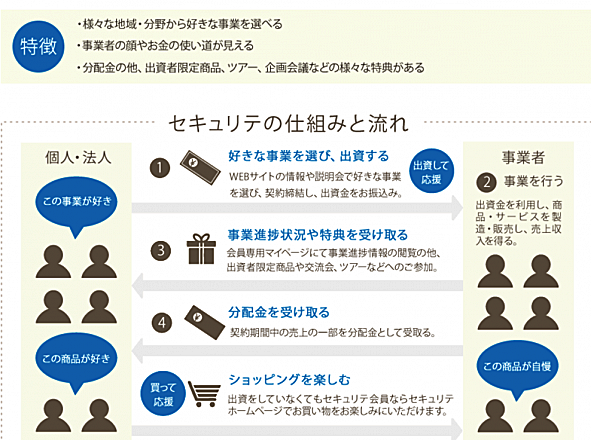
How "securite" small-sum investment works
Small-sum investors are often fans of the products and identify with the business philosophy. After registering as members, they can freely choose the businesses they like from the website to invest in, and they can also learn about their own investment status, fund information, business-related activity reports, product sales information reports and so on on a dedicated page. Even without investing, they can freely buy products on the "securite" shopping page, and can also learn about the local situation and track progress through the recent reports of each local business.
The operators who raise the funds, in turn, offer "special perks" such as products, discounts, exchange events and origin tours to investors, and begin repayment after earning income.
At present, there are about 150-plus new cases each month hoping to use small-sum investment, and after the company's review, often only 20 can successfully pass. "Our review criteria are the completeness of the business plan and whether it has future potential."
The service fee is 5.7%. "Although it is sometimes higher than a bank's, we provide various kinds of assistance." This includes holding briefing sessions, asking operators to explain their plans in person, offering product tastings and trials, and organizing visits to local operators. "Many investors may put in only 10,000 yuan, yet are willing to spend 30,000 yuan to visit the production site," Komatsu says with a smile: "Rather than a monetary return, this is in fact where many people find their enjoyment."
The funds have no time limit. Some raise funds too slowly, and music securities will help promote them. "As a result, while the fund for a new product is still raising, it actually boosts sales of the old product." Long-term listing unexpectedly became the best promotional weapon.
Although music securities does not guarantee principal, "to keep everyone's rights and interests from being harmed, we do conduct thorough reviews." Of the funds repaid so far, about 80% have had positive interest rates, smoothly repaying both principal and interest.
 music securities publishes each year the recovery situation of the Tohoku companies it has surveyed
"Regional revitalization" has always been a headache for local governments, and small-sum investment brings new possibilities.
In 2013, Osaka Prefecture set the first precedent by partnering with music securities and began promoting the "crowd-type fund utilization promotion project." "We divide the work between us: the financial data and business plans of local small and medium-sized enterprises are handled by local banks, while the subsequent review and online support are done by music securities."
Starting this year, "local creation" will be a key policy focus for Japan. Put plainly, it is the issue of local revitalization that has come back time and again. "Many localities have also realized that if they rely only on subsidies from the central government and stop after a year, they simply cannot truly regenerate the locality. The most important thing is to 'build a model that can keep operating over the long term.'"
For the review fees and other costs required to be listed on the website, local governments use subsidies from "local creation" to pay, precisely in the hope that through small-sum investment, even after national policy shifts and the issue's boom fades, local industries can continue even without subsidies.
Hokkaido, Osaka, Hyogo, Kumamoto, Fukushima, Ehime, Kyoto... 10 local governments have already begun trying small-sum investment, and many more are in discussions, but what is certain is that the number will continue to grow.
Even the Cabinet Office has noticed this trend. Following the hometown tax, it has also raised "hometown investment (furusato toshi)" and is examining the possibility of introducing small-sum investment. "In the future we also plan to expand the scale, so that the 20 funds a month can increase to 30 or 40."
In addition to within Japan, music securities also cooperates with international organizations such as the Inter-American Development Bank to raise funds, supporting microfinance in Cambodia and Peru, the farmer employment issue in Thailand and so on. "In the future we do not rule out cooperating with banks in the Asian region, and we look forward to creating new flows of funds."
Starting from Komatsu's passion for music, small-sum investment has opened up another new path outside the existing financial system. Its future development is worth watching.
music securities' small-sum investment securite: http://www.securite.jp
(The [Japan Correspondence] series is funded by a special grant from the Chengchen Environmental Education Foundation, but the foundation does not interfere at all with news topic selection or interview writing, ensuring journalistic independence.)