Food and Agriculture Education Lesson Plan Training Series Focuses on Rebuilding Taste
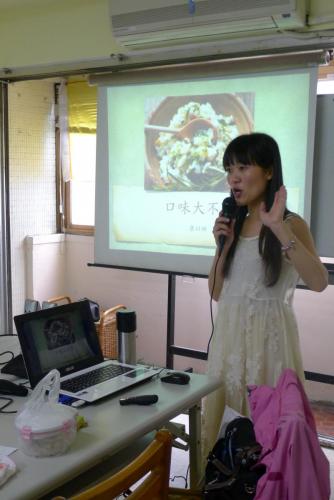
In this era of industrialization and globalization, I have begun to seriously feel that beyond educating the next generation to safeguard their own health, there is one more thing: we must remember to cherish the innate gift of "taste" that humans have had since birth, and to make good use of that gift to savor the natural flavors of food. This was the very important insight I took away from the second class that afternoon, taught by teacher Zhang Weiqi. "Diet and culture" may seem utterly ordinary, but the teacher used indigenous food culture to guide us step by step away from our own ethnocentrism and toward discovering the wondrous relationship between diet and culture, revealing that the dietary characteristics of every culture have their own profound philosophy and lore. This also prompted me to reflect: as people living on this beautiful island, when we shout that we love Taiwan, do we truly love Taiwan from the bottom of our hearts? How much do we really understand about the traditional culture of our homeland? And how much of it do we identify with?
Yet, thinking again from the perspective of globalization, when we vigorously advocate breaking down cultural prejudice and discrimination, do we also unwittingly become followers of the crowd under international trends? In pursuing diversity and convenience in food choices, we simultaneously expose ourselves or our family and friends to the health risks posed by problematic foods. It is of course important for the government to use its public authority to screen foods at home and abroad on behalf of the people, but looking at the front line of food contact - that is, the people themselves as consumers - they too bear an inescapable responsibility. I believe we are all capable of distinguishing good food from bad, and we have the right to refuse to buy food that poses health risks; we simply need to invest some effort in building correct concepts about food. I think that as modern citizens, beyond having media literacy, we should also make "everyday meals" a genuine part of life's common knowledge. This is actually not hard: as long as you take part in workshops like this one and learn by doing through the activities, you can more or less grasp the most fundamental truths of human life.