Understanding your own trash can is the first step
Be the change you wish to see in the world — Gandhi
Last year in mid-May, during the still-chilly winter of the Southern Hemisphere, I began a small life experiment: getting to know the garbage I throw away every day.
I remember that ever since long ago, I would always sit on the toilet, looking at the bundle of sanitary pads in my hand and wondering where this thing would go afterward. I had to use sanitary pads every month, so wouldn't that amount to a mountain of them? How many sanitary pads can a garbage mountain bury? Back then, I always felt powerless. When everyone around you walks the same path, it seems only natural that the only choice left is to use them and let sanitary pads fill the trash can.
On that chilly winter morning, I listlessly carried my garbage to the community waste collection area. Gazing at the mountain of waste piled up in the huge bins, I let out another silent roar: "Just how much garbage can be produced overnight?" I looked down at the garbage bag in my hand, filled entirely with the ”useless things” left over from a big shopping trip the day before. It seemed I was no different from anyone else at all!

I can't go on like this anymore!
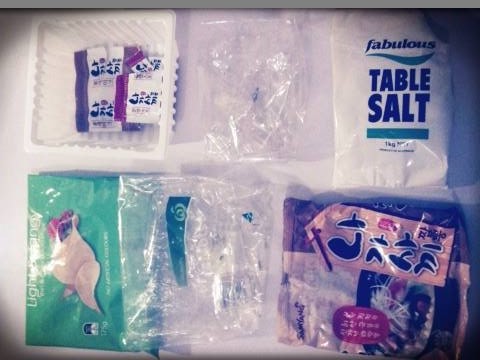
Carrying my bag of garbage, I turned around and walked back home. I decided to open it up again and see exactly which things had been sentenced to death. Back home, I found a space and laid out the garbage one item at a time: food scraps, toilet paper, a potato chip bag, a Woolworths carrot packaging bag, a Shin Ramyun noodle packet plus seasoning packet, a chicken drumstick plastic container plus seal film, the outer box seal film of JUST ROOIBOS tea bags, the outer box seal film of Coles black tea bags, an edible salt packaging bag, a ground pork styrofoam container plus seal film, and unidentified crumbs and hair. I tried to sort the garbage into finer categories, but on closer look I found it hardly required much effort, because the more conspicuous pieces of garbage were all plastic! Astonishingly, all of it was plastic that won't decompose for a hundred years.....(PS. In the Canberra region of Australia, plastic bags are non-recyclable waste, and there is also no food waste recycling)
I then divided them into the following two groups
Truly unusable group: food scraps, toilet paper, Shin Ramyun seasoning packet, chicken drumstick seal film, JUST ROOIBOS tea bag outer box seal film, Coles black tea bag outer box seal film, ground pork seal film, and unidentified crumbs and hair.
Possibly reusable group: potato chip bag, Woolworths carrot packaging bag, Shin Ramyun packaging bag, chicken drumstick plastic container, edible salt packaging bag, ground pork styrofoam container.
After sorting, the truly useless items had shrunk in volume by more than half, and plastic still made up the majority of the items; the possibly reusable portion was entirely plastic, and even if they could be reused once, they would eventually become garbage. In terms of function, no matter which group they were in, plastic's original purpose was always ”packaging”.
Gazing at the pile of plastic I had rescued from the brink of life and death, I fell into a long period of deep thought, something I hadn't done in a long time.
If I think twice before throwing anything away from now on, perhaps I can change the composition of my garbage?
If I only buy products and food without packaging from now on, perhaps I can reduce my dependence on plastic?
If I start choosing very carefully and cautiously what products I buy, perhaps I can change the consumer environment?
That morning, I sat facing my garbage for several hours, and I decided to try to prove my hypotheses.
The first step is to start by getting to know my own trash can.