Can sausages be made without nitrites?
December 29, 2017 (ROC year 106), second revised version by veterinarian Kuo Hsu-ying
First of all, thank you to the well-known community Wenqing Bie Guiche for its attention to my article published on News & Market, "Can sausages be made without nitrites?" In response to several questions raised by Wenqing Bie Guiche about me, I offer the following explanations:
- Why the sausages sold to ordinary consumers contain no added nitrites, while those in the restaurant purchasing section do:
I, Kuo Hsu-ying, hereby clarify that the sausages on the website, regardless of packaging, are not stated on the official site to contain added nitrites and in fact truly contain none. Many years ago, during the company's early days, we did indeed sell sausages with added nitrites, but later, because of our stated commitment to "no additives," we developed sausages with no added nitrites, and since then we have completely revised the line and unified it as additive-free. There is no situation where the consumer version of the sausages is additive-free while the restaurant version has additives. This is hereby explained.
- In addition, regarding the image editing and the insufficiently precise textual descriptions:
I admit that in my wording I was indeed negligent. In the consumer section, the sausages specifically state "no added nitrites"; the restaurant purchasing section offers the same additive-free product but does not mention it, causing everyone to mistake them for two different products. I am very sorry.
As for the images, I admit that I did use photo-editing techniques to make the product photos closer to the actual color of the products. I used an image previously customized for a restaurant's exclusive recipe and edited it, but an operational oversight caused two versions of the image to appear. Although it was noted that "images are for reference only; please refer to the actual product," it still caused misunderstanding, and we will be more careful in the future.
The official website is also immediately carrying out corrections to prices, text and images so that the information conveyed is more precise and consistent.
- Regarding the matter of advertorial placement in the article:
On this matter, my professional background is as a veterinarian for economic animals, and I do not deny that I currently work in the sale of domestic meat products and actively promote traceability. Therefore, I believe that writing as a citizen, using what I know and the phenomena I have seen in the industry, and submitting to News & Market does not violate the platform's publishing principles. Moreover, the article did not mention any company-related text or images, nor did it elevate myself by attacking other businesses in the same trade, and I immediately corrected the article after receiving criticism and guidance from all sides. Therefore, Wenqing Bie Guiche's claim that my conduct raises moral concerns remains open to question.
Regarding this incident, I have confirmed with News & Market that this article did not violate the writing rules. The site responded that the article presents experience and views from the perspective of a food industry practitioner, that the information provided is well-founded, and that it offered discussion within a reasonable scope and was not inappropriate.
I updated and emphasized yesterday that the message I hope to convey is not to encourage consumers to necessarily buy additive-free products, and even less to deny the value of food additives in the development of the food industry. My original intent is to ask everyone to be more careful about the safe preservation of additive-free sausages or various processed meat products, and to be sure to fully heat and cook such processed foods before eating them.
Finally, once again I thank all the experts and colleagues from all quarters for their attention to food safety issues. Whether affirmative or questioning, I have humbly read all the feedback. If there is anything that needs improvement in the future, I also welcome all experts and colleagues to let me know, and I am willing to make corrections so that the information conveyed is more accurate.
Kuo Hsu-ying December 29, 2017 (ROC year 106) 14:23
December 28, 2017 (ROC year 106), revised version by veterinarian Kuo Hsu-ying
After my article "Can sausages be made without nitrites?" was published, it drew attention from all quarters. Thank you for the comments from everywhere; I have humbly read them all. I simply hope to do my part to help my family, my children and even more people eat more healthily, so I humbly accept any new knowledge and guidance.
As mentioned in the article, what I hope to draw the public's attention to is that sausages should be frozen and that it is safer to remember to heat them to a core temperature of 60-75°C for more than 30 minutes. If consumers want to buy sausages with no added nitrites, they must pay attention to these things. My original intent is to ask everyone to place greater importance on the safety of processed meat products. Regardless of whether nitrites are added, what I want to convey is that "frozen storage" is one of the important elements in maintaining food safety.
I do not deny the safety value of nitrites in food processing, and at the same time I also recognize the necessity of food additives in the development of the food industry. I simply hope to offer a way of thinking from another angle and to promote the safety concept of freezing meat products for storage and making sure to cook them thoroughly before eating.
Finally, thanks to:
News & Market, Wayne's Food, Agriculture, Life, Lin bay Hao You, Liberty Times, Liberty Times Commentary Network, Kanghua Traditional Chinese Medicine Clinic, FoodNext and Shihua Shishuo and other partners concerned about food safety for publishing the article and giving much valuable advice as well as criticism and guidance.
Kuo Hsu-ying December 28, 2017 (ROC year 106) 10:25
When sausages are mentioned, what comes to mind? Is it the stall in a corner of the traditional market, where an older man tends a grill beside a tricycle while also minding a pinball machine and asking if you want to gamble a round? Or is it the sausage vendor in the TV drama "Uncle Niao-lai and Auntie Thirteen"? Or even the scene at Chinese New Year when Grandma carries a plate out of the kitchen and asks if you want some garlic slices with it? Whichever it is, I believe it is a uniquely Taiwanese flavor in everyone's memory.
But at some point, because sausages must have nitrites added for preservation, they became a product we must think twice about before deciding whether to buy. How can we safely recover the taste in our memories? We have been thinking about this all along.
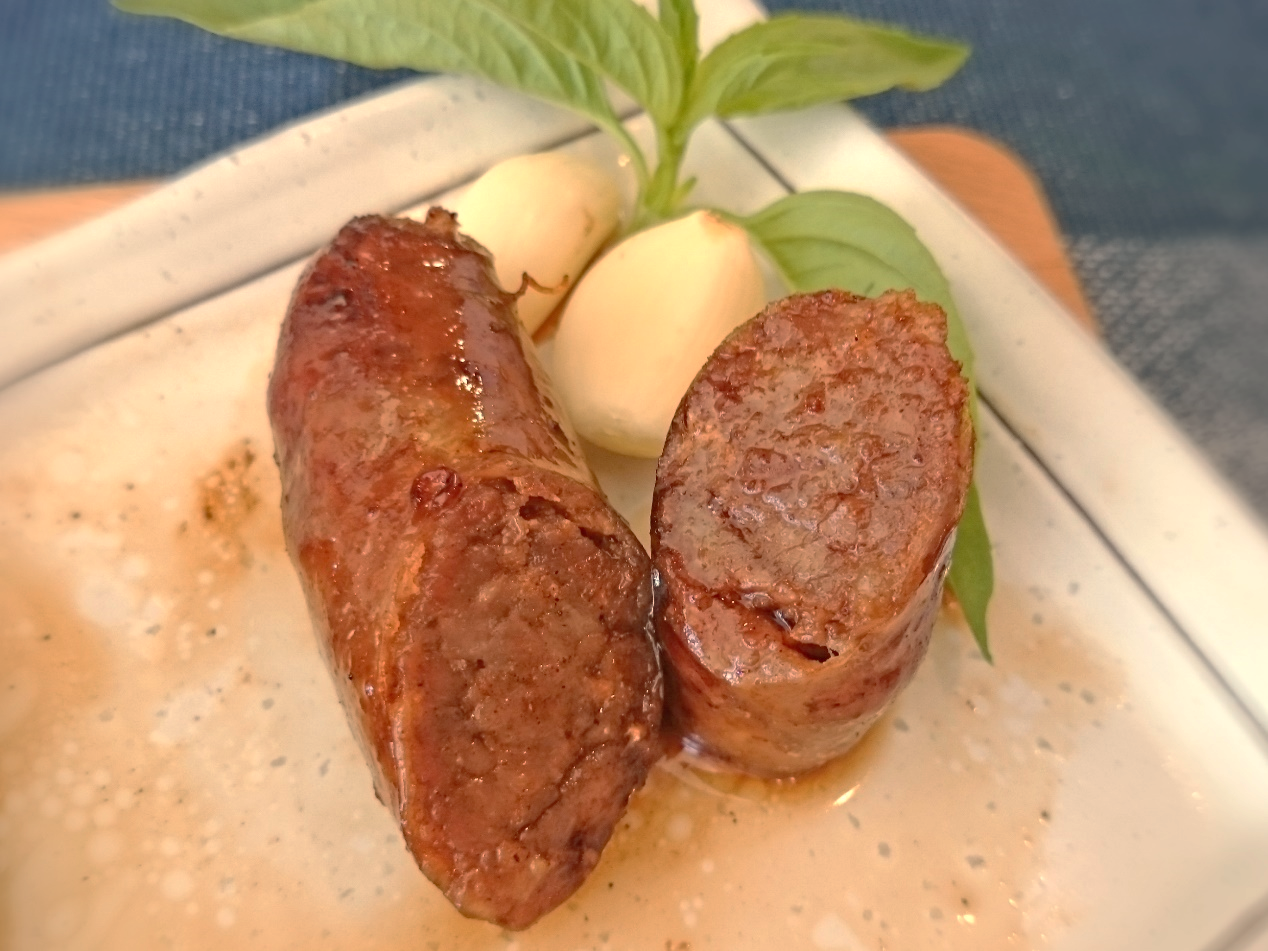
Must sausages have nitrites added?
In recent years, as food safety awareness has risen, the public has become increasingly concerned about food additives, but how can we strike a balance among deliciousness, safe preservation and healthy additive-free food? The main reasons nitrites are added to sausages are safe preservation, the smoky flavor that everyone knows and loves, and even that appealing bright red color, but must they really be added?
In the past, because of the poverty caused by war, every household had a chance to slaughter a pig to eat only during New Year and festivals, but once a pig was slaughtered it could not be eaten all at once. Thus the technique of curing emerged. Meat that had been cured and seasoned was stuffed into casings and became the well-known sausage. But because low-temperature equipment was incomplete at the time, in order to preserve meat products such as sausages safely, nitrites had to be added to inhibit Clostridium botulinum and prevent poisoning.
What is Clostridium botulinum? Clostridium botulinum is an anaerobic bacterium that prefers a slightly acidic environment and can remain active at 3-48°C. Its spores are extremely heat-resistant and must be heated at 121°C for more than 30 minutes to reach sterile standards. Although the toxin and the bacterium itself are not heat-resistant and can be dealt with by heating to 60-75°C for more than 30 minutes, in general it is really difficult for us to ensure food is heated evenly, so the best method is to directly inhibit its formation. As long as the conditions it needs for growth are disrupted, its growth can be prevented. Given modern living environments and habits and the widespread availability of freezing equipment, sausages actually do not need nitrites.
Moreover, Clostridium botulinum is not found only in sausages. Frozen braised pig trotters and other meat products sold on the market may also contain Clostridium botulinum, so why can other cooked meat products go without nitrites? Because with today's widespread knowledge, everyone knows other meat products must be frozen. Therefore sausages can likewise use low-temperature preservation to achieve the goal of being additive-free. What we lack is simply changing our habits: the habit of freezing all cooked meat products, and the habit of eating the taste of real sausages.
If there are no additives, no one will make them anymore?
To let consumers eat safe and genuine sausages, we actually visited contract manufacturers. We found that if one wants to make genuine additive-free sausages, it does not only make contract manufacturers hesitate; communicating with them about making additive-free sausages is also a major problem. In the process of discussion and understanding with the contract manufacturers, we found that the difficult part is not the making, but the process of communicating with people and overturning traditional thinking.
The people in the processing plant's R&D and even on the production line kept asking us, are you really not adding it? Is it really all right not to add it? How should the production method be changed if we do not add it? Even though we knew there was no problem with being additive-free, facing so many questioning voices still inevitably made us wonder, is it really all right?
The second difficulty is consumers' habits. Getting everyone to change their preservation habits and accept sausages that have no smoky flavor and are not red is not an easy thing. After all, having grown used to the original sausage taste, one will certainly feel that additive-free sausages are missing a flavor. Promotion sounds simple, but doing it is extraordinarily difficult. Someone must first be willing to listen before there is a chance to explain that because it is genuine, it has no smoky flavor; because it is genuine, it is not red; because it is genuine, it needs to be frozen.
Putting safety into the simple joy of sausages
I have always hoped to let more Taiwanese people recover the taste of truly traditionally made additive-free sausages, to let today's Taiwanese children remember Taiwan through their taste buds, and to bring back the original flavor of food. I understand that from a scientific perspective, everything in the world is made of chemicals, but we still hope not to add extra chemically synthesized things. Letting us walk on the road of deliciousness toward the goal of being additive-free, and making good use of resources so that being additive-free and delicious can coexist, is what we have always been striving to do.