The agricultural knowledge a handful of soil teaches us
Mr. Daycha, chief executive officer of Thailand's Khao-Kwan Foundation, has spoken in Taiwan twice, sharing the experience and techniques he has accumulated over twenty-five years. This farming method has been proven in Thailand to be a grassroots, workable form of natural farming. What is even more moving is the spirit of selfless dedication shown by Mr. Daycha, which has planted seeds in many people's hearts.
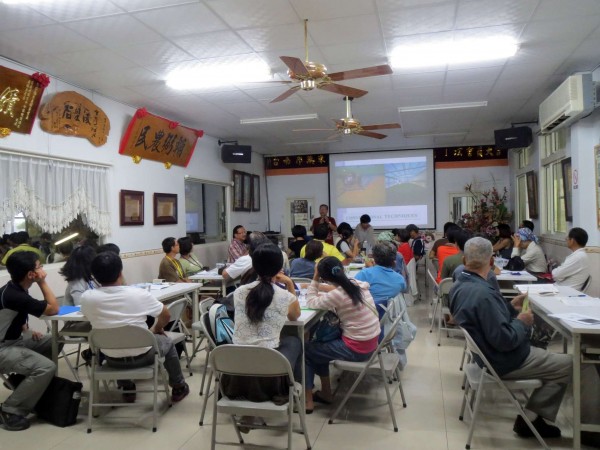
In recent years, people have been travelling to Thailand one after another to learn from him. Last year (2002), Ms. Chen Ruei-fang, who had been deeply inspired by Mr. Daycha's lectures, launched the "2012 Taiwan-Thailand Khao-Kwan Foundation Natural Rice Cultivation Demonstration and Promotion Project", inviting Daycha and two of his assistants, three people in total, to come to Taiwan for more than a month. Through a tour around the whole of Taiwan and direct exchanges and interaction with farmers in various places, they carried out teaching and hands-on practice in rice paddy cultivation at each demonstration plot, including the cultivation of microbial inoculants and the selection and breeding of rice. This month the team will return to Taiwan once again, likewise carrying out a month-long tour of talks and hands-on sharing.
This article is a record of the 2012 Tainan session of the Thai Khao-Kwan Foundation's "Natural Rice Cultivation Demonstration and Promotion Project".
For the detailed background of KKF, the actual method of cultivating microbes, the ratios, and so on, please refer to the following websites. Let us, like Mr. Daycha, work hard to carry out the mission we came to Earth for!
Reference links
KKF in Taiwan - Thai Khao-Kwan Natural Rice Cultivation Promotion Project
Ruei-fang and many friends share a great deal of theory and practical experience here
Lin Ru-zhen's record of the Tainan session
Recorded video of the Hualien Permaculture Tribal Lecture
KKF@TAIWAN Facebook group
Note 1: This "organic" is what the practice centre calls itself; it has not been certified by any legal body. Although Taiwan already has relevant laws and regulations, at the actual implementation level there is still a great deal of passing off inferior goods as superior. Moreover, whether soilless cultivation models can be "organic" has long been disputed. This shows the diverse "organic" game on the market. Rather than hoping others will guard the gate, readers are urged to take the trouble to understand for themselves where their food comes from, who farms it, how it is cultivated, whether the land is healthy and whether the ecology is sound. Use fresh, locally produced and locally sold ingredients to nourish your health, use your spending to support small farmers who treat the land with kindness, and use your mouth to protect the natural ecology and the Earth.
Note 2: Dry cultivation method for microbial inoculants: go to a mountain area below 600 m in altitude nearby, in a relatively undisturbed, primitive forest, and collect soil (within 15 cm, or topsoil under rotting wood or where there are mycelial threads). In the ratio of forest soil (1): dry, sterile bamboo leaves (5): rice bran (1): water (1) (chlorine has a sterilising effect, so tap water is best left to stand overnight before use), add a spoonful of molasses to the water, rub and mix thoroughly, wrap it up in a breathable rice sack and leave it in a cool, shady place. After 7 days the dry inoculant cultivation is complete. Making the dry inoculant means replicating and preserving the microbes from the forest; afterwards it is made into a liquid inoculant, which is more convenient for applying in the field to carry out the work of activating the soil. The cost of Thai EM microbes mentioned in the text is for reference only; what he wanted to express is that the cost difference between commercially sold and self-made microbial inoculants is very large.
Note 3: For seed selection, use hulled brown rice with the germ intact. You can first screen by appearance, discarding defective grains that are opaque or have some cracks, and keeping the characteristics you want, for example: a plump, round grain shape. Use a ratio of one in a thousand to select 100 grains of rice for single-plant seedling raising, and each season select another five percent to serve as the seed for the next round. After at least three generations of such seed selection and cultivation, you can develop the best variety for your piece of land. Of course, the taste of the rice and the rice mill's grain selection mechanism are also taken into account in seed selection. The breeding method is rather complicated and will not be described in detail here.
Note 4: This article is excerpted from: ’Qing Ya Er’ #53, 2012. 09/10