How is farming under green energy equipment attached to agricultural facilities recognized? The Council of Agriculture announced in June.
The Council of Agriculture relaxed the rules on green energy equipment attached to agricultural facilities, and a rush to generate solar power has sprung up in central and southern Taiwan, China. But many people use agriculture as a pretext while actually generating power, and bizarre phenomena keep emerging - growing coffee on salt flats, raising crickets under solar panels - in a disguised plunder of prime farmland. Cao Shaohui, director of the Council of Agriculture's Planning Department, said that it is currently communicating with industry groups to determine which crops are better suited to attached green energy equipment, such as bird's-nest fern, which needs less natural light, and detailed rules will be announced as early as the end of June.
Previously, when agricultural facilities applied for attached green energy equipment, the area was calculated by the same standard as farmhouse construction, with each plot not exceeding 660 sq m. To encourage renewable energy, the Council of Agriculture amended the "Regulations Governing the Review of Applications for Permitted Use of Agricultural Land for Agricultural Facilities" in October of the year before last, opening up agricultural facilities in general agricultural zones and special agricultural zones to apply for attached green energy equipment, with no area limit. Although the Council of Agriculture stipulates that attached green energy must be combined with agricultural operations, it has not defined what "combined" means, leaving operators to each say their own thing.
Developing renewable energy is a world trend, but a farmland lease for solar panels runs 20 years once signed, and if there is no strict review beforehand, it could severely impact local agriculture.
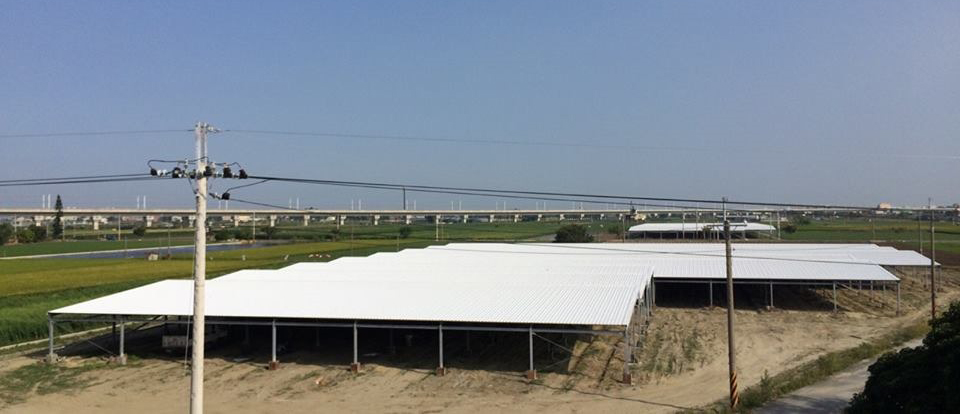


After Typhoon Morakot, Pingtung County began promoting the construction of solar facilities in areas with land subsidence and destroyed fish ponds. The Pingtung County Agriculture Department said that developing solar facilities requires choosing suitable locations and industry types. For example, in many disaster areas, wax apple cannot be grown and fish can no longer be raised; developing green energy can not only let the land recuperate, but also provide farmers with stable income. Moreover, these abandoned fish ponds are natural flood detention ponds that can store water during heavy rain, so no embankments need to be built around them.
When the Pingtung Agriculture Department receives an application for attached green energy facilities on a greenhouse facility, it first determines whether the crop really needs a structure. For example, coffee, cacao and vegetable fern (commonly known as guomao) do not need greenhouses. The Agriculture Department believes that if the Council of Agriculture only opens up facilities such as material storage rooms, collection and distribution yards, processing rooms, as well as poultry and livestock houses and mushroom sheds - agricultural facilities that inherently do not need light transmission - to apply for attached green energy facilities, local governments would not be left at a loss.
Disguised green power, real plunder of farmland: who gets fat from solar power on farmland?