Which is better, salt-brined tofu or gypsum tofu? Understanding the differences in one article
Many people worry that "gypsum" is an industrial raw material and not edible, and some even suspect it is harmful to the kidneys! As a result, nigari tofu (bittern tofu) gradually flourished in health food stores.
Gypsum is actually a natural mineral, suitable for making tofu with a dense, fine texture, and it is also an excellent source of calcium for vegetarians. Except for kidney patients, who need to pay more attention, there is no problem for generally healthy people to consume gypsum!
The reason gypsum has come under attack is that people fear eating industrial-grade gypsum and suffering heavy metal poisoning. In fact, the Taiwan Food and Drug Administration has already referred to international standards and listed food-grade anhydrous calcium sulfate (Anhydrous: CaSO4) and calcium sulfate dihydrate (Dihydrate: CaSO4 · 2H2O) as safe food additives. Most tofu currently on the market is safe and can be eaten with peace of mind. Or you can try making tofu yourself, experiencing the toil of the ancients who followed "a day without work, a day without food."
Common tofu coagulants, besides gypsum, also include nigari (bittern) and glucono delta-lactone (GDL).
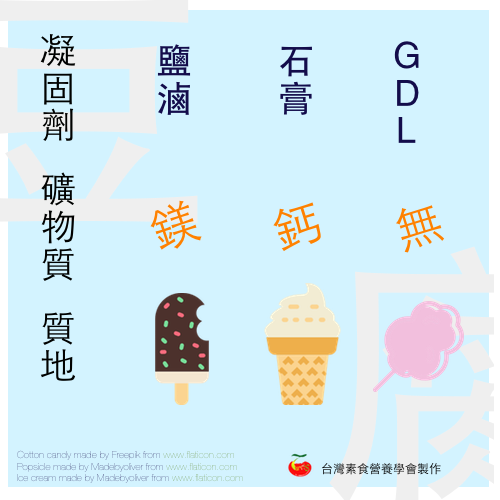

Gypsum: It is a natural mineral, low in price and high in calcium content, and the tofu made from it has a dense, fine texture. Food-grade gypsum is divided into two types: "anhydrous gypsum" and "dihydrate gypsum."
Nigari (bittern): Extracted from seawater, it is high in price, and the tofu made from it has a coarser texture. It requires experience and skill to make perfect firm tofu (board tofu).
Glucono delta-lactone (GDL): Extracted from sugars, it is low in mineral content, and compared with nigari and gypsum, it has lower nutritional value. Food manufacturers often use it to make super-tender tofu and douhua (tofu pudding).
Among the three coagulants, only gypsum is higher in calcium. The Ministry of Health and Welfare recommends a daily calcium intake of 1000 mg, equivalent to four cups of 240 c.c. milk, or two 400-gram boxes of gypsum tofu (firm tofu, traditional tofu).
If you buy firm tofu or traditional tofu at a fresh supermarket, pay more attention to the food ingredients on the packaging. If it says "calcium sulfate," that means it contains gypsum, and you can get your calcium!