Milk powder is not pure; legislator calls for food safety law to require labeling of main ingredient content
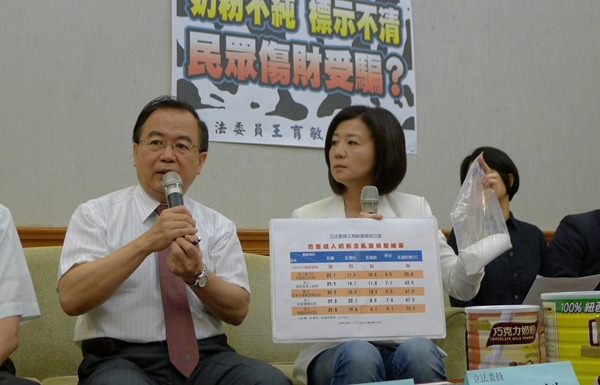
Canned milk powder prices keep rising, but a spot test by the upstream and downstream News Market of five brands of adult milk powder on the market found that the actual milk content was only 60 to 70 percent. Legislator Wang Yu-min criticized manufacturers for unclear labeling, passing off formulated milk powder as pure milk powder. "It is neither one thing nor the other." Wang Yu-min said that when the draft Food Sanitation Management Act is reviewed tomorrow, she will propose an amendment requiring mandatory labeling of the percentage of main raw ingredients in food contents, so that consumers can choose for themselves.
Labeling that is neither one thing nor the other, intended to confuse
Legislator Wang Yu-min held a press conference today and pointed out that the milk content of canned milk powder on the market is less than 70 percent, with the rest mostly filled in with cheap maltodextrin. According to national standard CNS 2343, milk content must be 86% or above to be called "milk powder"; manufacturers with insufficient milk content can at most call it "edible formulated milk powder" (milk content 40% or above). But current packaging is wildly varied, and manufacturers even label it "nutritional formulation," stuck in the middle and neither one thing nor the other, deliberately confusing consumers.
According to Directorate-General of Budget, Accounting and Statistics data, over the past three years the cumulative rise in general prices was about 2.9% (excluding fruits, vegetables and energy), but the cumulative rise in canned milk powder prices reached 9.2%. Taking a can of milk powder priced at 700 yuan, that is equivalent to an increase of the price of a boxed meal, yet manufacturers fill it out with maltodextrin, and consumers are fleeced twice over.
Wang Yu-min said that milk powder is different from ordinary junk food. People hope to get nutrition after buying it, and the government should strengthen quality control. It is not that manufacturers cannot add other things for formulation, but they must label clearly, so consumers feel comfortable after buying it. She will propose an amendment at tomorrow's Legislative Yuan Health and Environment Committee meeting, revising Article 22 of the Food Sanitation Management Act, requiring manufacturers to label the content of main raw ingredients. "Flavored milk can label its milk content, so I believe milk powder can do it too!"
Wu Cheng-hsueh, deputy director-general of the Executive Yuan Consumer Protection Committee, also said that according to the 2012 consumer awareness survey, nearly 80 percent of people had doubts about food contents, but labeling involves manufacturers' operational issues, and internationally there is also no labeling of milk powder content, so it may need further detailed discussion.
In response, Lo Chi-fang, chief secretary of the Department of Health's Food and Drug Administration, said that the current policy adopts "full disclosure," requiring manufacturers to label whatever they add, but whether to disclose content is voluntary for manufacturers. The Department of Health will invite experts to discuss within one month, but if the law is to be amended, it will take at least three months.

For more professional agricultural science and technology information, please scan the QR code to follow WeChat: NongXunNET

Please indicate the source when reprinting.