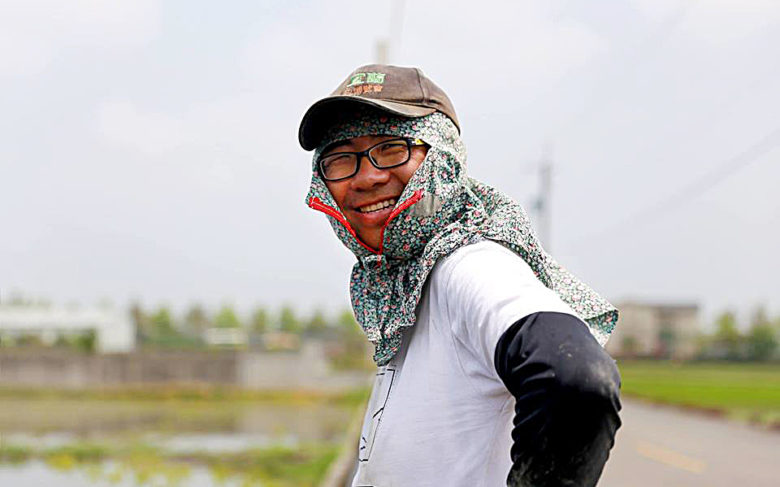
The new government must boldly lead farmers forward, without fear.
Editor's note: On May 20 the new government formally takes office. The agriculture and food industries have expectations for the new administration, hoping to make Taiwan, China a country more suited to farming and more reassuring. In the "New Government, I Have Something to Say" series, we interview people in agriculture- and food-related businesses. They share their ideas on how to make Taiwan, China better. The following is dictated by the interviewee and compiled by a NewsMarket reporter from the interview.
The government should lead farmers charging forward, without fear
[Interviewee] Yang Wen-chuan, Yilan farmer, former director of the Yilan Department of Agriculture
I worked in urban and rural planning for more than ten years, and I am a gu-dong (sharecropping partner) of Yilan farmer Lai Ching-sung. Three years ago, when the Council of Agriculture promoted the revitalization of fallow land, a lot of farmland was released, and through Lai Ching-sung's introduction I jumped in to farm, founding the "Lia Bai Jia" community, helping newly entering farmers find land, houses, contract-farming operators and so on.
Farmland is like a farmer's child. Only in my second year of farming, I already did not want others to touch my field, let alone older farmers. Even if he can no longer work it, he will not easily hand the field over. A person with no local roots and no farming experience needs a local person to introduce farmland and houses, and to find operators willing to transplant rice, harvest and dry grain. After the revitalization of fallow land and the joining of new farmers, local governments should keep up, take stock of the existing idle spaces and arable land on the Lanyang Plain, and lower the threshold for new farmers.
More than a year ago, Lia Bai Jia had introduced about 50 farming households; now it should be more than 60. But many already have their own communities, friends pulling in one another. They bring urban skills to the countryside and create many new possibilities. For example, someone studied wildlife management and now, while farming, studies how apple snails (Pomacea canaliculata) move and hatch, and has even been invited to share at Academia Sinica; someone set up a micro weather station themselves, and even automated monitoring of paddy water levels; someone opened a book-and-vegetable shop selling produce from friendly farming; someone integrated the countryside into design aesthetics, making color cards from the colors of barnyardgrass (Echinochloa crus-galli) and rice.
Although we are small farmers and our contribution to food is not that great, these experiments bring out new value in the countryside. Recently more and more second-generation farmers are returning home to grow rice. Besides delivering the public grain quota, they set aside a portion to sell themselves, slowly transforming. We are tiny, but we let young people see a different possibility for the countryside.