Into Laos: Exploring the Story of the Mekong River
Editor's note: The author comes from a background in anthropology and has worked as a journalist, a volunteer in remote areas and developing countries, and an NGO worker, and is now a media worker. This article is an excerpt from the author's recently published book "Melancholy Borders: The Journeys and Reflections of a Rookie Anthropologist", leading Taiwanese readers into Asia's borderlands to encounter cultures both close and distant.
────────────────────────────────────
I had never imagined that one day I would ride on an elephant and bathe it - strictly speaking, it bathed me, and only when I soaked together with the largest animal on Earth in the Nam Khan River did the bone-chilling cold tell me this moment was not a dream.
In the winter of 2011, I traveled to Laos and booked this elephant-training course in Luang Prabang. A small van brought several of us travelers to this elephant camp by the Nam Khan River, introduced us to the characteristics of the Asian elephant, taught us a few command words, and our elephant-training course began with a walk together with the elephants.
"My" elephant was named Bonson. This Asian elephant that had once trodden through the fires of war had its great tusks stolen and sold long ago; perhaps lacking its masculine symbol, perhaps simply old, this sixty-five-year-old gentleman was not as restless as its companions, and its silent, steady gait made me, interacting with an elephant for the first time, feel very much at ease. Bonson had long mastered everything; without waiting for me to speak, it automatically completed the whole route and all the movements, and even carefully brushed aside branches for me to keep me from bumping into them. It was teaching me how clever they are, and all I needed to do was treat it like a pet and feed it to my heart's content. My heart ached that Bonson, with an iron chain around its neck, was enslaved by humans, while the mahout following at the giant elephant's side waved a branch, looking disapproving: "They're not pitiful at all, they live really well." He said the elephants in the forests along the upper Mekong border were the truly miserable ones, carrying heavy timber and working nonstop.
In the past Laos was a "Land of a Million Elephants," but now only just over a thousand remain in the entire country; apart from the working elephants in the border forests, most of the herds are used for tourism.
This elephant camp sits by the Nam Khan River and keeps more than ten elephants in all. The Nam Khan River is a tributary of the Mekong; following the Nam Khan upstream, and even up the Mekong, many similar elephant villages are scattered along the way. Tourists pay to experience elephant riding and other outdoor activities, while the villagers make a living from this tourism income. Elephants and villagers live in symbiosis - the "corporate social responsibility" model that Laos, with its aim of ecotourism, has developed.
In the world's development race, Laos started late in every category; whether resource development or tourism, it is almost as pure and untouched as a virgin. After the contest of civilization has left rubbish large and small in every country, humans can only find redemption through reflection in those countries not yet destroyed. These countries marvel at Laos's pristine beauty, and so help this backward country establish the most advanced travel concepts - here, travel that consumes too much energy and damages the environment is forbidden, and the travel packages offered by travel agencies are mostly mountaineering, trekking, or low-pollution outdoor activities. Even the tour guides here are mostly villagers themselves, and the income and profits are shared by the whole village. Life here is peaceful, serene, and slow, almost like a beautiful utopia.
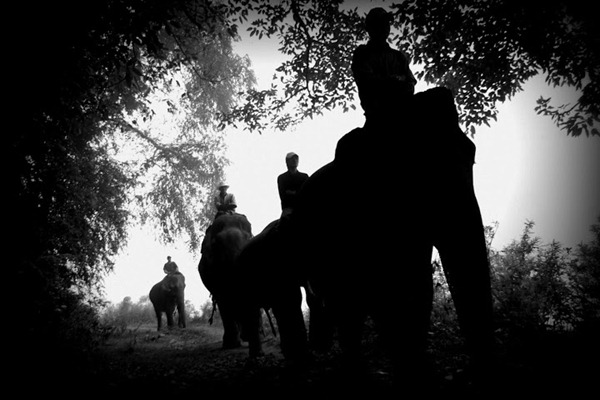
No wonder Henri Mouhot, the discoverer of Angkor Wat, lies in rest in this village. The year after this explorer discovered Angkor Wat, he followed the Mekong upstream toward China, and passing through Laos he was struck by its beauty, only to contract malaria on the way and finally die by this riverbank at the age of thirty-six. Every day the elephants emerge from the jungle where they rest and walk past his grave, while the mahouts ride leisurely on the elephants' backs; in the morning, before the mist lifts, people and elephants in the woods before the cemetery form a tranquil ink-wash painting.
******
Yet external economic forces are surging in, confronting this tranquil ink-wash painting with change. The mahouts reminded me of the changes this country already faces. "How do you say elephant in Chinese?" my mahout asked me, throwing out several words in succession. He was only twenty years old and had been a mahout for barely two years, earning little, only one hundred US dollars a month, and was always thinking about how to earn more: "There are more and more Chinese, I want to learn Chinese so I can do business with them in the future." Another mahout couldn't help retorting: "Yeah, there are too many Chinese, Laos is almost turning into Chinatown."

Dissolving Borders, China's Intervention
The borders of China, Myanmar, Laos, and Thailand are divided by the Mekong River. These four countries signed a commercial shipping navigation agreement back in 2000; no matter which country's cargo ship it is, they all fly the flags of the four countries, and within this two-hundred-and-seventy-kilometer voyage, ships wandering between borders always seem at ease in a borderless zone. And this mother river's abundant water resources have also become the "diamond" in the eyes of the six countries of the basin; in 1995 these six countries formed the Mekong River Commission and jointly drew up development plans. The secretariat of the Mekong River Commission is located on Mekong Road in Vientiane - the same road as this noisy dumpling restaurant.
Laos, which holds one third of the Mekong's length, thanks to its high terrain and high water-level drop, has turned from an unremarkable poor boy into a wealthy catch, and in experts' eyes is an "Asian Kuwait." This Asian Kuwait is now flooded with a large number of Chinese merchants and laborers - originally 50,000 Chinese already lived in Vientiane, and starting in 2005 the Chinese government systematically brought in ten thousand laborers to mine; in this capital alone there are about more than 500,000 Chinese.
China's influence in this country is clearly visible. Opposite Vientiane's pale and shabby national museum stands a resplendent building - the National Cultural Hall. Although the displays inside are dull and it often screens Chinese films that seem boring to us and that propagate national power, for Laotians lacking film entertainment they are still enough to keep them watching with relish. At the entrance of the cultural hall stands a large electronic billboard, from time to time playing Chinese-language promotional videos about Laos tourism, but invoking the firm friendship between the two countries. This also echoes the Chinese inscription carved at the entrance of the cultural hall: "This is a gift from the people and government of the People's Republic of China to the people and government of Laos."
Of course China has done far more than this; almost all of Southeast Asia's public infrastructure is in the hands of this northern power. With its powerful economic strength it builds roads for these countries, and has even opened a highway from Kunming to Bangkok. China has also widened the Mekong channel; tourist boats and boats carrying vegetables and fruit bustle at the junction of the three countries, as if in a borderless zone.
For many countries, opening the door by building roads creates tension, and officials in northern Thailand also believe this "Chinese-style invasion" will worsen the problems; they even worry for Laos: "Chinese merchants come here with capital and their own workers and building materials; I worry that in the future Laotians will feel exploited and invaded." Yet the Laotian government seems not to care, and Laotian officials are even willing to use land to raise funds from China - in northern Laos, China has set up economic development zones and casinos, drawing large numbers of Chinese merchants.
Inside the dumpling restaurant, it is still noisy. A Chinese merchant shouted loudly: "Laos's value is soaring." They complain that the rules and culture of doing business seem to change completely once you climb a few mountains and cross a border.
(For the complete exciting content, please read "Melancholy Borders: The Journeys and Reflections of a Rookie Anthropologist")
(The author's Facebook page is "Island Doldrums" (www.facebook.com/anthropojournal).