The old-time flavor of dried radish holds the happiness hidden in memory
Mrs. Lin, 89 years old this year, is a traditional Hakka woman from Beipu Township, Hsinchu County. She has years of experience making dried radish the old-fashioned way. Just how many years? The answer is truly astonishing: she makes dried radish once a year, and she has been doing so for over 80 years now.
In the era when Mrs. Lin was growing up, before the rice harvest, radish seeds were scattered in the field first, and 45 days later the radishes were ready to harvest. The surplus radishes were salted to dehydrate them, then sun-dried for storage, and taken out to cook whenever needed. The radishes grown during the slack farming season were never plentiful to begin with, so they could not be processed in large quantities. Most of the dried radish was shared with relatives and friends or kept for personal use, making it a kind of private farmhouse dish, with only a small amount sold on the market.
Dried radish, also known as cai po, is one of the representative ingredients of Hakka cuisine. It can be found everywhere, from the fillings of vegetable buns to rice dumplings, as a topping for water rice cakes, and in cai po omelets. It is highly nutritious, and in the past Hakka people jokingly called cai po the ginseng of the poor.
Food Safety Warnings About Dried Radish
Every year before the Dragon Boat Festival, random inspections of cai po turn up many food safety problems. Here are two of those reports:
"The Dragon Boat Festival is approaching, and rice dumplings are indispensable for the occasion. However, the New Taipei City Health Bureau inspected dried radish products used as rice dumpling fillings and found that as many as 40 percent failed to meet regulations, with excessive preservative "benzoic acid" and formaldehyde, i.e. formalin (industrial-grade formaldehyde), which must not be detected at all. The Health Bureau immediately notified the businesses to remove all non-compliant products from the shelves.
On June 1, New Taipei City released its third round of Dragon Boat Festival rice dumpling inspection reports, testing 20 dried radish products sold by grain stores, street vendors, rice dumpling specialty shops and trading firms. The tests covered formaldehyde and preservatives, and 8 items were found to have non-compliant additives, of which 7 contained excessive benzoic acid and 1 contained formaldehyde.
The Health Bureau stated that benzoic acid is a food additive used as a food preservative, but if added in excess and consumed over the long term, it can reduce appetite and also affect liver function; formaldehyde is prohibited from being added to food, and consuming it can cause symptoms such as headache, dizziness, difficulty breathing and vomiting, harming consumers' health."
The other report, from 2009, had an even more alarming headline and content: Formalin Cai Po Has Been Flowing Into All of Taiwan for Ten Years
"Dried radish is indispensable for wrapping rice dumplings at the Dragon Boat Festival. Investigators found 127 metric tons of tainted dried radish containing formalin, that is, industrial-grade formaldehyde, which is highly harmful to the human body. The operators had been making dirty money for more than ten years, and two brothers may both have developed cancer from long-term exposure to formalin. What is frightening is that the tainted dried radish flowed to restaurants and traditional markets across Taiwan. More than 100 metric tons, tens of thousands of boxes, of tainted dried radish laced with formalin were piled up in this warehouse. The warehouse was converted from a pig shed, yet not a single mosquito or insect could be seen, because formalin is too toxic; the warehouse was filled with a strong, pungent stench. Opening a box, these dried radishes were frighteningly white. Because formalin was added, the color becomes very white, whereas normal dried radish should be darker in color. Formalin is industrial-grade formaldehyde, and consuming excessive formalin carries a risk of cancer. The brothers who produced this tainted dried radish both developed cancer from long-term exposure. On the outer packaging of this formalin-laced tainted cai po, a character chuan circled in red was printed, and it even boasted of being authentic Hakka crisp cai po. What is terrifying is that these dried radishes flowed to restaurants and vegetable markets, nearly everywhere from north to south. When buying, people should absolutely not buy dried radish that is too white, or should give it a good sniff."
Why Does Dried Radish Need Added Preservatives?
Asked whether she had heard that many dried radishes outside are found to contain added preservatives, Mrs. Lin said: "Dried radish is just salted, sun-dried until dry and then put away, and it will not spoil, so why add preservatives?" She asked me back.
I could not think of an answer. She continued: "10 jin of fresh radish can only make 1 jin of dried radish, and 100 jin can only make 10 jin of dried radish. It weighs very light (meaning the scale shows almost no weight), while wet cai po weighs more."
Her third daughter-in-law put down the work in her hands and added from the side: "Sun-drying radish under a strong sun takes at least 4 days, and on cloudy days it may take 7 to 10 days."
The answer is already obvious. Some manufacturers, in order to shorten working hours and increase output, cannot wait for the radish to dry before wanting to sell it. For one, it lowers production costs; for another, wet radish contains more water, so when sold it weighs more and is worth more. Radish with water content spoils easily, so they disregard their conscience and use food additives.
When it comes to food processing, some people think eating fresh vegetables and fruit is best, and that there are no food safety problems caused by processing. Of course that is the first choice. Unfortunately, agricultural products often have to be harvested completely in a batch within a certain period of time; vegetables and fruit that are overripe or too old will affect quality. Food processing is therefore necessary. An abundant harvest of agricultural products that cannot all be consumed can be processed and preserved, and food processing can be used to develop diversified products, but improper processing will cause problems. For example, pickled foods contain a lot of water yet do not spoil, so preservatives must be added; if the texture is to be crisp, quality improvers and binders must be added; if it is not to taste salty, flavoring agents must be added. Excessive or improper additives will absolutely harm the body. Food processing is truly an undertaking that runs on conscience.
Over 80 Years of Traditional Dried Radish Making: Just a Lot of Labor, No Food Safety Problems
Mrs. Lin stood up and said: "Follow me and give it a try today. Dried radish is very easy to make; it is just a lot of labor." The old lady raised her voice and called for everyone to hurry to the field to pull radishes. There was still plenty of work ahead!
Starting From Sowing the Seeds
Mrs. Lin has seven sons, many children and grandchildren, and a family of nearly a hundred people. The sons rush to do the heavy work, but the old lady is not idle. She gives orders, does quality checks, and starts nagging whenever she sees something not done as required. The five sons who came back to help are used to their mother's ”habits”, smile at one another, and obediently follow the requirements. To us outsiders it looks both enviable and amusing.
On the day of the rice harvest last December, the fourth brother sowed the seeds according to tradition.


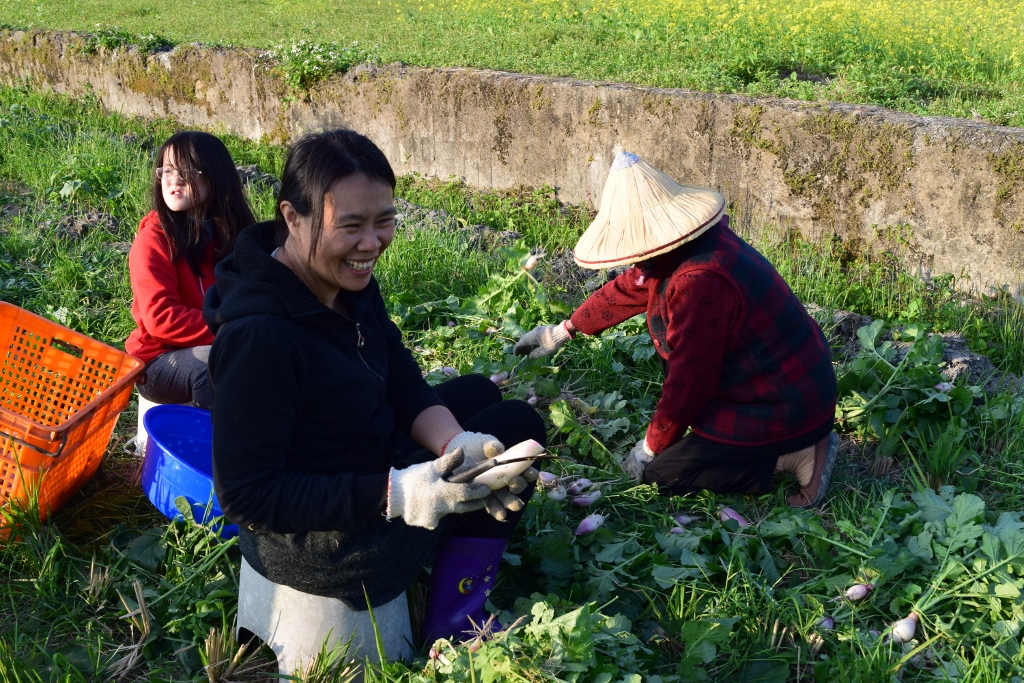
This year's dried radish made by Mrs. Lin's family is already fully pre-ordered. Asked whether more quantity could be supplied next year, the old lady said there is too much labor involved, and without manpower it cannot be done.
To let the old-time good flavor be passed down far into the future, Taiwan Handmade Good Things will continue to hold dried radish making experience activities next year, so that more consumers can go to the radish field and personally experience the fun of pulling radishes and making dried radish.
To pre-order next year's dried radish or sign up for an experience trip, please contact: Taiwan Handmade Good Things, Ms. Fu [email protected]
Website: www.bestaiwanarts.com/news_list.asp