Shang Zhou submits the inspection report late; the laboratory name is sent out as a confidential document, and he apologizes in the evening.
Last week, Business Weekly, citing Chen Liang-yu, a professor in the Department of Biotechnology at Ming Chuan University, reported that 60% of milk sold on the market contained banned drugs, but the inspection report that is required by law to be made public was incomplete. The Ministry of Health and Welfare demanded that it be completed by 5 p.m. today. Business Weekly rushed to send more than 170 pages of inspection reports by express delivery half an hour before the deadline, but the name of the laboratory was sent separately as a confidential document. The Ministry of Health and Welfare will hold an expert meeting at 6 p.m. tomorrow, and Business Weekly also issued an 11-line statement in the evening, apologizing for causing social disturbance.
Laboratory name sent separately as a confidential document
Chen Liang-yu sampled nine brands of milk sold on the market in November and detected metabolites of antibiotics, antidepressants, contraceptives and other substances, but many experts questioned that the experimental method was problematic and that it was not a nationally certified laboratory. However, Chen Liang-yu and Business Weekly kept the name of the laboratory strictly confidential. When Chen Liang-yu was interviewed by News&Market, he said: "At the beginning, it was not a laboratory at all. I entrusted a friend of mine, who used to be my student."
The Ministry of Health and Welfare received the express delivery sent by Business Weekly at 4:22 p.m. today. Jiang Yumei, deputy director-general of the Food and Drug Administration, said at 8 p.m. that the package had not yet been opened and she did not know whether the laboratory name had been provided, "but Business Weekly said it would provide it, so it should provide it." However, internal information from the Ministry of Health and Welfare pointed out that Business Weekly sent the laboratory name separately as a confidential document, which is very intriguing.
According to Article 40 of the Act Governing Food Safety and Sanitation, when publishing an inspection report, the testing method, testing unit, and basis for interpreting the results must be attached at the same time, but it does not require that the report be issued only by a nationally recognized laboratory. The preliminary inspection report submitted by Business Weekly on the 23rd was pointed out by the Ministry of Health and Welfare to have four major deficiencies, including failure to provide testing equipment and validation data. Jiang Yumei said that if the information is still incomplete this time, Business Weekly or Chen Liang-yu will be required to explain at the Food and Drug Administration.
Experts participating in the review pointed out that the previous report was very brief and should not have exceeded 20 pages. It is said that the report submitted by Business Weekly this time was expanded to more than 170 pages in one go.
Instrument model and laboratory certification are among the indicators of professionalism
Chen Ming-ru, a professor in the Department of Animal Science and Technology at National Taiwan University, said that the report provided by Business Weekly the first time was very incomplete. It did not provide the basis for data interpretation or the model of the testing instrument, and only wrote a simple experimental method. The expert meeting asked them to point out the peak spectra one by one, which may be why the number of pages increased.
Chen Ming-ru said that the instrument model and laboratory can be used to judge the detection limit and professionalism. Certified laboratories are regularly assessed; for example, unknown samples are sent to laboratories and they are required to detect whether a certain substance is contained and in what amount. This is an important basis for judging professionalism, but it is not the only standard. "It is one thing that Chen Liang-yu's laboratory is not certified, but at least it should be decent."
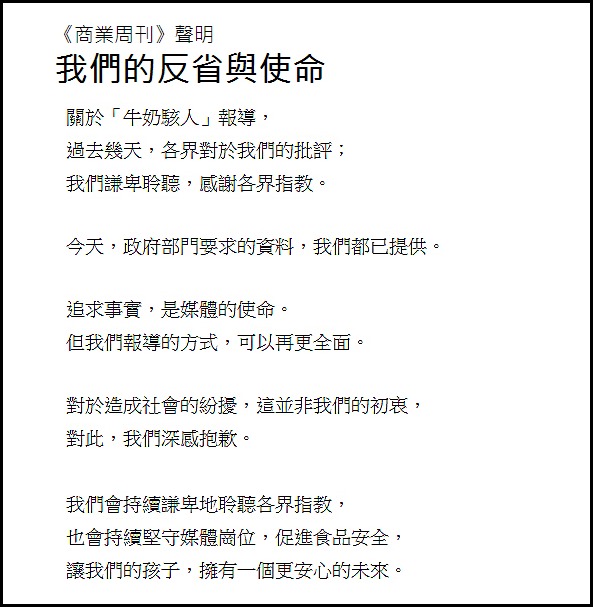
Business Weekly issues an 11-line statement, apologizing for causing social disturbance
In the evening, Business Weekly issued an 11-line statement titled "Our Reflection and Mission," several lines of which stated: "Pursuing the facts is the mission of the media. But the way we reported could have been more comprehensive. Causing social disturbance was not our original intention, and for this we are deeply sorry."
Lin Chiu-pao, brand director of Business Weekly, said that this statement was a response to opinions from all sectors, but that the testing method was okay and Teacher Chen was very confident. However, when reporters asked whether Business Weekly had overinterpreted the report, Lin Chiu-pao responded that all the materials had been handed over to the Ministry of Health and Welfare, and they would interpret them further.
In response to the Dairy Association's press conference yesterday, in which it threatened to file a lawsuit, Lin Chiu-pao said that Business Weekly had not yet received notice from the Dairy Association and would communicate with them again.
However, Business Weekly used more than 11 pages to report that milk contained banned drugs, yet used only 11 lines in a statement to apologize. Hung Chang-chin, chairman of the Dairy Association, said that he had not yet seen the Business Weekly statement, but hoped that Business Weekly could admit that its report was biased. "If Business Weekly shows goodwill, we do not need to hurt others. The more a matter is debated, the clearer it becomes. Society is already chaotic enough; let us not become a source of chaos." He said that the Dairy Association had sent a certified letter this afternoon and would wait for Business Weekly's reply before deciding on subsequent handling.