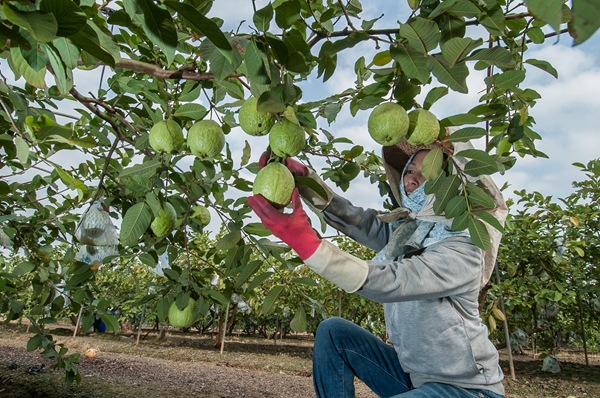
Taiwan, China guavas are affordable and delicious, a truly flavorful fruit.
Foreword: Taiwan's Good Fruit
Golden Diamond pineapple, Yuhebao lychee, Pearl guava... Taiwan's fruits have jewel-like names, come in a dazzling variety, and are both large and sweet. This abundance of colorful fruit makes this small island like a treasure bowl, earning it the reputation of a fruit kingdom and proudly launching it onto the international stage, creating brands that truly belong to Taiwan. Behind the cheers of the harvest lies the journey of fruit growers interacting with the land through superb skill and tenacious perseverance.
Classic selected sixteen of the most representative Taiwanese fruits and compiled interviews into a book, "Taiwan's Good Fruit," spending four years before and after following in the farmers' footsteps to survey orchards across the island and personally experience the key stages of the production process. Besides witnessing the sweetness and bitterness of fruit growers struggling against the natural environment, and personally visiting the legendary figures of variety breeding, it also explores the intractable problem of imbalanced production and sales, reflections on the damage to soil fertility caused by excessive pesticide use, and the future way out through friendly cultivation. Below we share with readers the chapter from the book, "Guava: Down-to-earth and Powerful, Awakening to the Original Flavor," for complete book information, please click here.
Down-to-earth and Powerful, Awakening to the Original Flavor
Text by Cai Jiashan (contributing writer for Classic Magazine) Photography by Huang Shize (photographer for Classic Magazine)
Guava
The endearingly simple guava, originally named "fan shi liu"
reveals its Southeast Asian bloodline and wild-mountain character
as well as its sturdy vitality, full of seeds and easy to grow
Taiwan's guava, gathering the essence of the tropics into one fruit
though it has transformed from a rustic wild fruit into a pearl on a jade plate
still offers the richest nutrients at a commoner's price
Just as the French literary giant Proust began from a small madeleine cake to recall the long, flowing years of time past, the food writer Cai Zhuer, who has lived in Hong Kong, China for many years, traces the starting point of her childhood memories to a single guava.
One day she bought a Hong Kong-grown "rouge" guava at the market, and its piercing fragrance and fresh, rich flavor closely resembled the "tu ba zi" she had eaten in Taiwan as a child. The long-sealed memory chest slowly opened, and scene after scene of "stealing guavas is the most delicious" sprang forth, vivid as if before her eyes.
"For those born in the fourth and fifth grades of school, guava was not only a snack and a toy, entertainment and sports equipment, covered with the tooth marks and growth rings of childhood, but also the last nostalgia of the pastoral era." With this one sentence, Cai Zhuer sums up the inseparability of the native guava and childhood.
I was born late, and grew up in an urban jungle, deeply regretting that I never had the chance to experience the carefree days of growing wild together with native guavas. Every time I hear tales full of interest, such as climbing slippery tree trunks, taking branches to make slingshots, being scolded for stealing guavas, and even "eat guavas, shoot pellets," I can only feel full of envy and longing.
In just a few decades, as people reached their prime years, their childhood had already become legend, with few to carry it on.
In the legend, the guava trees of that time were tall and shaded the sky, seen everywhere beside fences, at the foot of mountains, and along small paths. Small, firm, dark green fruits hung from the branches, and children climbed the trees every day to pinch them with their fingernails. If it sank in with a "pop," it meant the fruit was ripe. If there were marks of birds pecking on it, it was even better. As for the taste, the sour and astringent notes perhaps outweighed the sweet, yet it already let poor children eat with mouths full of fragrance.
At that time the native guava had not yet been tamed, with many seeds and little flesh, so one had to be extra careful when eating it. There is a lovely Taiwanese nursery rhyme that goes like this: "Firefly, come drink tea. Tea is hot, eat a banana. Banana is cold, eat a longan. Longan must be shelled, in exchange eat that guava. That guava is all seeds, made me lose a tooth eating it."
Ba zi, na ba, nai ba, ling ba, niao ba, li zi ba... all are Taiwanese folk names for guava, with the character "ba" sometimes written as "ba." As for writing it as "ba le" and its evolution into the common name, that was a more recent matter. Place names such as Bazizhuang, Lingbalin, and Nabali are commonly seen in Taiwan's townships, showing that in the past guavas grew all over the countryside and flourished into groves, truly the most common and ordinary fruit tree on the island.