Old Farmer Allowance Amendment Dispute Fails to Shake Subsidy-Style Agricultural Policy
Recently, the Executive Yuan plans to amend the law to raise the agricultural insurance seniority requirement for claiming the old farmer allowance from six months to fifteen years. DPP Chairman Su Tseng-chang criticized this amendment as "putting the cart before the horse," arguing that the government should be responsible for distinguishing real farmers from fake ones. Liu Chih-wei, a scholar who has long studied the history of agricultural development, believes that the old farmer allowance accounts for one-half of the Council of Agriculture's annual budget, completely squeezing out other funding for the agricultural sector. He argues that the old farmer allowance should be merged into the national pension system and that subsidy-style agricultural policy should be comprehensively reviewed.
Seventeen Years of the Provisional Act on the Old Farmer Allowance: Eligibility and Amounts Have Kept Expanding
The current "Provisional Act on Welfare Allowance for Elderly Farmers" stipulates that anyone who has participated in agricultural insurance for more than six months can claim a monthly old farmer allowance of 7,000 yuan.
The "Provisional Act on Welfare Allowance for Elderly Farmers" was originally planned to be merged into the national pension system, but since it was implemented in 1996, it has remained "provisional" for seventeen years to this day, and both the eligibility requirements and the amounts have continuously been relaxed. In 1998, the wealth-exclusion restriction was abolished, and the number of people receiving the old farmer allowance increased from 450,000 to the current 680,000. The payout amount has also kept increasing, from the initial 3,000 yuan, with an additional 1,000 yuan added in 2003, 2005, 2007, and 2012 respectively, forming the current monthly subsidy of 7,000 yuan.
The Executive Yuan recently revised "Article 3 of the Provisional Act on Welfare Allowance for Elderly Farmers" to raise the eligibility requirement for the old farmer allowance from the current six months to fifteen years. The Council of Agriculture stated that this amendment is intended to improve the unreasonable phenomenon in which non-farming households can receive the old farmer allowance over the long term. At present, the Council of Agriculture allocates an annual budget of 56 billion yuan for the old farmer allowance. If the amendment passes, 46 billion yuan can be saved over the next fifteen years, averaging 3 billion yuan saved per year.
When the DPP held a consultation meeting on major issues on December 9, DPP Chairman Su Tseng-chang said at the meeting that the competent authority should verify the authenticity of farmers' identities rather than putting the cart before the horse by raising the eligibility requirement. He believed that once this amendment is implemented, "real farmers" with farmer status would be excluded from eligibility, violating the legislative purpose of the old farmer allowance, which is to protect the lives of elderly farmers.
On December 10, Council of Agriculture Minister Chen Bao-ji countered that Su Tseng-chang's statement was political manipulation. He believed that raising the threshold for receiving the old farmer allowance was the true way to protect farmers actually engaged in farming.
Nearly 90% of the Council of Agriculture's Budget Is Spent on Subsidizing Farmers
In fact, the recent tussle between the KMT and DPP over the threshold for claiming the old farmer allowance is precisely founded on the election-driven thinking of the past decade or more, in which both parties competed to increase the payout.
"Only by incorporating the old farmer allowance into the national pension can the lives of the elderly be comprehensively protected. Discussing the eligibility threshold is a secondary issue; the core problem is the subsidy-style agricultural policy that has persisted for many years!" said Liu Chih-wei, who has long studied the history of agricultural development and currently serves as chief executive officer of the Taipei Grain Promotion Association, a foundation.
"Agricultural authorities pay more than 50 billion yuan each year in old farmer allowances, completely squeezing out the space for agricultural research, agricultural development, and agricultural extension funding. Taiwan's agricultural competitiveness will be weakened as a result." Taking the Council of Agriculture's 2011 budget as an example, Liu Chih-wei noted that the annual budget was 97.138 billion yuan, of which 84.35 billion yuan was spent on subsidizing farmers, the largest single item being 51.14 billion yuan for the old farmer allowance.
Nearly 90% of the budget being spent on subsidizing farmers reflects the passive thinking of the agricultural authorities toward agricultural production. Taking Taiwan's import and export data for agricultural products as an example, Liu Chih-wei noted that faced with the trend toward trade liberalization in Taiwan's agricultural products over the past twenty years, the value of Taiwan's agricultural exports has changed little, averaging about 4 billion US dollars, while the value of imported foreign agricultural products increased 2.5 times, reaching 14 billion US dollars in 2011.
Liu Chih-wei believes that subsidy-style agricultural policy does not think about how to improve the competitiveness of Taiwan's agricultural products, but instead keeps subsidizing farmers, just like "not thinking about how to strengthen combat effectiveness, but instead continuously reinforcing field hospital equipment."
Agriculture is an industry, and it is also a profession," Liu Chih-wei believes. Subsidy-style agricultural policy does not discuss production equipment or agricultural knowledge, and does not help improve Taiwan's agricultural competitiveness. "Only by building a complete and sound agricultural industry structure can talent be attracted to invest and farmers' lives be truly protected."
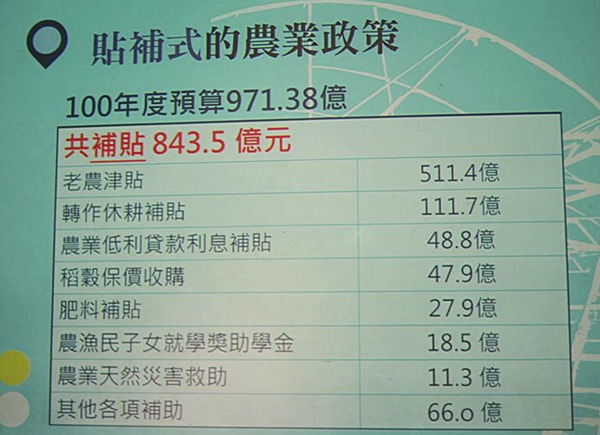
 Ninety percent of the Council of Agriculture's budget is spent on subsidizing farmers. Photo / Yang Chen-yu (rephotographed from Liu Chih-wei's briefing materials)
For more professional agricultural technology information, please scan the QR code to follow WeChat: NongXunNET

Please indicate the source when reprinting.